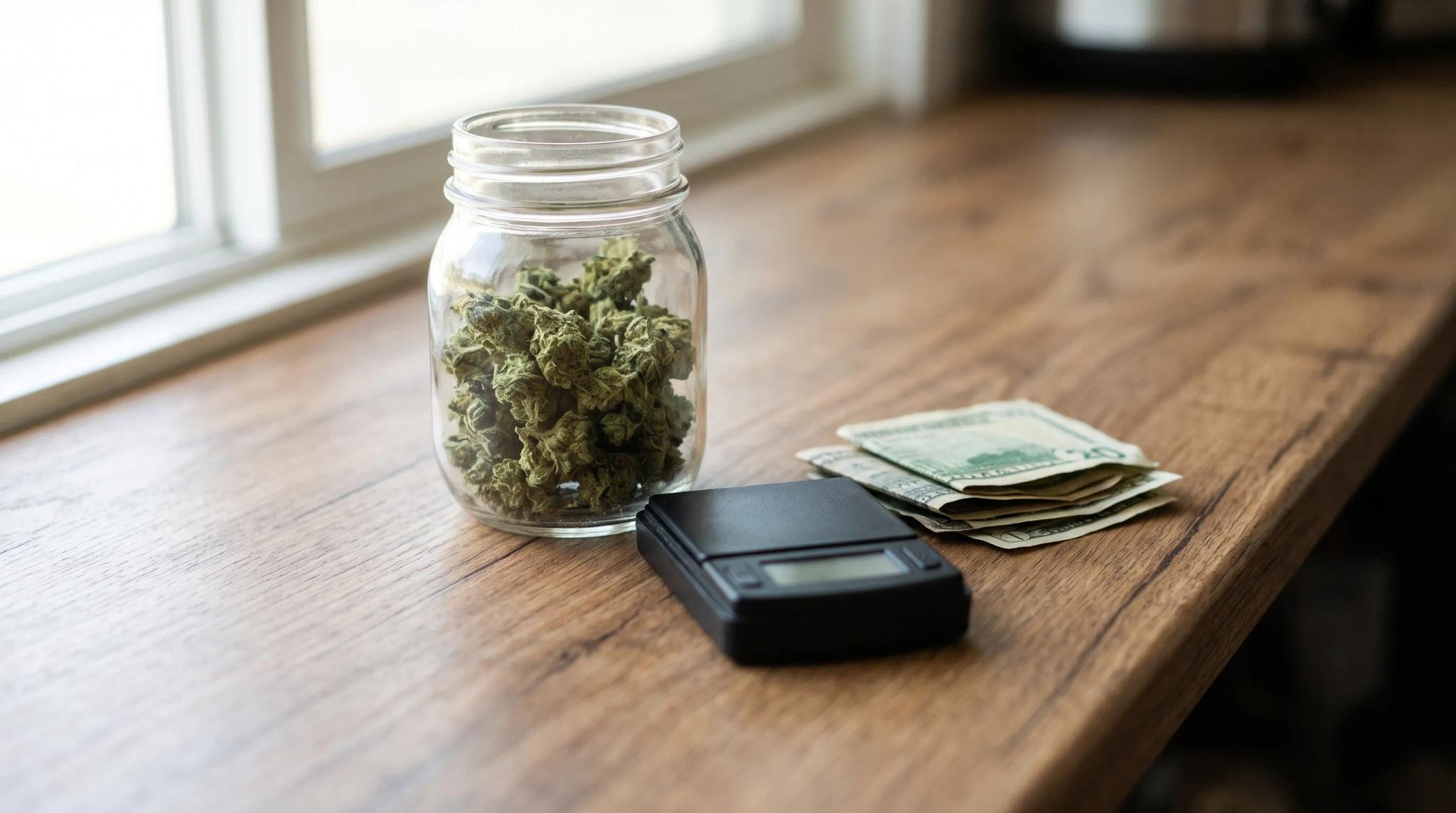
In 2026, the average eighth of flower sold in California cost about $21, and the average price of buds in Illinois was a little over $5. Those figures come from each state's own sales data, which draws on what licensed dispensaries record at the register, discounts included.
Averages hide a lot. Prices vary by store, by brand and by how much you buy at once, and taxes add a real share at the register. This guide covers what the state data shows, what taxes add, and what the numbers can't tell you.
How much does weed cost in California?
California's Department of Cannabis Control publishes an average price for packaged flower by package size, drawn from the state's track-and-trace system. For January 1 to October 31, 2026, its sales data dashboard shows these average prices:
- A gram: $8.63
- An eighth (3.5 grams): $21.35
- A quarter ounce: $29.47
- A half ounce: $45.05
- An ounce: $62.45

These are averages across the licensed sales recorded in the state's system, from budget flower to top shelf, so any one store can sit well above or below them.
The gram figure is the least steady. Far fewer single grams sell than eighths, and the average gram price fell from $10.60 in March to $5.98 in October 2026. Over the same months, the average eighth stayed between about $20 and $22.
How much does weed cost in Illinois?
Illinois publishes a monthly average retail price for adult-use products on the website of the state's Cannabis Regulation Oversight Officer. In September 2026, the most recent month available, the averages were:
- Buds: $5.33
- Concentrate: $34.59
- Infused edibles: $11.64
- Infused non-edibles: $27.68
The state labels these figures "price per gram or item" without saying which applies to which category. For buds, reading it as a price per gram puts an average eighth at about $18.66. Medical prices were close: $5.18 for buds in the same month.
Illinois prices fell sharply in mid-2025, but not all of that drop was a real price cut. The state moved its dispensaries to a new tracking system, Metrc, in mid-2025, and says a review found that prior months "collected some pre-discount prices." Compare months after mid-2025 with each other, not with earlier ones.
Is weed cheaper in bigger amounts?

The California figures show the volume discount plainly. Divide each package price by its weight, and the average works out to about $8.63 per gram for a single gram, $6.10 per gram in an eighth, $4.21 in a quarter ounce, $3.22 in a half ounce and $2.23 in an ounce.
Our guide to how dispensary flower is priced explains why, and why two jars of the same weight can differ by double. A bigger package is only a saving if you will use it before it goes stale.
How much tax is on weed?
California charges a 15% cannabis excise tax on the retail price, according to the California Department of Tax and Fee Administration. Sales tax is then charged on the price plus the excise tax. The statewide sales tax rate is 7.25%, and district taxes in most areas add between 0.10% and 2.00%. On an average $21.35 eighth at the base rate, the bill looks like this:
- Price: $21.35
- Excise tax at 15%: $3.20
- Sales tax at 7.25% of $24.55: $1.78
- Total: $26.33
Our guide to how much you can buy in California works through the same math on a larger purchase, and our guide to medical cards in California covers the sales tax exemption for cardholders.
Illinois taxes adult-use cannabis by potency and product type. The state purchaser excise tax is 10% on non-infused cannabis at or below 35% adjusted THC, 25% on cannabis above 35%, and 20% on cannabis-infused products such as edibles. Concentrates and vapes are taxed by their THC level rather than as infused products. Sales taxes come on top, and the Illinois Department of Revenue's rate table puts the combined rate for cannabis sold in Chicago at 16.5% from August 1, 2026. Our guide to buying in Chicago adds these up.
Medical cannabis in Illinois is taxed at the same 1% state rate as other qualifying drugs and is generally exempt from local retailers' occupation taxes. Our guide to medical cards in Illinois covers who qualifies.
What these numbers can't tell you
They are averages. A state average mixes every brand, strain and store, so it says little about what a specific jar is worth.
California's figures are entered by retailers, and the state does not vouch for their accuracy. In a 2026 rulemaking, the Department of Cannabis Control wrote that sales data in the system "has so far been unreliable," and that the state's tax agency finds gross receipts that sometimes vary "by as much as 30%" from recorded sales. A report prepared for the department describes the receipts as "pre-tax and after discount."
Both states' figures include discounts. A buy-one-get-one deal pulls the average down, so the typical shelf price can sit above the average sale price.
The two states also measure differently. California reports flower by package size, while Illinois reports one average across all bud sales, so the numbers are not a like-for-like comparison between states.
Checking prices before you buy
The most useful number is the one on the menu of the store you are going to. Convert to price per gram before comparing packages of different sizes, as our pre-roll guide explains, and check whether the listed price includes tax.
Each store's live menu shows its current prices: Fresno, Orcutt, La Mesa and Chicago.
Sources and further reading
- California Department of Cannabis Control, sales data dashboard and glossary, data through October 31, 2026
- California Department of Cannabis Control, DCC-2026-02-R: Initial Statement of Reasons
- ERA Economics for the Department of Cannabis Control, California Cannabis Market Outlook, 2024 Report
- California Department of Tax and Fee Administration, cannabis tax guidance for retailers
- California Department of Tax and Fee Administration, sales and use tax rates
- Illinois Cannabis Regulation Oversight Officer, cannabis sales figures, data through September 2026
- 410 ILCS 705/65-10, cannabis purchaser excise tax rates, Cannabis Regulation and Tax Act
- Illinois Department of Revenue, cannabis tax frequently asked questions
- Illinois Department of Revenue, cannabis taxes
- Illinois Department of Revenue, sales tax rate files, cannabis rates effective August 1, 2026
This article is general information for adults 21 and older and is not legal or tax advice. Prices change; figures are current as of November 2026.


