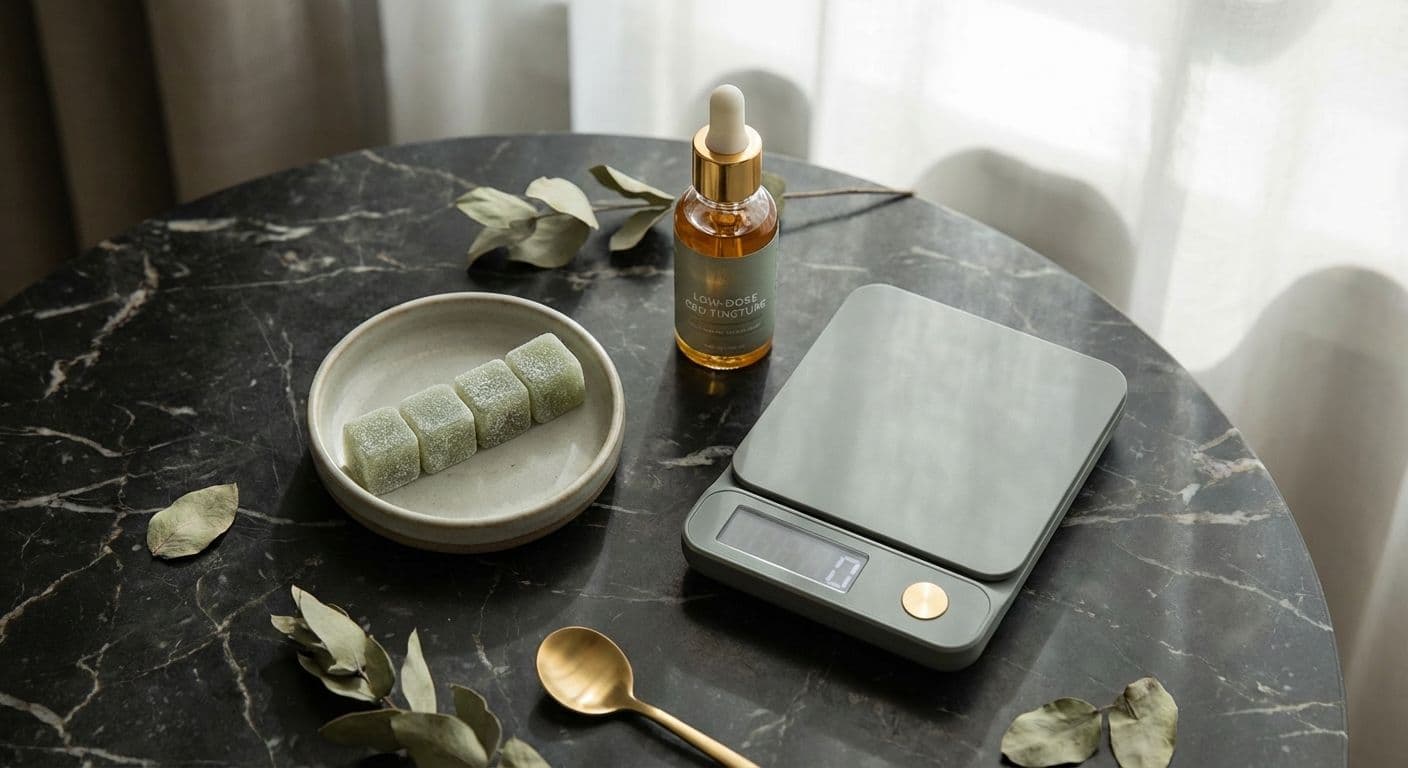
Microdosing THC means taking a small amount rather than a full serving. That is the whole of the definition, and it is looser than most guides make it sound. There is no legal or medical standard for what counts as a microdose. What does exist, in California, is a set of labeling rules that tell you exactly how much THC is in what you are holding.
This guide covers those rules: what a serving is, how the label states the dose, and why the timing warning required on edibles applies to small amounts too. It does not recommend a dose or promise an effect, for reasons explained at the end.
What does microdosing THC mean?
In practice, it means using an amount of THC well below a typical serving. People describe the goal differently, and the amounts they call a microdose vary from person to person and from source to source.
The word has no fixed number attached to it. California law does not define a microdose, and neither do its cannabis regulations. When you see a product marketed as a microdose, that is a description the manufacturer has chosen, not a category the state recognizes.
What the state does define is the maximum.
The most THC a California edible serving can contain
Under California's cannabis regulations, an edible product may not contain more than 10 milligrams of THC per serving, or more than 100 milligrams of THC per package. State law sets the same 10 milligram ceiling per serving, and requires edibles in solid form that contain more than one serving to be delineated or scored into standardized serving sizes.

That gives you a useful reference point. A 100 milligram package of gummies contains at least ten servings. A product labeled at 2.5 milligrams of THC per piece holds a quarter of the most a single serving is allowed to contain. Whether you call that a microdose is up to you; the label tells you the number either way.
Some products are marketed specifically as low-dose, with pieces well under the 10 milligram limit. The package still has to state the THC content, so you can compare a low-dose product against a standard one on the same terms.
How to read the dose on the label
For edibles, the label must state THC and CBD content in milligrams, both per serving and per package. Those two numbers answer different questions: per serving is what one piece or one measured portion contains, and per package is the total you are buying.
Three details are worth knowing:
- Small amounts can be shown as "less than 2 mg." On labels applied before lab testing, the regulations allow amounts under 2 milligrams to be stated as "<2 mg per serving" or "<2 mg per package," so a very low-dose product may not show an exact figure.
- After testing, the numbers come from the lab. Labels applied once a product has its certificate of analysis must reflect that certificate, and the amount may be rounded to the nearest whole number.
- Other cannabinoids may be listed too. On those post-testing labels, a cannabinoid that makes up 5% or more of the total cannabinoid content is also listed.
We cover the rest of the label, including the certificate of analysis, in how to read cannabis product labels.
The warning on every edible, and why it matters at low doses
Every manufactured cannabis product sold in California must carry a government warning, either on the label itself or on supplemental labeling such as a package insert or hanging tag. Part of it reads: "THE INTOXICATING EFFECTS OF CANNABIS PRODUCTS MAY BE DELAYED UP TO TWO HOURS."

That delay is the most practical fact in the warning, and it applies just as much to small amounts. With a small serving, it is easy to conclude that nothing is happening before the product has had time to take effect, and that is when people are most tempted to take more. The state's own warning is the reason to wait.
The same warning adds that consuming cannabis products impairs your ability to drive and operate machinery. It does not make an exception for small amounts.
Why an edible and an inhaled product are not the same dose
Milligrams on an edible label and milligrams in a vape or a joint are not directly comparable, because the body takes them in differently.
A review of cannabinoid pharmacokinetics estimates that swallowed THC has low bioavailability, as low as 6 percent, and puts inhaled THC at roughly 10 to 35 percent, varying with how people inhale. A separate clinical review attributes the low oral figure to variable absorption, breakdown by stomach acid and first-pass metabolism in the liver, and notes that vaporized cannabis takes effect within about 10 minutes, far sooner than an edible.
So the same number of milligrams can mean a different amount reaching the bloodstream, on a different timeline, depending on the format. An edible's label tells you exactly what one serving contains. An inhaled product's label tells you the total in the package, but not what a single puff delivers, so the two cannot be compared one-to-one. Edibles also depend on THC that has already been activated by heat, which we explain in what is THCA and how does it convert to THC.
What this guide does not tell you
You will find plenty of microdosing guides that recommend a starting dose, a schedule, or a set of effects to expect. This one does not, for two reasons.
The first is evidence. As far as we have found, controlled research on very low doses of THC is limited, and much of what circulates about microdosing is personal experience rather than measurement.
The second is that we are a licensed cannabis retailer, and we do not make health or effect claims about the products we sell. What we can do is help you understand what is in the package, so that any decision about how much to take is made with accurate information. If you have a medical question about cannabis, that is a conversation for a doctor.
Our staff can walk you through a label in any of our stores.
Sources and further reading
- Cal. Code Regs. Tit. 4, Section 17304 — the 10 milligram per serving and 100 milligram per package THC limits for edibles
- Cal. Code Regs. Tit. 4, Section 17407 — how cannabinoid content must be stated on labels, including the "<2 mg" rule
- Cal. Code Regs. Tit. 4, Section 17406 — the required government warning, including the two-hour delay statement
- Labeling requirements: Manufactured cannabis products in final form checklist — California Department of Cannabis Control
- The pharmacokinetics and the pharmacodynamics of cannabinoids — British Journal of Clinical Pharmacology, 2018, on oral and inhaled THC bioavailability
- Clinical Evaluation of the Cannabis-Using Patient: A Moving Target — The Permanente Journal, on onset and bioavailability by route
This article is for general information for adults 21 and older and is not medical advice. Information is current as of September 30, 2026.

