Call it a crutch, a filter or a tip. Three names for the same object, and one of them is causing a misconception that has outlived every attempt to correct it.
It is not a filter. Not the paper one, not the glass one, not any of them.
That matters because people buy these things expecting something they do not deliver, and miss the reasons they are actually worth having.
Why "filter" is the wrong word
A cigarette filter is made of cellulose acetate. Particulates are physically trapped in the fiber mass as smoke passes through, while nicotine and other semi-volatile compounds are absorbed into the acetate itself. Either way the material is doing something to the smoke, which is why a used one is stained brown.
A paper crutch does none of that. It is a hollow paper structure, and smoke passes through it with almost no resistance at all. There is nothing in it to absorb anything.
This is the most persistent myth in the category, and it survives largely because the word "filter" is printed on the packaging.

If you want the difference in one sentence: a cigarette filter removes things from smoke, and a crutch gives smoke somewhere to go.
What it actually does
Four things, and they are all structural.
It keeps the end open. Paper softens as you smoke — from heat, from moisture, from your mouth. A softened mouth end can pinch closed under your fingers, and a pinched joint has no draw. The crutch is a rigid spacer that holds the channel open.
It stops plant matter reaching your mouth. The particles a rolled crutch blocks are the visible bits that come loose as the joint burns down. Not smoke constituents — actual pieces of flower. A poorly rolled spiral crutch leaves a hole big enough to let them past, which is why the accordion fold exists.
It keeps the mouth end from going soggy. Particularly when a joint is shared.
It lets you finish the joint. Without something to hold, the last section is either wasted or smoked until it burns your fingers and lips. A crutch buys you that material back — which, at dispensary prices, is not nothing. Our guide to how flower is priced covers what that last third actually costs you.
Notice what is missing from that list: anything about what you inhale. A crutch changes the mechanics of the joint. It does not change the smoke.
What glass changes, and what it doesn't
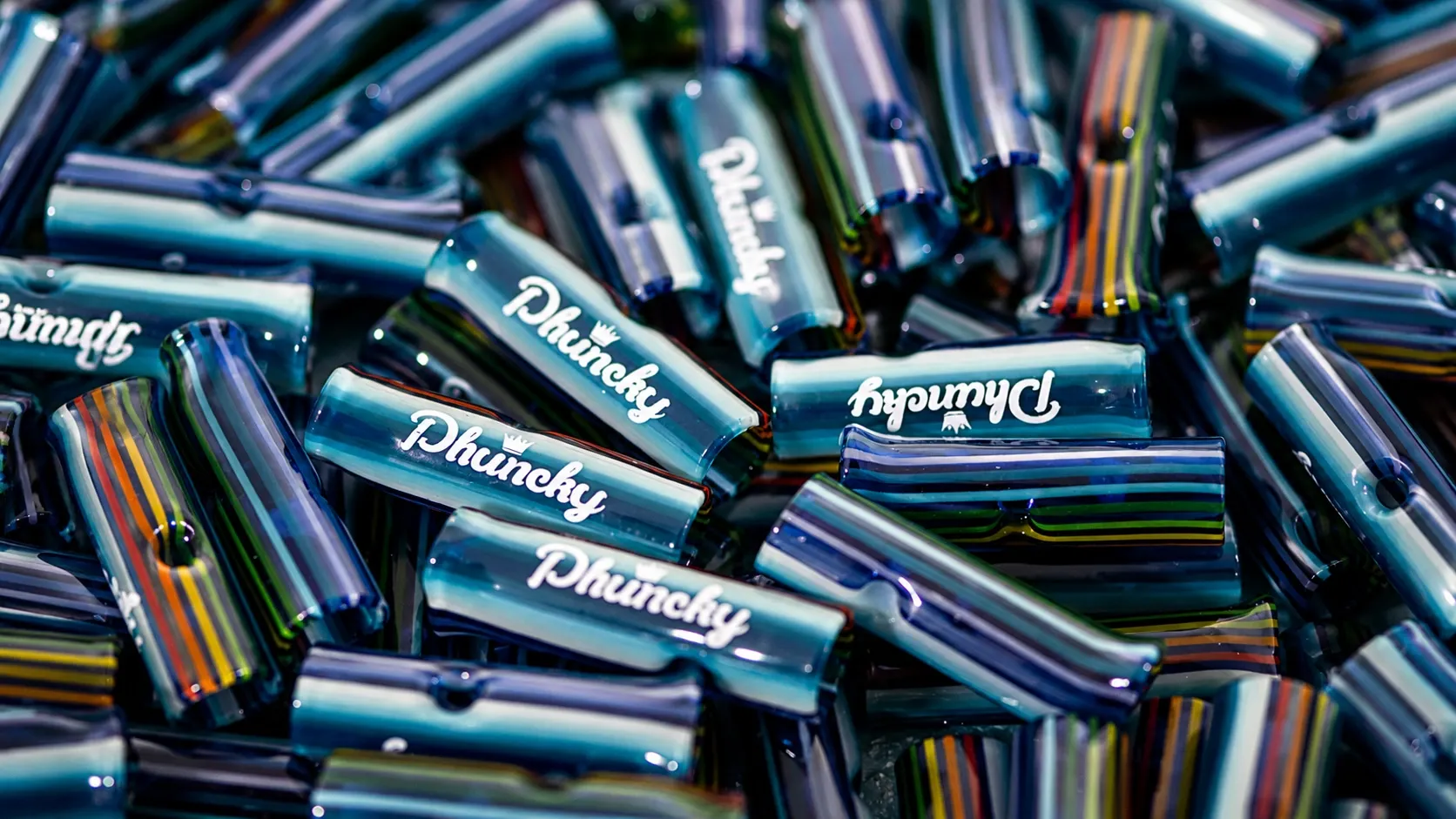
Glass tips — usually borosilicate, the same material as laboratory glassware — replace the paper crutch with a reusable one. Dr. Greenthumb's carries Phuncky Feel Tips, the B-Real and ROOR collaboration, alongside the rest of our accessories in Fresno, Canoga Park, Orcutt, La Mesa and Chicago.
Here is the honest version of what changes.
The defensible claims
Glass adds nothing to the taste. This is the strongest claim in the category and it is materials science rather than marketing. Borosilicate is inert and non-porous — it does not absorb terpenes and it contributes no flavor of its own. Paper can do both, particularly as it heats.
Worth stating precisely, though: the claim that holds is glass adds nothing. "Preserves full flavor" is a stronger phrasing that implies paper is actively taking something away in measurable amounts, and nobody has published that measurement.
It cannot go soggy or collapse. A rigid tube has a fixed bore. It is the same argument as the paper crutch's, just more reliably true — the failure mode paper has, glass does not have.
It is reusable. One glass tip replaces a great many paper ones. True by definition, and the reason the sustainability argument is the least arguable thing here.
The claims that do not survive
Several glass-tip sellers describe an internal spiral, honeycomb or pinch as a "mini filtration system" that filters particles. That is the paper-crutch myth transplanted to a new material.
The mechanism is real and worth understanding correctly. Most glass tips carry one or more internal pinches — narrowings in the bore that loose flower and ash cannot pass. Phuncky Feel Tips use exactly that design. It is a physical obstruction stopping visible debris, the same job the accordion fold does in a folded paper crutch. Nothing is removed from the smoke itself.
"Cooler hits" and "reduces harshness" are asserted everywhere and measured nowhere. They may well be true; a longer rigid channel plausibly gives smoke more distance to cool. But we could not find anyone who has measured it, and this is a category where every description comes from somebody selling the product.
That last point is worth saying plainly. We looked for independent research on glass tips and found none. Essentially every article describing them is published by a company that sells them, this one included. Treat the whole category's claims accordingly, ours as much as anyone's.
The tradeoffs sellers tend to skip
- It needs cleaning. Resin builds up inside, and a clogged tip draws worse than a fresh paper one. Isopropyl alcohol and coarse salt in a bag, shaken and rinsed, is the standard method.
- It breaks. It is glass, in a pocket.
- Sizing matters, and this is the mistake people actually make. Tips run roughly 6mm to 12mm, with wider bores giving a more open draw. Sources disagree about which size suits which format, so ignore the guidance and measure: the tip has to seat in the paper you actually use. An over-tight wrap around a mismatched tip chokes the airflow you bought it for. Note also that hand-blown premium tips vary in size by their nature, while machine-made clear ones hold a precise measurement.
Which should you use
Genuinely a preference question, and the honest answer depends on how often you roll.
Paper is fine. It has worked for decades, it costs almost nothing, there is nothing to clean, and a well-folded one does its structural job perfectly well. If you mostly buy pre-rolls, the factory crutch is already there and already sized correctly — our guide to choosing a pre-roll covers what else is worth checking on those.
Glass makes sense if you roll frequently, if flavor is the thing you optimize for, or if single-use waste bothers you. It is a better object. It is not a different mechanism.
What neither one is, whatever the packaging says, is a filter.
Sources and further reading
- Joint filters: the real guide to crutches and tips — on why a paper crutch does not work like a cigarette filter
- Leafly, how to roll a filter or crutch — the structural failure modes of a rolled spiral, and the accordion fold
- Everything you need to know before buying a glass tip filter — notable for coming from a company that does not sell glass tips
This article describes product function as of September 18, 2026, and is general consumer information. We sell glass tips, and so does nearly every other source writing about them — we have tried to separate what is demonstrable from what is claimed, and to say which is which.


