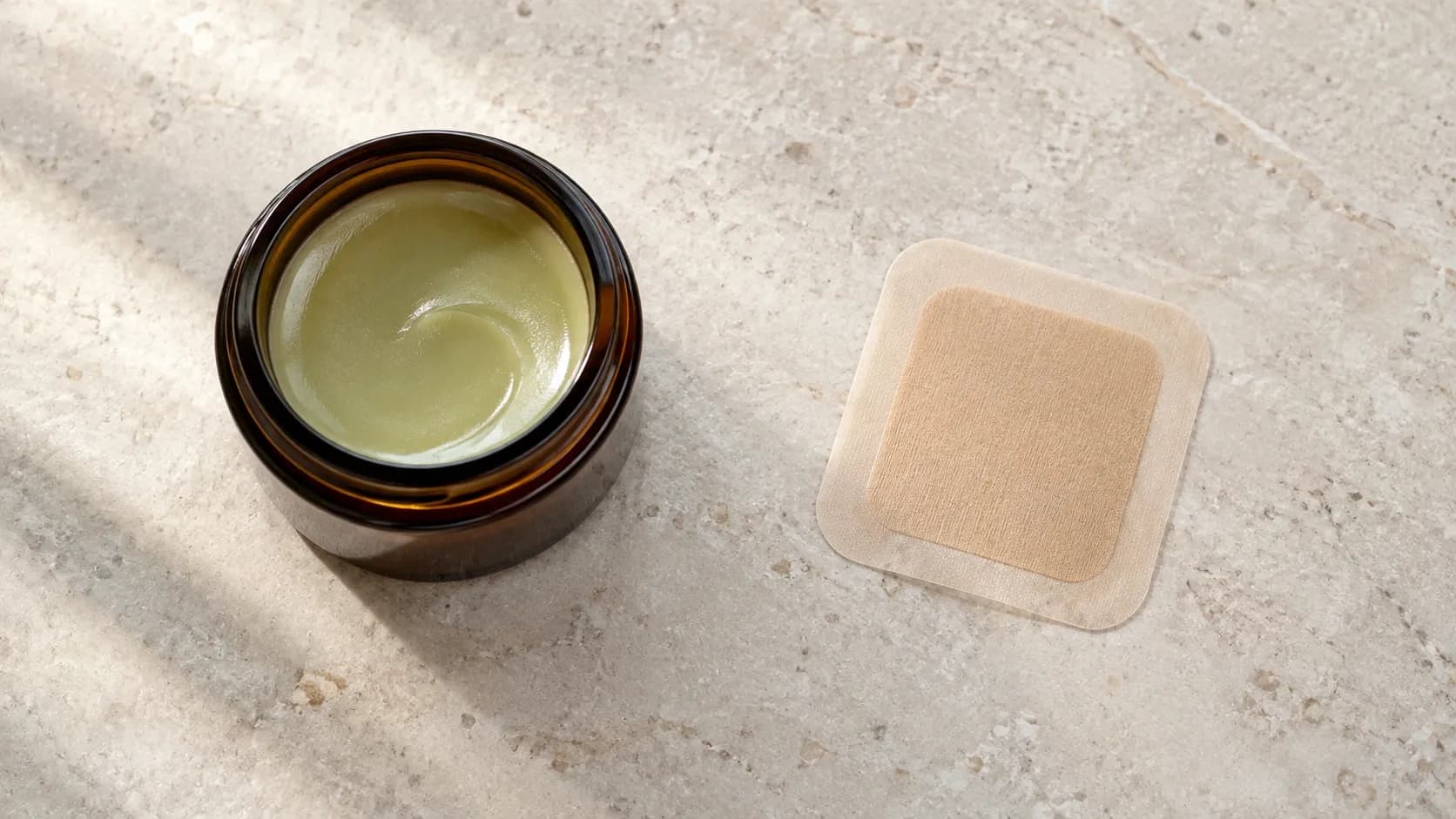
A cannabis balm and a cannabis patch are both applied to the skin, both carry a milligram figure on the label, and both sit on the same shelf. They are designed to do opposite things.
That difference decides whether a product can affect how you feel, and whether it can show up on a drug test. It is also the one thing most labels do not state directly, so it is worth understanding before you buy either.
Two products that look alike
A topical — a balm, cream, salve or lotion — is made to stay where you put it. It acts on the skin and the tissue just beneath it.
A transdermal is engineered to do the opposite. Patches and some gels use penetration enhancers and specific formulations to push cannabinoids through the skin's outer barrier and into the bloodstream, the way a nicotine patch does.
The cleanest way to hold the distinction: both are applied topically, but only one delivers transdermally. "Topical" describes where the product goes on; "transdermal" describes where the cannabinoid ends up. The biggest difference between the two is not the form of the product. It is the intended route.
Why a balm usually stays local

The outer layer of skin, the stratum corneum, is a genuinely effective barrier — and cannabinoids are particularly bad at getting past it. They are extremely hydrophobic, which limits how well they diffuse through skin, and peer-reviewed pharmacology describes effective transport across skin as achievable only with permeation enhancers. A standard balm does not use them. That is why a THC balm is generally not expected to produce the effects you would get from eating or smoking the same cannabinoid.
One detail worth knowing: CBD passes through skin roughly ten times more readily than THC does, according to in-vitro studies on human skin. The two are not interchangeable here.
That much is well established. The common phrasing of it is not.
Product pages routinely say topicals "don't enter the bloodstream." That is close to true and not quite true.
A human pharmacokinetic study of a commercial transdermal cannabinoid system applied 100mg of CBD and 100mg of THC to the skin. It found measurable levels in the blood — but in picograms per milliliter, and with no psychoactive effects reported. That was a product engineered specifically to get through skin, at a substantial application. The variation between participants was also enormous, with the spread larger than the average itself.
Three cautions about reading too much into it: it was a small, single-arm, exploratory study; it tested one transdermal system rather than an ordinary balm; and it was funded by the company that makes the system it tested, with no independent authors. What it does show is that even a product built for absorption delivers very little — and that absorption depends heavily on the individual, the formulation, the amount, and whether the skin is intact. Broken or irritated skin is a weaker barrier.
So the accurate version is minimal, not none. For most people using a standard balm as directed, minimal is small enough not to matter. It is still worth knowing the difference, because it is the difference that matters in the next section.
Drug testing
This is where the distinction stops being academic.
For urine and blood tests, a standard topical is unlikely to cause a positive. Because so little reaches circulation, there is little for those tests to find, and controlled studies of commercial THC products applied to the skin have not produced positive urine or blood results.
A transdermal can. It exists to put cannabinoids into your blood, so a test looking for them may find them.
Oral fluid is different, and it is the one that has been measured failing. A 2024 study from Johns Hopkins, with federal workplace-testing co-authors, gave 46 people either an ordinary retail hemp topical or a placebo over a 17-day protocol. None tested positive in urine. But nine of the 37 using an active product crossed the federal workplace threshold for THC in oral fluid — seven using a lotion, one a patch, one a gel. Oral fluid is the swab test used at the roadside and increasingly at work. The study reports the result without settling why; absorption is one possibility and contact between hands and mouth is another.
"Unlikely" is not "won't." Several product pages state flatly that topicals will not show up on a drug test. We would not rely on that if your job depends on it. Absorption varies between people, oral-fluid testing has already produced positives from ordinary retail topicals, and a product described as a topical may use penetration enhancers that behave more like a transdermal. If you are in a zero-tolerance position — federal employment, the military, commercial driving, many safety-sensitive roles — the only safe assumption is that any THC product carries some risk. For how sport specifically handles testing, our guide to where each league stands covers thresholds and windows.
CBD-only products are not a clean exception either. Full-spectrum CBD contains trace THC by definition, and third-party testing has repeatedly found CBD products mislabeled as to their actual cannabinoid content.
What the label can and cannot tell you
It will tell you the cannabinoid content — how many milligrams of THC and CBD are in the container. Our guide to reading a cannabis label covers the rest of what a compliant package carries.
It will usually tell you whether a product is transdermal, because that is a selling point for the products designed to be. If a label does not say transdermal, the product is almost certainly a standard topical. If you are unsure, ask — it is a fair question at any counter, and a well-run shop will know.
It will not tell you how much reaches your body. This is the part worth understanding about patches in particular. A milligram figure on a patch is normally what is loaded into it, not what is delivered through your skin during the time you wear it. Those are two different measurements, and a content test on the product is not a human absorption study. Two patches both labeled 20mg can deliver very different amounts.
What we are not going to tell you
People buy topicals for aches, stiffness and pain. We are not going to tell you whether they work for any of that.
Topical cannabinoids are an active area of research, including for skin conditions, and some of it is promising. It is not settled, and this is a licensed retailer's website — which is exactly the place that should not be making health claims about products it sells. If you have a condition you are trying to manage, that is a conversation for a clinician, who can also tell you whether a cannabinoid product might interact with anything else you take.
What we can tell you is what these products are, which is what this article is for.
At Dr. Greenthumb's we carry a topical relief balm, and staff can tell you exactly what is in it. Find us in Fresno, Canoga Park, Orcutt, La Mesa and Chicago.
Sources and further reading
- The Skin and Natural Cannabinoids — Topical and Transdermal Applications — a peer-reviewed review of topical cannabinoid research and the pharmacokinetics of transdermal delivery
- Lucas, Galettis and Schneider, The pharmacokinetics and the pharmacodynamics of cannabinoids, British Journal of Clinical Pharmacology, 2018 — on why cannabinoids cross skin poorly without permeation enhancers
- Examining the Systemic Bioavailability of CBD and THC from a Novel Transdermal Delivery System in Healthy Adults — a human pharmacokinetic study of a commercial transdermal system, funded by its maker
- Zamarripa et al., Pharmacokinetics and pharmacodynamics of five distinct commercially available hemp-derived topical cannabidiol products, Journal of Analytical Toxicology, 2024 — the oral-fluid findings from retail hemp topicals
- California Department of Cannabis Control, labeling requirements
This article describes product categories as of September 21, 2026, and is general consumer information, not medical or health advice. It makes no claim about whether any topical product helps with pain or any other condition. For questions about your own health, or about interactions with anything else you take, speak with a clinician.


