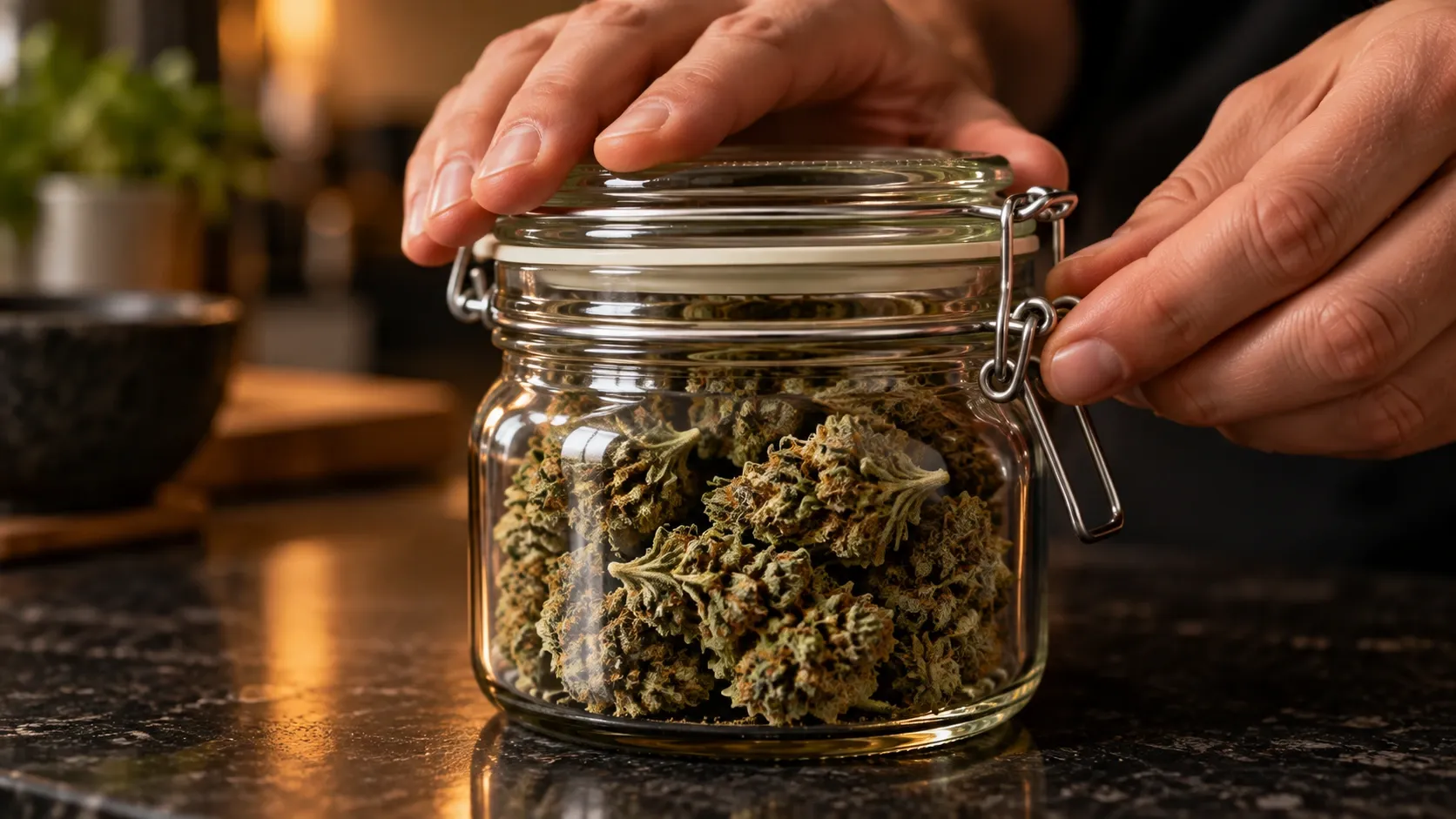
Cannabis does not spoil the way food does. Dried, properly cured flower will not rot on a shelf. But it does go downhill, and in a particular order: the smell fades first, often within months, and the cannabinoids decline more slowly after that.
The research on this is older and more consistent than most storage advice suggests. Light, air and heat each do something different, and the freezer, sometimes recommended as the best option, turns out to be a trade-off rather than a clear win.
Does weed actually go bad?
Not in the way food does. The storage research measures what cannabis loses over time, not whether it becomes unsafe, and the one well-understood hazard is mold, which is a moisture problem rather than an age problem. It is covered below.
What does happen is loss. A 1976 study at the University of London stored herbal cannabis and resin for up to two years and concluded that carefully prepared cannabis is reasonably stable for one to two years if kept in the dark at room temperature. The catch is in the conditions: in the dark, and carefully prepared.
How long does weed stay fresh? The smell goes first
The most striking finding in the storage research is how quickly the aroma disappears.
A 2020 study at the Technion in Israel stored cured flower in the dark at four temperatures for a year and measured both cannabinoids and terpenes, the compounds responsible for smell and much of the flavor. In the strain it measured terpenes on, terpene concentrations dropped by more than half on average within the first four months, and they fell under every storage condition tested. Over the full year, the cannabinoids the plant produces lost an average of about 26% in the same strain.
One caveat worth stating: those two figures come from a single CBD-rich strain. The study measured terpenes only on that strain, so treat the numbers as an illustration of the pattern rather than a rule for every jar.
If that pattern holds more widely, the order of loss is lopsided: a jar can lose much of its aroma well before it has noticeably weakened. If your flower smells flat and grassy compared with when you bought it, that is the terpenes going, and no storage method in that study stopped it entirely.
What happens to the THC
Cannabis flower contains mostly THCA, an acid form, rather than THC itself. Two slow reactions happen in storage.
The first is that some THCA converts to THC over time, the same reaction that heat drives much faster when you smoke or cook with it. The second is that THC oxidizes into a different compound, CBN. In the Technion study's THC-rich strain, THCA in flower stored at 25 degrees C (77 degrees F) had dropped by about a third after a year.
Researchers commonly use CBN as a marker of how old a sample is, because it builds up as THC breaks down. The same study noted that it is only useful that way for THC-rich flower, since CBD-rich strains produce very little of it.
Light is the fastest way to lose potency
The 1976 London study found that exposure to light was the single greatest cause of cannabinoid loss, and was especially damaging to cannabinoids in solution. That was ordinary light, not direct sunlight.
It also found something that is easy to get wrong. THC lost to light did not turn into CBN. THC lost to air oxidation in the dark did. Light and oxygen are two separate routes to losing potency, and they leave different traces behind.
The practical point is simple. A clear jar on a windowsill is the worst common way to keep cannabis. An opaque container, or a clear one kept in a drawer, removes the single biggest factor.
Air, and why ground flower goes stale faster
The Technion study compared whole buds with ground flower stored the same way, and the ground samples showed more oxidation and lower terpene levels. The researchers suggested the reason is surface area: grinding exposes far more of the plant to air.
The same London study described the resin glands on the flower as acting like well-filled, well-closed containers, and found that losses could be reduced by avoiding damage to them. Handling that breaks buds up does the opposite.

That is why whole buds keep better than anything pre-ground, and why we say the same thing about pre-rolls in how to choose a pre-roll: ground cannabis stales faster than whole flower. Grind what you are about to use.
Should you store weed in the fridge or the freezer?
This is where the evidence is more interesting than the usual advice.
The 1976 study found that temperatures up to 20 degrees C (68 degrees F) made little difference. The 2020 Technion study found that 25 degrees C was the worst of the four temperatures it tested for cannabinoids. Read together, the simplest interpretation is that cool room temperature is not the problem, but warm is.
The Technion study's overall conclusion was that whole buds stored at 4 degrees C, roughly refrigerator temperature, were the best condition it tested. The freezer was not. The researchers found temperatures below minus 20 degrees C were the least favorable for terpenes, and minus 80 degrees C generally produced the greatest terpene decline of any condition.
A study published in August 2026 by researchers at the University of Mississippi reached a partly different conclusion. Its abstract reports that room temperature accelerated the breakdown of THC into CBN in most of the products tested, while freezing at minus 20 degrees C preserved cannabinoid content best. It also found that CBD-only products stayed stable even at room temperature. We have not been able to read the full paper, so we cannot say how long the samples were stored or whether it measured terpenes.
The two findings fit together once you separate what each measured. Freezing protects cannabinoids. It appears to cost you terpenes. Which matters more depends on whether you care most about potency or about smell and flavor.
Moisture, mold and the fridge
The fridge carries one risk that has nothing to do with chemistry: condensation. Opening a cold container in a warm room lets humid air in, and moisture condenses on the cold contents. Moisture is what allows mold to grow on dried plant material.
The flower in the Technion study was cured to a steady moisture level before storage, and it stayed there. Flower that goes into cold storage damp, or that picks up condensation from being opened repeatedly, is a different situation. If you use the fridge, keep the container sealed and let it come to room temperature before opening it.
Mold is the one form of cannabis going bad that is a safety issue rather than a quality one. Visible fuzz, spots, or a musty smell mean it should be thrown out.
How to store cannabis flower
Putting the research together:
- Keep it in the dark. Light was the single biggest cause of loss. An opaque container, or a drawer or cabinet.
- Keep it sealed. An airtight container limits the air that drives oxidation, and every opening lets fresh air back in.
- Keep the buds whole. Grind only what you are about to use.
- Keep it cool, not warm. Ordinary room temperature is fine. A hot car, a sunny shelf or a spot near an appliance is not.
- Treat the fridge as an option, not a requirement. It was the best condition in the Technion study, but only for flower that was already properly dried, in a sealed container.
- Treat the freezer with caution. It protects cannabinoids and appears to cost terpenes.
The label itself also carries some of this information. We cover what a packaging date and best-by date do and do not mean in how to read cannabis product labels. Edibles follow different rules, covered in how to store THC gummies.
How to tell if yours is past its best
The research gives a clear order of loss, which makes the signs easy to read:
- The smell has faded or gone grassy. That is the terpenes, which go first.
- It crumbles to powder when touched. Flower in that state is being physically broken up, and the 1976 study linked damage to the resin glands with greater losses.
- It has visible mold or smells musty. That one is a reason to throw it out, not just a sign of age.
Faded aroma is a sign of lost quality. Flower that has been kept dry and shows no mold has, at minimum, lost some of what you paid for.
Sources and further reading
- The stability of cannabis and its preparations on storage — Fairbairn, Liebmann and Rowan, Journal of Pharmacy and Pharmacology 28(1):1-7, 1976, on light, air oxidation, temperature and the one-to-two-year stability window
- Metabolic Profiling of Cannabis Secondary Metabolites for Evaluation of Optimal Postharvest Storage Conditions — Milay, Berman, Shapira, Guberman and Meiri, Frontiers in Plant Science 11:583605, 2020, on terpene losses, whole versus ground flower, and storage at 25, 4, minus 30 and minus 80 degrees C
- University of Mississippi cannabinoid storage stability study (DOI) — Majumdar, Radwan, Chandra and colleagues, Cannabis and Cannabinoid Research, published online August 2026, on room temperature, refrigeration and freezing
This article is for general information for adults 21 and older and is not medical advice. Information is current as of September 28, 2026.


