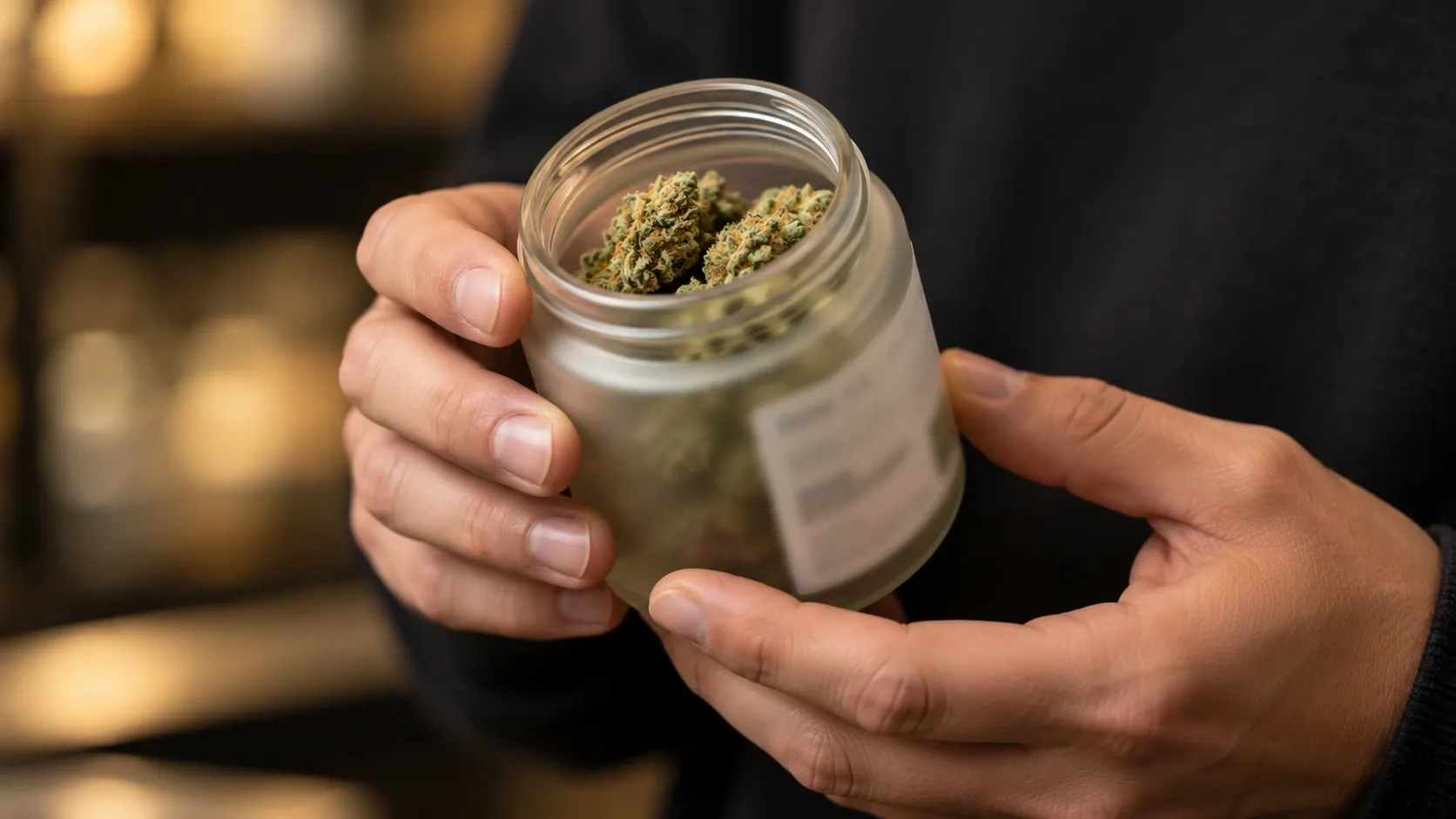
Every legal cannabis package is a compliance document before it is a piece of marketing. Most of what is printed on it is there because a state regulator requires it, and the parts that were chosen freely by the brand are the parts most likely to be selling you something.
That distinction is the whole skill. Once you can tell required information from voluntary information, and verified numbers from unverified claims, a shelf full of near-identical jars stops being a guessing game.
This is a guide to what the label tells you and how much of it to believe. It is about reading what is printed on a product, not about deciding how much of anything to consume.
What the law makes them print
The required elements are not a matter of brand preference, and they differ between states — which is why the same product looks different in Fresno than it does in Chicago.
California
California splits the label into two zones. The primary panel is the portion most likely to be displayed to you at retail; the informational panel is any other part of the label. The universal cannabis symbol must appear on the primary panel of every cannabis product sold in the state, at no smaller than half an inch square, and it may not be altered other than in size.
The state also restricts what a label may claim. A label may not use the name of a California county unless all of the cannabis was grown there, may not use designs attractive to children, and may not make unproven health claims. That last rule is worth holding onto — it becomes relevant later, when we get to terpenes.
California additionally fixes the wording of the government warning in statute rather than leaving it to the brand. The required statement opens with GOVERNMENT WARNING, names a federal drug schedule, and runs through keep-out-of-reach, age, pregnancy and driving language, all in bold print. The federal scheduling picture behind that sentence changed in 2026 and is covered separately in our guide to cannabis and federal law.
Illinois
Illinois takes a different approach, and this is the single most common error in online label guides. Illinois fixes the exact warning wording. Under 8 Ill. Adm. Code 1300.940, every cannabis product carries warning statements sized to be legible and readily visible to someone inspecting the package, and they may not be covered or obscured. The first opens by stating the product contains cannabis and is intended for adults 21 and over.
What Illinois does not have is a state universal symbol. Illinois goes further than most states on wording. Where California fixes one government warning, Illinois layers several: the general statement above, plus a smoking hazard line on anything smokable, a delayed-onset and allergen caution on infused products other than topicals, and DO NOT EAT in bold capitals on topicals.
That is why an Illinois package often reads as denser than a California one carrying the same product. More of the panel is spoken for.
This is general information about labeling rules, not legal advice, and the rules in both states are amended regularly.
The THC percentage is the most misleading number on the package
Total THC, THCA, and the 0.877
Raw flower contains very little THC. What it contains is THCA, an acid form that converts to THC when heat is applied. Labs account for that with a conversion, because THCA loses mass in the process — the 0.877 figure you see in testing rules is the ratio of the molecular weights.
Total THC is the same standard already used in federal and Illinois hemp cultivation rules, and it counts THCA rather than delta-9 alone. When a jar says 25% THC, that is almost always the total-THC calculation, not raw THC content. Our explainer on what THCA is and how it converts covers the chemistry.
What the percentage does not tell you
Potency is the number shoppers anchor on, and it is a poor predictor of whether you will enjoy the product. It tells you how much of one compound is present. It tells you nothing about the rest of the chemical profile, nothing about how the flower was grown or cured, and nothing about how it will smell or taste.
Growers know that shoppers sort by that number, which creates pressure to select for it at the expense of everything else. A well-grown jar at 20% with a full aromatic profile is a different product from a stripped 30% jar, and the label ranks them identically.
Treat the percentage as a rough band — low, middle, high — rather than a score. The difference between 24% and 26% is inside the noise of the test.
CBD and the minor cannabinoids
CBD is reported alongside THC on every compliant label. Products carrying meaningful CBD alongside THC behave differently from THC-only products at the same total cannabinoid content, which is why balanced ratios are a common starting point for people new to a product category.
Below those two, labels sometimes report CBG, CBN, CBC or THCV, usually at well under one percent each. Premium brands report them; budget brands often do not bother. Their presence on a label is a reasonable signal that the brand paid for a fuller panel. What they do at those concentrations is much less settled than marketing copy implies — our piece on minor cannabinoids goes through what is known.
Terpenes: real chemistry, oversold claims
What they are
Terpenes are the aromatic compounds that make a lemon smell like a lemon and a pine forest smell like pine. Cannabis produces well over a hundred of them, and they are the reason two jars both labeled OG Kush from different growers can smell nothing alike.
The aroma part is straightforward and verifiable. If a label reports high limonene, the product will smell citrusy. That is chemistry, and you can check it with your nose.
Where the shelf talk outruns the evidence

The chart you have seen — myrcene means couch-lock, limonene means uplifted, linalool means calm — is presented across the industry as established fact. It is not.
A 2020 study set out to test whether cannabis terpenes have detectable activity at the cannabinoid receptors, or change what THC and CBD do there. It found no clear interaction. A comprehensive review four years later reached a similar place: it called the evidence for individual terpene benefits exploratory, described the idea that terpenes enhance cannabinoid effects as unproven, and said clinical trials are still needed to confirm any entourage effect at all.
Read that carefully, because it cuts both ways. The claims are not debunked. They are unproven, which is a different thing. Plenty of experienced consumers report exactly the patterns the chart describes, and the honest position is that the human research has not caught up with the shelf talk.
There is also a regulatory dimension for California shoppers. Since the state prohibits unproven health claims on cannabis labels, a brand asserting flatly that a compound produces a mood is on shaky ground — and a retailer repeating it is on the same ground.
Our recommendation: use the terpene panel to predict aroma and flavour, which it does reliably, and to identify products you have personally liked before. Use it as a chemical fingerprint rather than a horoscope. If a jar you enjoyed was high in caryophyllene, look for another high in caryophyllene — that is a sound method regardless of what the underlying mechanism turns out to be.
Total terpene content
Total terpene content in flower is generally reported as a low single-digit percentage of dry weight. The number is more useful than the individual breakdown for one purpose: it separates products with an intact aromatic profile from products that have very little left.
Terpenes are volatile. Heat, light and time destroy them, which is why the harvest date matters and why a lab result from eight months ago describes a product that no longer exists in that form. The lab tested it fresh.
Whether terpenes appear at all
This varies more than people expect. In California, terpene testing is not optional. The Department of Cannabis Control requires labs to test for cannabinoids and terpenes together, alongside residual solvents and processing chemicals, pesticides, heavy metals, microbial impurities, mycotoxins, moisture content and water activity, and foreign material.
Whether that data reaches the printed label is a separate question from whether it was measured. Which brings us to the document that actually holds it.
The COA is the document that matters
What it is
A Certificate of Analysis is the lab report behind the package. Everything printed on the label about potency and safety originates there, compressed into a few numbers. Labs report on a COA whether the batch passed or failed for each substance, may only issue results once every test is finished, and cannot revise them afterward without the department signing off.

Most legal packages carry a QR code linking to the COA for that specific batch. If you have never scanned one, that is the single highest-return habit in this article.
For the full mechanics of how testing works, we have a separate guide to lab testing and COAs.
What is on the panel
In California the required panel is broad, and the contaminant tests are the ones worth your attention. The department states the purpose plainly: testing exists to confirm potency is labeled accurately and that the product does not carry harmful heavy metals, microbial impurities, mycotoxins, pesticides, residual solvents or processing chemicals.
Two of those deserve a word. Cannabis takes up metals and other contaminants from soil and water, which is why heavy metal testing exists at all rather than being a formality. And mycotoxins are produced by molds that may leave no visible trace, so a clean-looking jar is not evidence of a clean panel.
The consequences of failure are real rather than paperwork. Some microbial failures can be remediated. Mycotoxin, heavy metal and pesticide failures generally cannot, and those lots are destroyed.
Reading one in about thirty seconds
You do not need to understand the chromatography. Three checks cover most of the value.
- Confirm the batch number on the COA matches the batch number on the package in your hand. A COA for a different run tells you nothing about this product, and this is the check people skip.
- Scan the safety section for pass or fail on each category. Anything marked fail should not be on a shelf, and if it is, walk away.
- Compare the potency figures to the printed label. Small variance is normal because testing is not perfectly precise. A large gap is a reason to ask questions.
Red flags
No QR code and no COA available on request is the clearest one. So is a potency figure that sits well above what the category normally produces — very high flower numbers are uncommon enough to be worth verifying rather than celebrating. A COA whose date or batch does not line up with the package is another.
None of this is a safety guarantee, and nothing here is health advice. If you have a medical condition or take other medications, that conversation belongs with a clinician rather than a product label.
Dates, and what staleness actually costs you
Cannabis does not spoil the way food does. It degrades, which is a slower and less dramatic problem.
The harvest date tells you when flower was cut. The package date tells you when it was sealed for retail, and the gap between them is the cure — a process measured in weeks. A product harvested in January and packaged in March had a proper cure. Harvested and packaged in the same week, it was rushed.
The best-by date is about quality rather than safety. Over time, THC slowly converts to CBN, and terpenes evaporate. The practical effect is that older flower drifts toward a duller, heavier character and away from whatever the label described.
If two products are otherwise comparable, take the newer one. If the packaging date is not visible on the shelf, ask — a dispensary that rotates stock will tell you.
Storage, briefly
Keep products in their original packaging, somewhere cool and dark, and sealed. Air and light are the two things that reliably cost you potency: THC oxidises into CBN over time, and that reaction runs faster warm and faster in the light. A half-empty jar is worse than a full one for the same reason, since every opening swaps in fresh oxygen.
The fridge is more defensible than its reputation suggests. A storage stability study published in August 2026 by researchers at the University of Mississippi found that room-temperature storage accelerated THC's conversion to CBN across most products tested, while freezing held cannabinoid content considerably steadier. Refrigeration suits well-cured, properly dried flower; it is a bad idea for anything still damp, where the moisture risk outweighs the benefit. Glass beats plastic bags, which are fine for transport and poor for storage.
A sequence that works at the counter
- Start from the experience you want rather than a strain name. Strain names are inconsistent between growers, and the indica, sativa and hybrid labels are a looser guide than most shelves suggest. The chemical profile is not.
- Check the aroma profile if one is reported, and use it to match products you have liked before.
- Look at the full cannabinoid picture rather than the THC number alone.
- Check the dates. Newer is better, and the harvest-to-package gap tells you whether it was cured properly.
- Scan the QR code. Match the batch, confirm the safety results, compare potency to the label.
- Ask your budtender. They handle this inventory daily and they know which batches customers are coming back for — information that appears on no label.
At Dr. Greenthumb's, every product carries an accessible COA, and our staff will pull up a batch report at the counter if you ask. That is the standard the brand was built on, and it is also just what a well-run dispensary should do.
Sources and further reading
- California Department of Cannabis Control, requirements for cannabis goods — packaging, labeling panels and the universal symbol
- California Department of Cannabis Control, packaging requirements — child-resistance, tamper-evidence and opacity
- California Department of Cannabis Control, testing laboratories — the required testing panel and how COAs are issued
- Illinois Administrative Code, 8 Ill. Adm. Code 1300.940, implementing 410 ILCS 705/55-21 — required warning statements
- California Business and Professions Code section 26120 — statutory government warning text
- Finlay et al., Terpenoids From Cannabis Do Not Mediate an Entourage Effect by Acting at Cannabinoid Receptors, Frontiers in Pharmacology, 2020
- The Entourage Effect in Cannabis Medicinal Products: A Comprehensive Review, 2024
- Storage stability research summarised at Greenline, covering the August 2026 University of Mississippi study in Cannabis and Cannabinoid Research
This article describes California and Illinois labeling and testing rules as of September 10, 2026. Both states amend these rules regularly, and this is general consumer information rather than legal or health advice. For questions about a specific product, ask the dispensary that sold it; for questions about your own health, ask a clinician.


