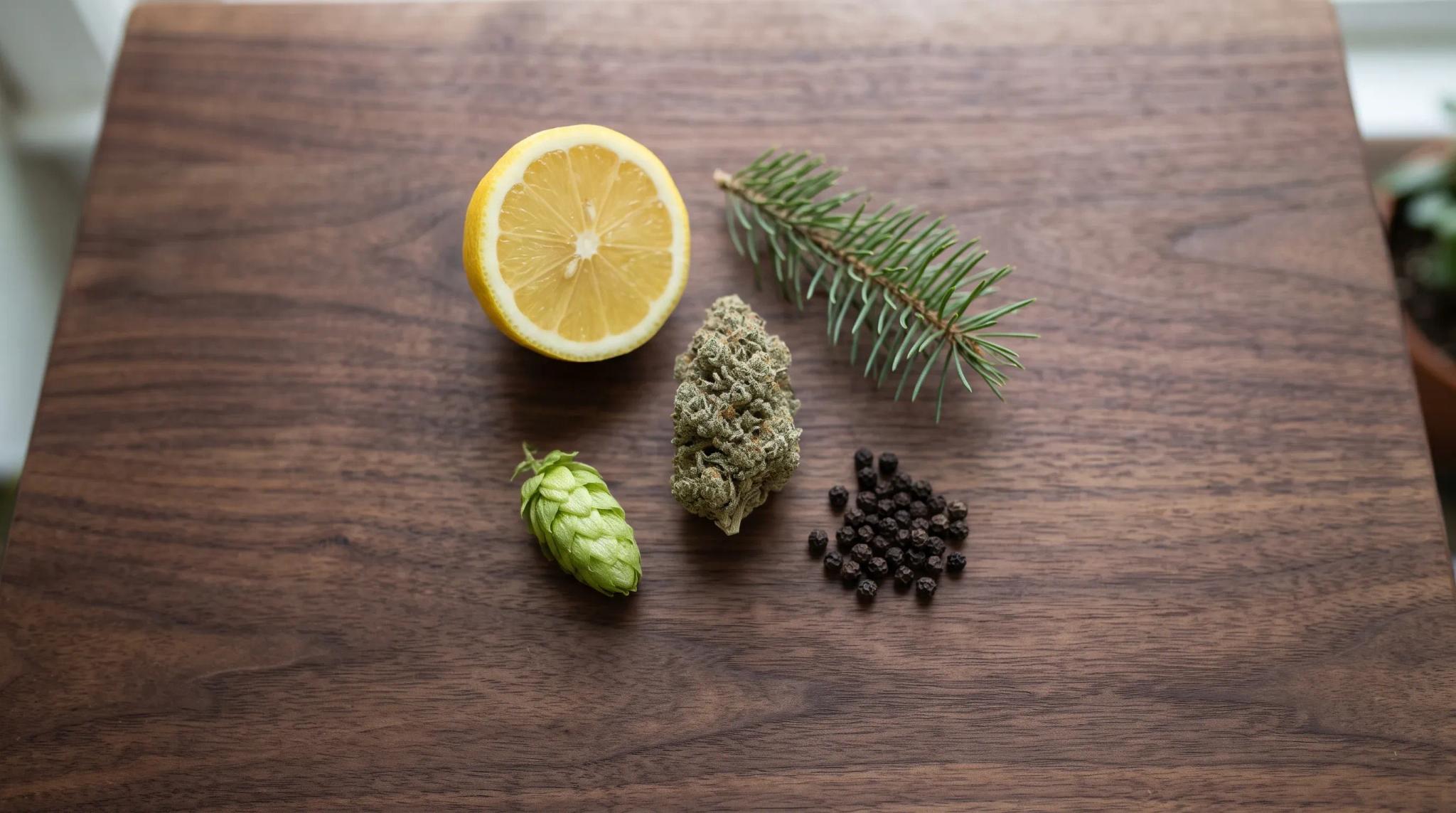
Terpenes are the compounds responsible for much of the scent of cannabis flower. Cannabis makes them in its trichomes, and the same family of compounds is widespread across the plant kingdom. The plant produces more than 200 known compounds that contribute to its aroma, and research on that smell has traditionally focused on terpenes. They also attract claims that the research has not backed up. Here is what they are, which ones show up most in flower, why they fade, and what the studies do and do not show.
What are terpenes made of?
Terpenes are hydrocarbons, molecules made of carbon and hydrogen, produced by living things and built on a carbon skeleton derived from isoprene, a small five-carbon unit. Chemists group them by size. Monoterpenes have 10 carbon atoms and sesquiterpenes have 15. Related compounds that also contain oxygen are called terpenoids. This article uses "terpenes" for both.
Unlike most cannabinoids, terpenes are not unique to cannabis. In hops, a close relative of cannabis, they are an important source of flavor in brewing.
Where does cannabis make terpenes?

Cannabis makes its terpenes in the glandular trichomes, the tiny resin glands found mainly on the surface of female flowers. It makes its cannabinoids in the same glands. Our guide to kief shows what those glands are, and our guide to trichome ripeness covers how growers read them before harvest.
In a 2017 study, researchers at the University of British Columbia identified nine terpene synthases, the enzymes that build terpenes, in the trichomes of a hemp variety called Finola. The enzymes they characterized accounted for most of the terpenes in its resin.
What are the most common terpenes in cannabis?
A 2022 analysis drew on 89,923 commercial flower samples from testing labs in six US states. In the 42,843 samples with terpene data, myrcene, beta-caryophyllene and limonene were, on average, present at the highest levels, and total terpene content averaged 2% by weight.
Describing the UBC findings, Judith Booth, a graduate student on the team, said the "limonene compound produces a lemon-like flavour and myrcene produces the dank, earthy flavour" associated with Purple Kush.
- Beta-caryophyllene is a sesquiterpene found in large amounts in the essential oils of spice and food plants such as oregano, cinnamon and black pepper. A 2008 study reported that it binds to and activates the CB2 cannabinoid receptor, though later research has questioned this.
- Alpha-pinene was among the most abundant monoterpenes in the UBC team's hemp. The Flavornet odor database lists its smell as pine and turpentine.
- Terpinolene defines one of the three terpene groups the 2022 study found.
That 2022 study sorted THC-dominant samples into three groups by terpene profile: high in caryophyllene and limonene, high in myrcene and pinene, or high in terpinolene and myrcene. It also found that indica, sativa and hybrid labels do not reliably distinguish samples by their chemistry, while many strain names were more consistent from product to product than chance would predict.
Why does weed smell skunky?
The classic skunky note is a separate story. A 2021 study in the journal ACS Omega noted that terpenes are the major source of many plant smells but found little evidence that they produce the "skunk-like" aroma of cannabis. The researchers traced that note to a newly identified family of sulfur compounds and named one, 3-methyl-2-butene-1-thiol, as the primary odorant.
Why do terpenes fade?

Terpenes are volatile, and their levels can drop quickly after harvest. A 2020 storage study found that terpene concentrations decreased rapidly under every storage condition it tested, and that grinding the flower and storing it below minus 20 degrees C were the least favorable conditions. Its flower terpene data came from one CBD-rich strain over four months; its extract data covered two strains over a year. Our guide to whether weed goes bad walks through that study and what it means for storage.
What happens when terpenes meet a very hot dab nail is covered in our dab rig guide. Our vape cartridge guide explains why distillate carts have terpenes added back after refining.
Do terpenes change the high?
This is where terpene marketing runs ahead of the evidence. The popular idea, called the entourage effect, is that terpenes and cannabinoids work together, so the whole plant does more than its separate compounds would.
In a 2020 lab study at New Zealand's University of Otago, researchers tested five common cannabis terpenes (myrcene, alpha-pinene, beta-pinene, beta-caryophyllene and limonene), alone and in mixtures, at the CB1 and CB2 cannabinoid receptors. Apart from a possible weak interaction between beta-caryophyllene and CB2, they found no sign that the terpenes act directly at those receptors or change how THC or CBD binds or acts there. The study looked only at those receptors, and the authors concluded that the entourage effect cannot be explained by direct effects at CB1 or CB2.
A 2024 review of medicinal cannabis research reached a similar place. It described the research suggesting terpenes influence the therapeutic benefits of cannabinoids as exploratory, said any enhancement of cannabinoid efficacy by terpenes remains unproven, and called for further clinical trials.
Use a terpene panel as a guide to smell and flavor, not as a prediction of how a product will feel. Our guide to reading cannabis labels goes further into the claims you will see on packaging.
Why don't all products list terpenes?
In California, the testing rules list terpenoids among a lab's required tests only "if applicable," and the terpenoid section says a lab analyzes a sample's terpenoid profile "if requested." When it does, the results go on the certificate of analysis as a percentage and in milligrams per gram if measured by weight or milligrams per milliliter if by volume. A product with no terpene panel may simply not have been tested for them.
Where a panel is listed, use it to compare: if you liked a jar that was high in limonene, look for another high in limonene. Our guide to choosing cannabis flower covers the rest of what to check at the counter.
How to use terpenes when you buy
Your nose picks up terpenes directly, so use it. If a store has a display sample, smell it. If the flower is sealed, ask the budtender to describe its aroma.
Each Dr. Greenthumb's store page, from Fresno to Chicago, has its menu, so you can check what flower is in stock before you go.
This article is general information for adults 21 and older and is not medical advice. Current as of November 2026.
Sources and further reading
- IUPAC Compendium of Chemical Terminology, terpenes
- IUPAC Compendium of Chemical Terminology, terpenoids
- PLOS ONE, Terpene synthases from Cannabis sativa, Booth, Page and Bohlmann, 2017
- University of British Columbia Faculty of Science, Researchers identify genes that give cannabis its flavour, March 29, 2017
- PLOS ONE, The phytochemical diversity of commercial Cannabis in the United States, Smith, Vergara, Keegan and Jikomes, 2022
- PNAS, Beta-caryophyllene is a dietary cannabinoid, Gertsch and others, 2008
- Flavornet, odor entry for alpha-pinene
- ACS Omega, Identification of a New Family of Prenylated Volatile Sulfur Compounds in Cannabis Revealed by Comprehensive Two-Dimensional Gas Chromatography, Oswald and others, 2021
- Frontiers in Plant Science, Metabolic Profiling of Cannabis Secondary Metabolites for Evaluation of Optimal Postharvest Storage Conditions, Milay, Berman, Shapira, Guberman and Meiri, 2020
- Frontiers in Pharmacology, Terpenoids From Cannabis Do Not Mediate an Entourage Effect by Acting at Cannabinoid Receptors, Finlay, Sircombe, Nimick, Jones and Glass, 2020
- Pharmaceuticals, The Entourage Effect in Cannabis Medicinal Products: A Comprehensive Review, 2024
- Cal. Code Regs., tit. 4, § 15714, Required Testing, Medicinal and Adult-Use Cannabis Regulation and Safety Act regulations
- Cal. Code Regs., tit. 4, § 15725, Terpenoid Testing, Medicinal and Adult-Use Cannabis Regulation and Safety Act regulations


