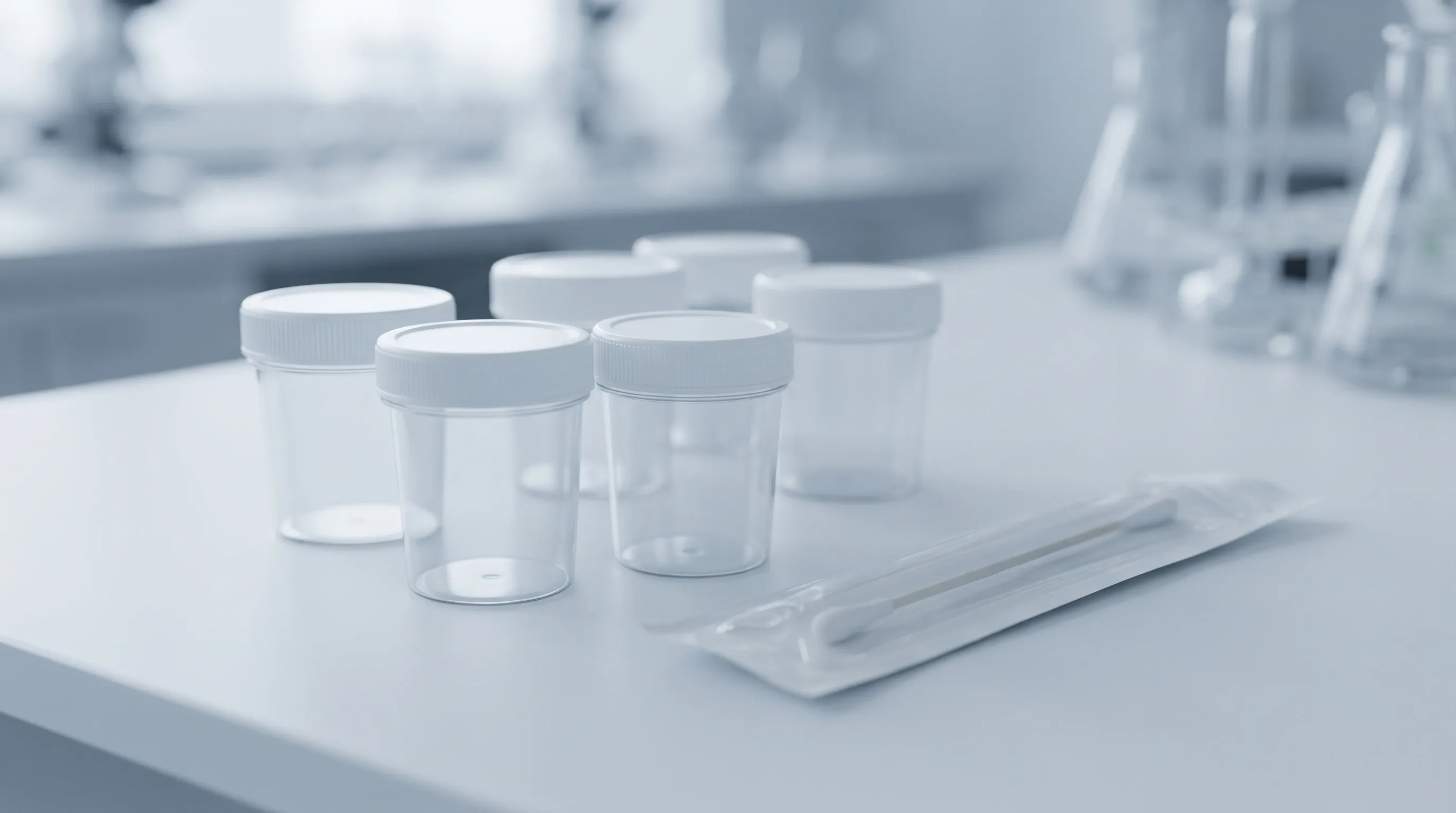
There is no single answer, because "in your system" depends on three things: which test is used, how often you use cannabis, and the cutoff the lab applies. For an occasional user, a standard urine test is usually negative within a few days. For someone who uses every day, it can take one to several weeks, depending on the cutoff.
The same is true whether you ask how long THC or how long weed stays in your system: the tests look for THC and for what the body turns it into, not for the plant.
This article covers what each common test looks for and what studies have measured. It does not cover ways to beat a test, and no number here is a guarantee for any one person.
What a drug test actually looks for

A standard urine test does not look for THC itself. It looks for carboxy-THC, also written THC-COOH, the main compound the body turns THC into.
Oral fluid and blood tests are different: they look mainly for THC itself.
Every test also has a cutoff, the concentration below which a result is reported as negative. The federal workplace drug testing program, run under guidelines from the Substance Abuse and Mental Health Services Administration (SAMHSA), sets these cutoffs:
- Urine: 50 ng/mL of the THC metabolite on the initial screen, and 15 ng/mL on the confirmation test.
- Oral fluid: 4 ng/mL of THC on the initial screen, and 2 ng/mL on the confirmation test.
SAMHSA's March 2026 notice made no change to those values. Private employers, courts and sports bodies can use different cutoffs, and a lower cutoff means a longer detection window.
How long THC shows up in urine
The most useful summary we found comes from the National Drug Court Institute, which reviewed published studies of urine testing after smoking. Its fact sheet, written by Paul L. Cary, reached these conclusions:
- At a 50 ng/mL screening cutoff, detection after occasional or single use would rarely extend beyond 3 to 4 days.
- At the same cutoff, a chronic user would be unlikely to test positive for longer than 10 days.
- At a more sensitive 20 ng/mL cutoff, single use would not be expected to stay positive longer than 7 days, and a chronic user would rarely stay positive longer than 21 days.
Longer windows have been reported. The fact sheet notes that 30-day elimination times are possible in very heavy long-term users, and that study participants with detection times of 30 days or more were the exception, not the rule. It also points out that some older studies reporting very long windows did not confirm that participants were actually abstaining.
That fits what we covered in our article on tolerance breaks: in a Yale study of moderate daily users, urine levels of the main THC metabolite had reached undetectable levels by day 28, under that lab's testing threshold.
Why frequent use stretches the window
THC and its metabolites dissolve in fat rather than water. The National Drug Court Institute fact sheet describes cannabinoids as lipid-soluble compounds that preferentially bind to fat-containing structures in the body.
With occasional use, there is little stored, and levels drop below the cutoff quickly. With chronic use, the fact sheet says, the body's stores of metabolites build up faster than they can be eliminated, so it takes longer for levels to fall below the cutoff after the last use.
How long THC shows up in oral fluid

An oral fluid test is the mouth swab. It looks for THC itself rather than the metabolite, and heavy use can stretch its window.
A study published in 2014 followed 26 chronic cannabis users admitted to a closed detoxification unit. THC was found in oral fluid from 11 of them, and was detected for up to 8 days after admission. The researchers also found that results could switch between negative and positive from one day to the next, so a single negative swab did not mean the next one would be negative.
Oral fluid testing has also produced positives from cannabis topicals in at least one study. Our guide to topicals and transdermals covers that result.
How long THC shows up in blood
Blood tests look for THC itself. One of the clearest measurements of how long it lingers in frequent users comes from a study designed with impaired-driving laws in mind.
A 2013 study published in Clinical Chemistry followed 30 men who smoked cannabis every day while they stayed on a secure research unit, where they could not use cannabis. On admission, 27 of the 30 had THC in their blood. Levels fell gradually, and two of the five men still on the unit at day 30 still had a small amount of THC detectable.
The researchers' point was about driving laws: a person who uses cannabis daily can have measurable THC in their blood long after their last use.
What changes the window
- How often and how much you use. In the studies above, occasional use cleared much faster than daily use.
- The cutoff. The same urine sample can be positive at 20 ng/mL and negative at 50 ng/mL.
- The test. Urine looks for the metabolite; oral fluid and blood look for THC itself, and each has its own cutoff.
- The product. Full-spectrum CBD products contain trace THC, and regular use can produce a positive. Our guide to hemp vs marijuana explains why.
Sport has its own rules and thresholds, and they vary widely by league. Our guide to cannabis and athletes covers where each one stands.
What this article can't tell you
The windows above come from studies of groups of people under controlled conditions. They describe what is typical, not what will happen to you. People, products, amounts and labs all vary.
If a test matters for your job, your license or a court case, the only safe assumption is that any THC product carries some risk. Ask the employer or the testing program which test and which cutoff they use.
Sources
- Paul L. Cary, The Marijuana Detection Window: Determining the Length of Time Cannabinoids Will Remain Detectable in Urine Following Smoking, National Drug Court Institute, Drug Court Practitioner Fact Sheet, April 2006
- Substance Abuse and Mental Health Services Administration, Mandatory Guidelines for Federal Workplace Drug Testing Programs: Authorized Testing Panels, Federal Register, March 2026
- Andås et al., Detection time for THC in oral fluid after frequent cannabis smoking, Therapeutic Drug Monitoring, 2014
- Bergamaschi et al., Impact of prolonged cannabinoid excretion in chronic daily cannabis smokers' blood on per se drugged driving laws, Clinical Chemistry, 2013
This article is general information for adults 21 and older. It is not medical or legal advice. If a drug test matters for your job, license or a legal case, ask the employer or testing program which test and cutoff apply. Current as of October 2026.


