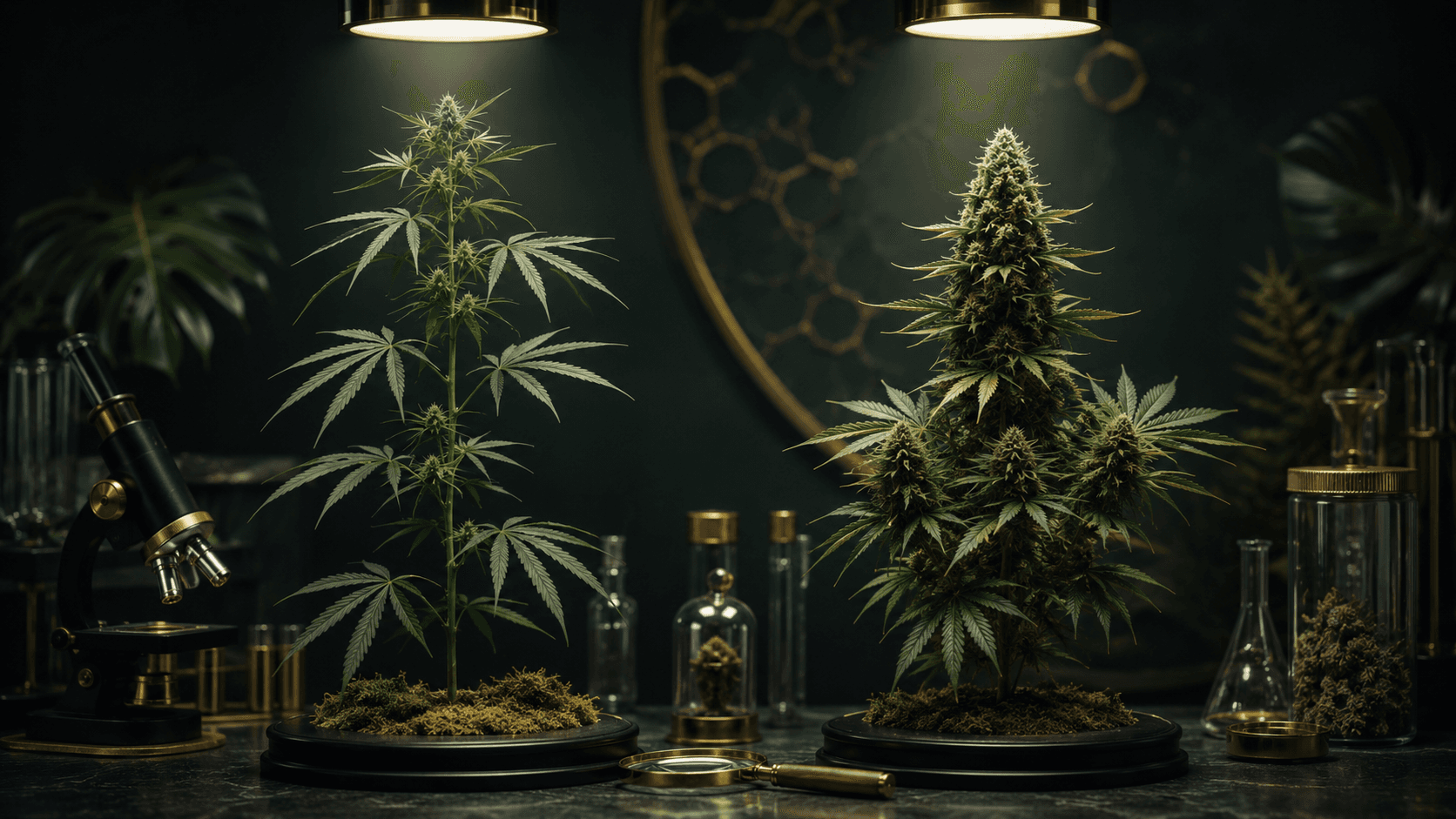
Hemp and marijuana are the same plant species — Cannabis sativa L. There is no botanical line between them. The difference is legal, and it comes down to a single number: THC content.
Under federal law, cannabis containing 0.3% or less delta-9 THC by dry weight is hemp. Anything above that is marijuana. Hemp is not a controlled substance; marijuana is. That one threshold decides whether a plant can be shipped across state lines and sold in a gas station, or whether it can only be sold by a licensed dispensary to someone over 21.
That threshold is about to change. More on that below.
The difference at a glance
Both are Cannabis sativa L. Everything below follows from the THC threshold, not from the plant.
THC content. Hemp is 0.3% or less delta-9 THC by dry weight. Marijuana is anything above that.
Federal status. Hemp is not a controlled substance. Marijuana is Schedule I.
Where you buy it. Hemp products are sold in general retail and online. Marijuana is sold only by licensed dispensaries.
Age requirement. Hemp varies by state and is often unrestricted. Marijuana requires 21+, or a medical card.
Lab testing. Hemp testing varies and is not federally mandated. Marijuana is tested to state standards in every legal market.
Potency labelling. Hemp labelling is inconsistent. Marijuana potency is verified before sale.
Typical products. Hemp: CBD oils, topicals, fibre, seed. Marijuana: flower, vapes, edibles, concentrates.
Where the 0.3% line came from
The threshold entered US law before it mattered much to anyone. The 2014 Farm Bill used 0.3% delta-9 THC on a dry weight basis to define industrial hemp, and the 2018 Farm Bill carried the same figure forward when it removed hemp from the Controlled Substances Act entirely.
It is not a biological boundary. Nothing changes about the plant at 0.31%. It is an administrative line that has since become one of the most consequential numbers in American cannabis law — the difference between an agricultural commodity and a Schedule I substance.
What changes in November and December 2026
The 2018 Farm Bill defined hemp using delta-9 THC only. That wording created what became known as the hemp loophole: products could contain large amounts of other intoxicating cannabinoids — THCA, delta-8 THC, HHC — and still qualify as hemp, so long as delta-9 stayed under 0.3%. That is how intoxicating "hemp-derived" gummies and THCA flower ended up on shelves in states with no legal cannabis market at all.
That loophole is closing. Section 781 of the Continuing Appropriations and Extensions Act, 2026 makes three changes:
- A total THC standard. The 0.3% ceiling now counts THCA and other THC forms, not just delta-9.
- A per-container cap. Finished hemp-derived cannabinoid products are limited to 0.4 milligrams of total THC per container.
- Synthetics excluded. Cannabinoids synthesised or manufactured outside the plant fall outside the hemp definition regardless of their source material.
Most of the change takes effect December 11, 2026. The exclusion for cannabinoids the plant can't naturally produce takes effect earlier, on November 12, 2026. One industry estimate suggests the change would place the large majority of currently marketed hemp-derived cannabinoid products outside the federal hemp definition.
A stopgap funding law signed on September 2, 2026 moved most of the change from November 12 to December 11. It did not repeal or weaken the new definition.
From December 11, 2026, the federal definition of hemp narrows to a total-THC standard that counts THCA, with a 0.4 mg per-container cap on finished products. Some products sold as federally legal hemp today may not qualify after that date.
What this means in practice: the 0.3% figure survives, but what counts toward it expands. A product that qualified as hemp under a delta-9-only test may not qualify under a total-THC test. If you buy intoxicating hemp products, expect the category to change.
THCA is the compound at the centre of this change — it converts to THC when heated, which is why counting it changes the arithmetic. Our explainer on THCA and how it converts to THC covers the chemistry, and our guide to THC, CBD and CBG covers how the individual cannabinoids differ.
What this means for what you're buying
The legal distinction shows up at the counter in ways that matter more than the label.
Hemp-derived CBD is sold in general retail — pharmacies, wellness shops, online. No licence is required to sell it, age restrictions vary by state, and testing standards are inconsistent. Reputable brands publish a Certificate of Analysis (COA) for each production batch, showing cannabinoid content and screening for pesticides, heavy metals and residual solvents. Many products don't, and there is no federal requirement that they do. If a product has no COA, or the COA doesn't carry a batch number matching the package, you are trusting the label and nothing else.
Dispensary cannabis comes from a licensed retailer operating under state regulation. In legal markets, every batch is tested by a licensed laboratory before it can be sold, and the results determine what goes on the label. Potency is verified rather than claimed. Products carry a unique identifier that ties them back through the supply chain, and states run track-and-trace systems that follow inventory from cultivation to sale.
That is the practical difference. Not the plant, not the cannabinoid — the accountability behind the number on the package.
Intoxicating hemp products sit in between, and it is the category the federal change targets. Delta-8 gummies, THCA flower and similar products have been sold outside dispensaries under the federal hemp definition while delivering effects closer to dispensary cannabis. Their legal status has always varied by state, and it is about to narrow federally.
If you want to read a COA properly rather than trusting the front of the package, our beginner's guide to reading a gummy COA walks through one line by line. For dispensary packaging, reading cannabis product labels covers what the numbers mean.
Which one do you actually need?
Most people searching for the difference are trying to answer a more specific question.
You want CBD for wellness reasons and don't want to feel anything. Hemp-derived CBD is what you're looking for, and it's available without a dispensary. Look for a current COA, and prefer broad-spectrum or isolate if you want to avoid trace THC entirely — our guide to what full-spectrum and isolate labels mean explains what each actually contains.
You want the effects. That means THC above the hemp threshold, which means a licensed dispensary in a state with a legal market. There is no legal route around this, and products marketed as achieving it through hemp are the ones the federal change addresses.
You're worried about a drug test. Standard tests screen for THC metabolites. Full-spectrum hemp CBD contains trace THC and regular use can accumulate. If a test matters, isolate or broad-spectrum reduces the risk — though testing quality varies and no product can guarantee a result.
You're travelling. Hemp-derived CBD is federally legal to carry, but state rules on intoxicating hemp vary widely. Dispensary cannabis cannot legally cross state lines, including between two states where it's legal.
California and Illinois
California. Adults 21 and over can buy from any licensed retailer with valid government-issued photo ID. Daily adult-use limits are 28.5 grams of non-concentrated cannabis, 8 grams of concentrate, and 6 immature plants. Adult-use edibles are capped at 10 mg THC per serving and 100 mg per package. Medical patients qualify from 18 with a physician's recommendation and have higher limits. Retail hours run 6:00 a.m. to 10:00 p.m. statewide, and purchases are tracked, so limits apply across dispensaries rather than per visit.
Illinois. Adults 21 and over can buy from licensed dispensaries with valid photo ID. Illinois is unusual in setting different limits for residents and out-of-state visitors — visitors are held to half the resident amount, applied separately to flower, concentrate and infused products. Those limits were raised in 2026, so figures published before then are out of date. Check the current numbers with the state or ask at the counter.
Both states run medical programmes alongside adult-use, with different limits, eligibility and tax treatment. Our state law pages cover California and Illinois in more detail, including possession rules, home cultivation and where consumption is permitted.
The short version
Same plant, different legal category, separated by a number. That number is 0.3%, and from late 2026 the way it's measured gets stricter — total THC instead of delta-9 alone, with a hard cap on finished products.
If you want CBD without effects, hemp-derived products are widely available and the main thing to check is the Certificate of Analysis. If you want anything with meaningful THC in it, a licensed dispensary is where the potency is verified, the testing is mandated, and the rules are consistent.
Sources
- The 2018 Farm Bill's Hemp Definition and Legal Challenges to State Laws Restricting Certain THC Products — Congressional Research Service
- Changes to the Statutory Definition of Hemp and Implications for Agricultural Policy — Congressional Research Service
- Change to Federal Definition of Hemp and Implications for Federal Enforcement — Congressional Research Service
- Hemp Production and the 2018 Farm Bill — US Food and Drug Administration
- California's cannabis laws — California Department of Cannabis Control
- Cannabis Regulation FAQs — State of Illinois


