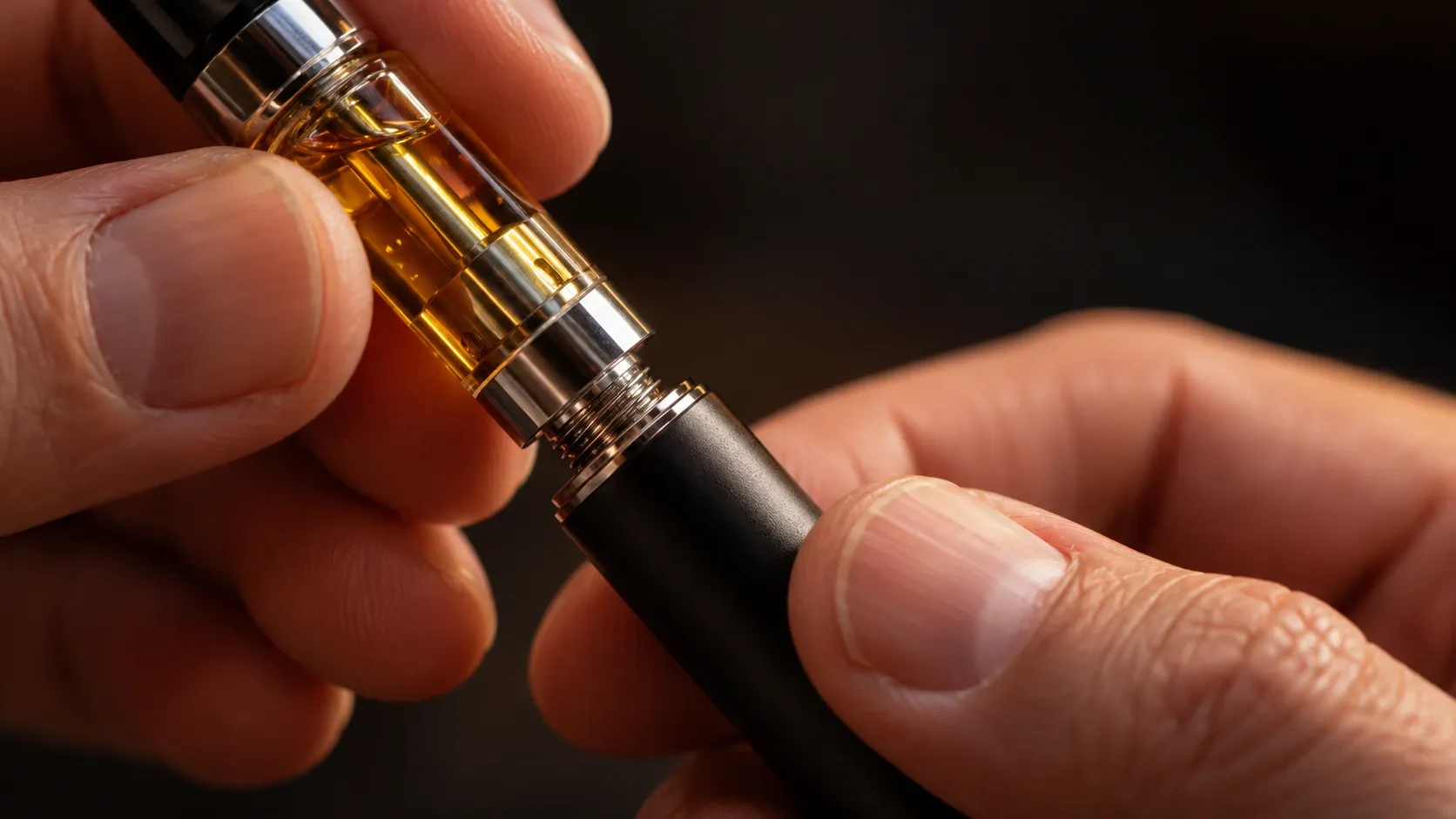
A vape cartridge is only half of what you use. The other half is the battery, and it is the half nobody explains at the counter. The cartridge gets a label, a lab report and a strain name. The battery gets a voltage number, and that number is less informative than it looks.
The short version: almost any 510 cartridge fits almost any 510 battery, so compatibility is rarely the problem. Control is. A battery that lets you run cooler gives you more say over how a cartridge tastes and how long it lasts, but the numbers printed on two different devices are not comparable, and one measured study shows exactly how far apart they can be.
This covers what the 510 standard is, what the settings do, and what is worth checking before you buy. For the cartridge half of the purchase, see how to choose a vape cartridge.
What "510 thread" actually means
510 describes a screw fitting: ten threads at a pitch of 0.5 mm. The diameter is less tidy than the name suggests. One seller's guide gives the core diameter as roughly 5 mm and the outer thread diameter as closer to 7 mm, so the name describes the thread count and pitch rather than a single measurement you can take with calipers.
The more useful fact is what 510 is not. It is not a formal standard issued by a standards body, and nobody owns it. It became the default because early e-cigarette hardware used it and cannabis cartridge makers adopted it rather than inventing something new. A study of vaporizer hardware describes the practical result plainly: all cartridges and devices in the 510 ecosystem connect to one another, so any manufacturer can build for it.

That is the strength and the weakness in one sentence. You are not locked to one brand. You are also relying on two components that were never designed together and never tested together.
One seller's caveat is worth keeping: matching threads do not guarantee matching performance. A cartridge that seats properly can still run hotter or cooler than the maker intended on a battery it has never met.
Voltage settings are not temperature
Here is the part that changes how you read a battery's spec sheet.
Researchers at PAX Labs used infrared thermography to measure what the heating coil inside a cartridge actually reaches during a simulated puff, comparing one temperature-controlled device against two 510 voltage-controlled ones. Published in PLOS One in 2022, it is the only direct measurement of cannabis cartridge coil temperature under use conditions that we found, and the authors say the same of the literature before it.
The measurements:
- The variable-voltage 510 device at its 4.0V setting averaged 543 degrees C, plus or minus 95.9.
- The same device at 2.4V averaged 443 degrees C, plus or minus 56.1.
- A single-voltage 510 device fixed at 3.2V averaged 450 degrees C, plus or minus 60.8.
- The temperature-controlled device set to 420 degrees C averaged 420 degrees C, plus or minus 9.5. At its lowest setting it averaged 246.
Read the 3.2V number against the other two. If voltage alone determined temperature, a 3.2V device should land about halfway between 2.4V and 4.0V, near 493 degrees. It came in at 450, essentially the same as the 2.4V setting on the other device. The authors' conclusion is blunt: voltage alone was a poor indicator of coil temperature.

Look at the variability too. The voltage-controlled devices swung by 56 to 96 degrees around their own averages. The temperature-controlled one varied by under 10. Only the temperature-controlled system held below 400 degrees C for a full puff.
Two things have to be said about this study. It was funded by PAX Labs, the authors are PAX employees, and PAX makes the temperature-controlled device that performs best in the comparison. That competing interest is declared in the paper and you should weigh it. The practical limits are real too: three device types, three cartridges each, cartridges cut open to expose the coil, and puffs longer than most people take, which the authors chose deliberately as a worst case.
Worth knowing too: the device that held its temperature was not a 510 battery at all. It was a proprietary pod system, which the paper describes as one of the only devices letting the consumer set a temperature directly. Buying your way out of this is not simply a matter of picking a better 510 battery.
What survives those caveats is the relative finding, which does not depend on which device wins: a voltage number on one device does not predict the temperature on another.
Why coil temperature matters
Cannabis oil and terpenes break down as they get hotter. A 2019 study of gas-phase components found that people using cartridge vaporizers and dabbing may be exposed to degradants including methacrolein, benzene and methyl vinyl ketone, and that adding terpenes to THC raised the levels of those products rather than lowering them. The same work reports that gas-phase products from vaping were significantly lower than from smoking cannabis, which is worth stating alongside the rest. Summarizing the wider literature, the thermography authors write that higher concentrations of undesirable and potentially toxic degradation products are produced as temperature or device power output increases, and that the increase tends to be steep once an inflection point is passed.
Be careful how you read that, the same way you should read the hardware metals research covered in our cartridge guide. This is product chemistry measured in a lab. It documents that heat produces compounds you would rather not inhale. It is not a clinical study of people, and it does not establish that any particular device or setting delivers a harmful dose to anyone.
What it does support is modest and practical: heat is the variable you control, and running cooler is the direction that preserves flavor. If your cart tastes scorched, the setting is the first thing to change.
Draw-activated or button, and what preheat does
Three functional differences are worth knowing, all of which sellers describe consistently and none of which we found measured.
- Draw-activated batteries fire when you inhale, with no button to press.
- Button-activated batteries fire when you press and hold.
- Preheat applies a low, brief warm-up before the main draw. It is marketed for thick oil in cold weather, where a cartridge can otherwise draw poorly.
Activation and adjustability are separate questions, and it is worth not confusing them. All three devices in the thermography study were draw-activated, and one of them still offered three voltage settings. What you want is a battery with more than one setting, however it fires. The researchers above described their fixed-voltage device as one of the cheaper ones that might be given away with the purchase of a cartridge. That is the configuration they measured at 450 degrees C, with no way to adjust it.
Capacity, charging and connections
Capacity is quoted in mAh. A higher number means longer between charges and, usually, a bigger device. These are manufacturer figures, and we found no independent testing of whether they hold up in use.
Two things are worth checking on the physical device. Note which cable it charges with, since newer batteries tend to use USB-C and older ones micro USB. And the connection itself is where most "my cart stopped working" problems live: residue on the contact pin, or a cartridge screwed down too hard. Screw cartridges on gently. Overtightening can press the center pin down far enough to break the connection, which is a common cause of a cartridge that suddenly will not fire.
Flying with a vape battery: the FAA rule
Vape batteries are lithium-ion, and aviation rules treat them accordingly.
The FAA prohibits electronic cigarettes and vaping devices in checked baggage. They must travel in carry-on or on your person, and if a carry-on bag gets gate-checked, the device has to come out and stay with you in the cabin. Spare batteries must be protected against short circuits, by leaving them in retail packaging, taping the terminals, or putting each in its own case or bag. Lithium-ion batteries are capped at 100 watt-hours. Recharging the device on board is not permitted either. In its guidance for retailers and consumers, the FAA goes further: the devices must never be used or charged in the aircraft, and it notes that vaping on a plane is a federal offense.
Those are rules about lithium batteries, and they are separate from the question of transporting cannabis products, which is governed by an entirely different set of laws.
The same short-circuit logic applies in your pocket. Keys and coins across the terminals of a loose battery are what the FAA's packaging advice exists to prevent.
How to use that when you shop
- Buy a battery with settings, not a free one with none. Control is the entire point.
- Treat voltage numbers as relative to that device, not absolute. Lower is cooler on your battery; it does not tell you what a different battery's 3.2V does.
- Start at the lowest setting and work up. It is the cheapest way to find where a given cartridge tastes right, and you can always add heat.
- If it tastes burnt, turn it down before blaming the cartridge.
- Check the charging port and the pin. USB-C and a clean, undamaged center contact solve most of the problems people blame on the oil.
- Keep it in a case or pocket by itself. Not loose with your keys.
- Ask staff what hardware the store has. Battery selection varies by location and is not something you can check from a menu.
Sources and further reading
- Thermography of cannabis extract vaporization cartridge heating coils in temperature- and voltage-controlled systems during a simulated human puff — Oar, Savage, Rufer, Rucker and Guzman, PLOS One 17(1):e0262265, 2022. Funded by PAX Labs; the authors are PAX employees
- Aerosol Gas-Phase Components from Cannabis E-Cigarettes and Dabbing: Mechanistic Insight and Quantitative Risk Analysis — Meehan-Atrash, Luo, McWhirter and Strongin, ACS Omega 4(14):16111-16120, 2019
- PackSafe: Electronic Cigarettes, Vaping Devices — Federal Aviation Administration, on carry-on requirements, short-circuit protection and watt-hour limits
- Lithium Batteries in Baggage — Federal Aviation Administration
- Vapes On A Plane Marketing Kit — Federal Aviation Administration, on never using or charging the device in the aircraft
- Electronic Cigarettes and Vaping Devices — Transportation Security Administration
- What is a 510 thread? — a seller's explanation of the fitting, including the caveat that matching threads do not guarantee compatibility
- Why 510 Is the Standard for Vape Pens — a seller describing the connector as roughly 5 mm at the core and closer to 7 mm at the outer thread
This article is for general information for adults 21 and older and is not medical advice. Product availability varies by location; ask staff what is in stock. Information is current as of September 25, 2026.


