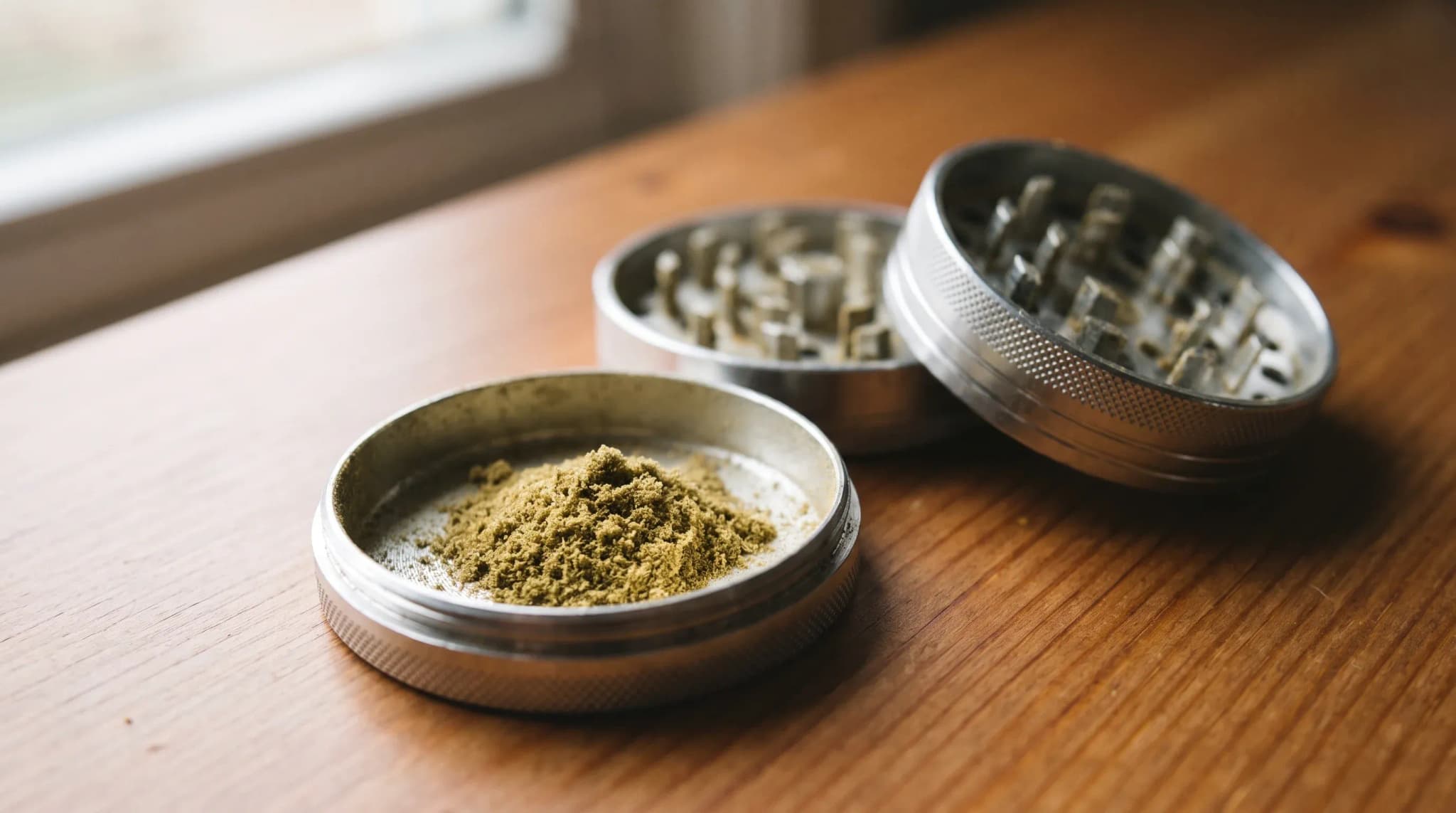
Kief is the loose, sandy powder that collects at the bottom of a four-piece grinder. It is made of trichomes, the tiny resin glands that give cannabis flower its frosty look, after they have broken off the plant.
California's cannabis regulations put it plainly: kief means "the resinous trichomes of cannabis that have been separated from the cannabis plant." This guide covers what that means, how kief is collected, how people use it, and how to keep it.
What kief is made of
Look closely at a bud and you will see a coating of tiny crystals. Those are trichomes. The ones that matter most look like little mushrooms: a stalk with a round head on top. Our guide to reading trichomes at harvest shows what they look like up close.
Those heads are where much of the plant's chemistry happens. A University of British Columbia study published in The Plant Journal found that the large, mushroom-shaped stalked trichomes are the richest source of the compounds that become THC and CBD, and described them as expanded "cellular factories" for cannabinoids and terpenes.
When flower dries and gets handled, many of those heads snap off. Collected together, they are kief.
Why kief counts as a concentrate
Because kief is mostly trichome heads with most of the leaf and stem left behind, it is more concentrated than the flower it came from. California treats it that way. The state's regulations list kief by name in their definition of cannabis concentrate, alongside tinctures, extracts and vape cartridges.
That matters at the register. In California, kief counts toward the 8-gram daily limit for concentrates, not the 28.5-gram limit for flower. Our guide to how much you can buy in California covers both limits.
How kief is collected

Most people collect kief without trying. A four-piece grinder has a mesh screen above its bottom chamber, and as you grind, loose trichome heads fall through the screen and build up underneath. It fills slowly. Our grinder guide explains how the screen works and when a four-piece is worth it.
Kief can also be collected on purpose by rubbing or shaking dried flower over a fine screen. Leafly suggests screens in the range of 75 to 125 microns, and notes that home extractors sometimes pass kief through several screens of different sizes. Kief collected this way is often called dry sift.
California's rules describe the same two routes: kief "obtained from accumulation in containers or sifted from loose, dry cannabis flower or leaf with a mesh screen or sieve."
How people use kief
- On top of a bowl. A pinch sprinkled over packed flower is sometimes called crowning a bowl. Our guide on how to pack a bowl covers the packing itself.
- In a joint. Leafly describes mixing a pinch into the flower before rolling, or rolling the outside of a joint in kief. Our guide on how to roll a joint walks through the rolling.
- In pre-rolls. California allows kief as pre-roll fill on its own or mixed with flower, shake and leaf. Under the state's definitions, adding kief does not make a pre-roll "infused": that category covers concentrates other than kief. Our pre-roll guide explains what the label does and does not tell you about the fill.
- Pressed into hash. Kief can be pressed into a solid piece, which is covered below.
Moon rocks use kief too. Leafly describes them as buds covered in hash oil and then rolled in kief.
If you buy kief, check the label for its tested potency.
Kief vs hash

Hash is a solid. Weedmaps describes it as "a hardened, solid piece of compressed kief," made by applying heat and pressure to collected kief. Kief is the loose powder; hash is what it becomes when it is pressed.
Hash can also be made in other ways, such as washing trichomes off the plant with ice water, which produces what is often sold as bubble hash. Our guide to choosing a concentrate covers the main solventless and solvent-based types.
Does kief go bad?
It can lose potency over time, the same way flower does. We found no study that measured kief storage on its own. For cannabis in general, the storage studies point to light as the biggest single cause of cannabinoid loss. Our guide to whether weed goes bad covers those studies.
Weedmaps recommends keeping kief in an airtight container somewhere cool and dark, away from moisture and direct sunlight, and handling it as little as you can. Leafly also advises a cool, dark place out of direct sunlight.
Sources
- California Department of Cannabis Control, Cannabis regulations, California Code of Regulations, title 4, section 15000 (definitions)
- University of British Columbia, The frostier the flower, the more potent the cannabis
- Leafly, What is kief and how can you use it?, updated July 2025
- Weedmaps, What is kief and how to use it, updated February 2026
This article is general information for adults 21 and older. It is not medical or legal advice. Current as of October 2026.


