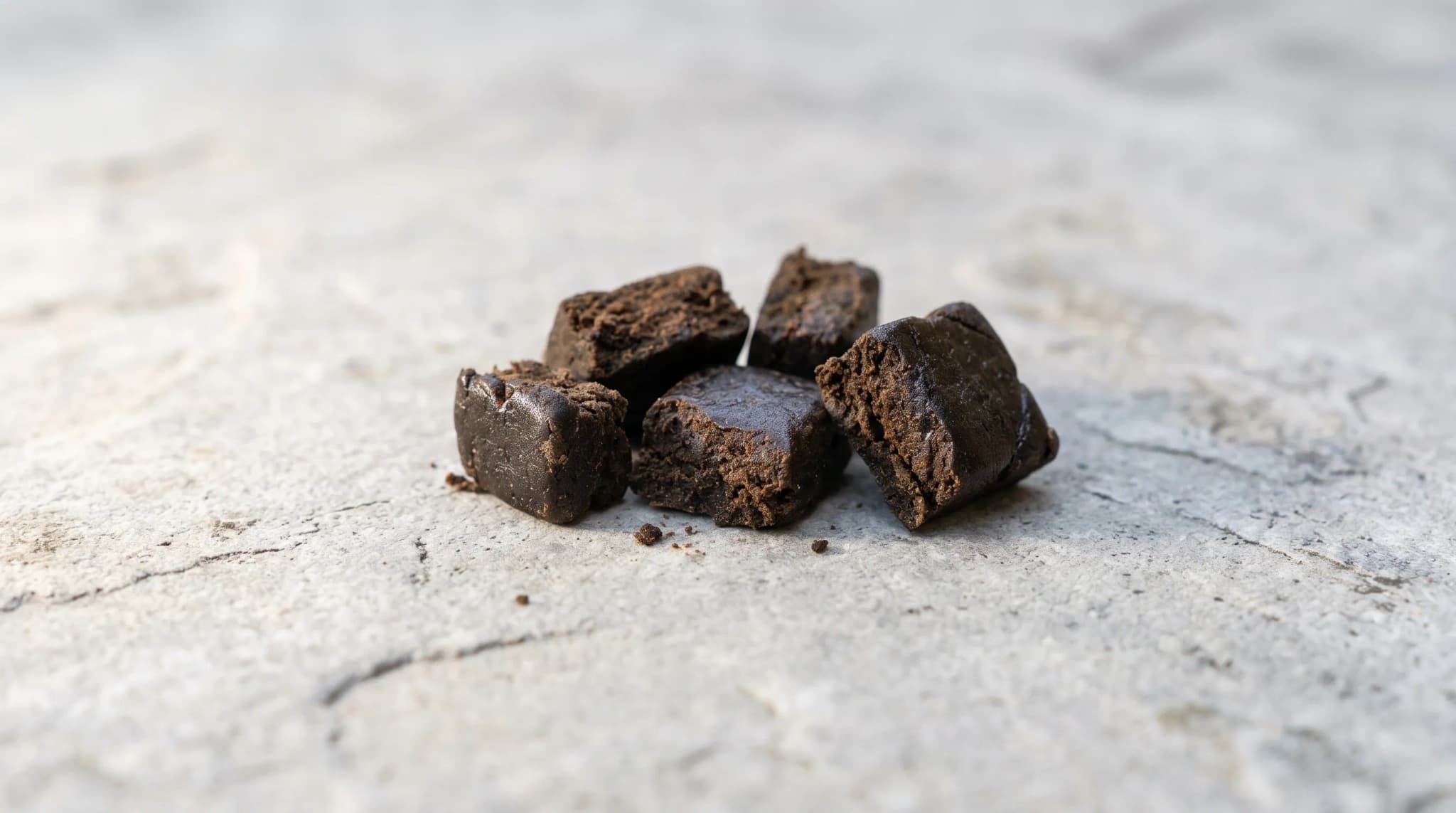
Hash is cannabis resin: the plant's sticky resin glands, separated from the leaf and stem and collected into a mass. A European drug-monitoring analysis now published by the European Union Drugs Agency describes cannabis resin, also known as hashish and charas, as a natural product made by separating and compressing the resin glands, or trichomes, of the female cannabis plant. Those are the same glands that coat a cured bud and collect as powder in the bottom chamber of a grinder.
That shared origin is the whole relationship between hash and kief, and it is where most of the confusion starts. This guide covers what hash is made of, the main ways it is made, how it compares with kief and rosin, what the terms on a dispensary menu mean, and whether hash goes bad.
What hash is made of
Trichomes are the tiny resin glands on cannabis flowers. The Hash Marihuana & Hemp Museum, which has sites in Amsterdam and Barcelona, describes them as the glands that produce the plant's active components. Making hash is the work of getting those glands off the plant and away from everything else.
How well that separation goes decides what the finished hash is like. The EUDA analysis notes that, depending on the method and on the skill and care of the people making it, hash can carry different amounts of dirt and plant fragments, and can vary a great deal in appearance, texture, smell and potency. Two pieces both sold as hash can be very different products.
How hash is made

Every method does the same job: get the trichomes off the plant and keep the plant matter out. The EUDA analysis says cannabis resin is usually made either by hand-rubbing or by sieving, though other methods exist. A third route uses ice water.
Sieving. Most types of hash, according to the Hash Museum, are made by rubbing dried plants over a very fine mesh. The trichomes fall through and the plant matter stays on top. The collected glands are then worked with heat and pressure into a solid mass. The museum notes that sieved hash tends to be harder and denser than hand-rubbed hash because it is often pressed mechanically, and that it ranges from light brown and dry to very black and sticky. Before it is pressed, the sifted powder is kief, often called dry sift.
Hand-rubbing. Charas is made by rubbing the hands over the flowers of living plants so the resin sticks to the palms. The museum describes the resin being scraped off and pressed by hand into a ball that is usually dark brown or black, slightly sticky and soft at room temperature.
Ice water. Ice water hash, also called bubble hash, uses cold water instead of a dry screen. In Leafly's description, the cannabis goes into ice water, which freezes the trichomes, and the mix is agitated so they break off. It is then poured through a series of mesh bags with finer and finer screens, which hold back the plant matter. No chemical solvent is involved.
The older methods go back a long way. The EUDA analysis says cannabis resin has been consumed for many centuries, that large-scale production in the early twentieth century was centered on Kashmir, Afghanistan and parts of India, and that Morocco's production of sieved hash became large enough to export in the late 1960s.
Hash vs kief vs rosin
Kief is the loose powder: trichomes that have been separated but not pressed. Our guide to kief covers how it collects in a grinder and how people use it. Pressing or working that powder into a solid gives you hash.
Rosin is a further step. Leafly describes rosin as an extract made by pressing cannabis between heated plates until oil comes out, with no solvent, and lists flower, trim, kief and hash among the materials it can be made from. Rosin made from bubble hash or dry sift is sold as hash rosin. Live resin is different again: it is made with a chemical solvent such as butane or propane, which none of the methods above use. Our explainer on resin vs rosin goes into the solvent side.
Reading a hash menu
A few terms come up again and again.
Stars and full melt. Ice water hash is often graded from one to six stars, which Leafly describes as a measure of refinement and meltability, with six the most refined. Full melt is the name for the top grades. Leafly defines it as high-grade dry sieve or water hash that melts fully without leaving a residue.
Hash holes. A hash hole is a pre-roll with a core of hash rosin or hash running through the center of the flower. Weedmaps explains that the name comes from the ring of ash it leaves as the center burns away. Our pre-roll guide covers infused pre-rolls more generally.
Hash oil. Despite the name, butane hash oil is not hash. Leafly describes BHO as an umbrella term for concentrates made with a solvent such as butane, which puts it on the opposite side of the line from the methods in this guide.
Hash in a strain name. Some flower strains carry the word hash in their names. That is a name, not a product type. The menu category tells you whether you are looking at flower or a concentrate.
How people use hash

Hash is used in most of the same ways as kief. Common ones are crumbling a little over flower in a bowl, mixing it into a joint, buying it already inside a hash hole, or, for full melt, dabbing it. Leafly notes that ice water hash is usually dabbed but can also be sprinkled on top of flower. Our guides on packing a bowl and choosing a dab rig cover the gear.
Buying hash at a dispensary
In California, hash is legally a concentrate. The state's Health and Safety Code lists hash by name in its definition of concentrated cannabis, alongside extracts, oils, shatter, rosin and wax. That puts it under the concentrate limit, not the flower limit. Our guide to how much you can buy in California has the numbers, and Illinois limits are in our guide to buying in Chicago.
The label and the certificate of analysis are worth reading before you buy. Our guide to choosing a concentrate walks through both. Each store's menu shows what is in stock that day: La Mesa, Fresno and Chicago.
Does hash go bad?
Hash can lose potency over time. A 1976 study by Fairbairn, Liebmann and Rowan stored herbal cannabis and two samples of cannabis resin for up to two years. It found that light, even indirect, was the greatest single factor in cannabinoid loss, especially in solutions, and that air oxidation also caused significant losses. The authors concluded that carefully prepared herbal or resin cannabis was reasonably stable for one to two years when kept in the dark at room temperature.
They also noted that intact resin glands act like well-closed containers, so damage to them speeds up the loss. In practice that points to an airtight container kept out of the light. Our guide on whether weed goes bad covers storage in more detail.
Sources and further reading
- EMCDDA (now the European Union Drugs Agency), Changes in Europe's cannabis resin market
- Hash Marihuana & Hemp Museum, Making Hashish
- Leafly cannabis glossary, Ice water hash
- Leafly cannabis glossary, Full melt
- Leafly, Leafly's guide to rosin: What is it and how do you make it?
- Weedmaps, What is a hash hole
- California Health and Safety Code section 11006.5
- Fairbairn JW, Liebmann JA, Rowan MG, The stability of cannabis and its preparations on storage, Journal of Pharmacy and Pharmacology, 1976
This article is general information for adults 21 and older and is not legal advice. Current as of November 2026.


