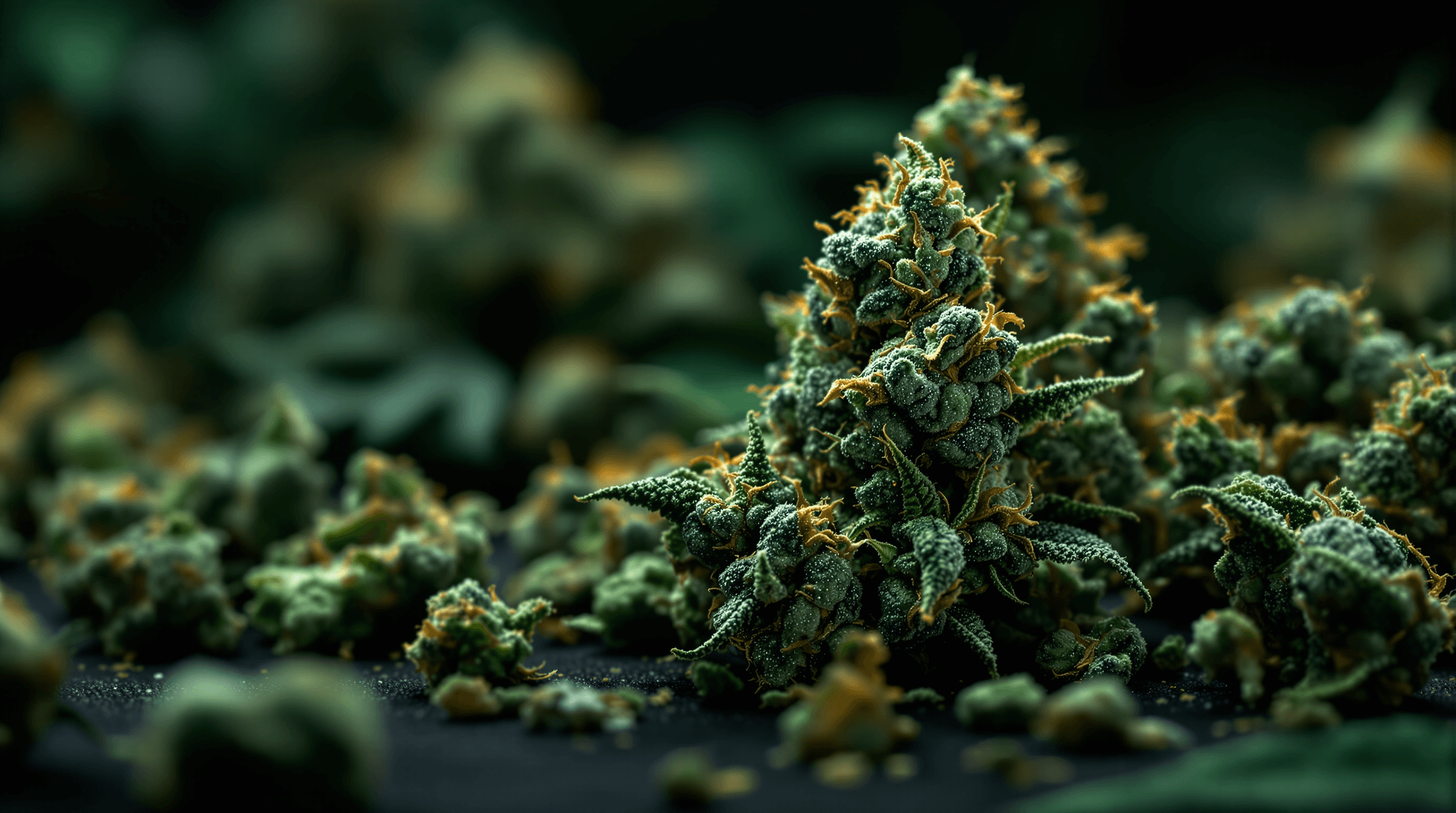
The Raw Cannabis Mystery: Why Fresh Flower Won't Get You High
You just picked up some fire from Dr. Greenthumb's. The buds are sticky, covered in trichomes, and the lab test shows 25% THCA. You decide to get creative and toss a raw nug into your smoothie. Twenty minutes later... nothing. An hour passes. Still nothing.
This confuses the hell out of new cannabis users. How can flower testing at 25% potency do absolutely nothing when eaten raw? The answer lies in a fundamental misunderstanding about cannabis chemistry. That percentage on your label? It's not THC — it's THCA, and there's a massive difference.
Fresh cannabis plants don't actually produce THC. They produce THCA (tetrahydrocannabinolic acid), a non-psychoactive compound that needs heat to become the THC we know and love. According to research from the National Center for Biotechnology Information, "THCA (tetrahydrocannabinolic acid) is the non-psychoactive precursor to THC found in raw cannabis plants." Without applying heat through smoking, vaping, or proper cooking techniques, you're essentially consuming an expensive salad garnish.
Our budtenders get this question constantly: "what should I start with?" Not the strain — the whole category. Flower, edibles, vapes — beginners don't know the difference yet. We keep a printed cheat sheet at the counter now. Walks through each option. Cut our average first-visit time from 25 minutes to 12.
This reality check hits different when you realize how much cannabis gets wasted by people who don't understand this basic principle. We've all heard stories about someone dumping ground flower into brownie batter without decarbing first, wondering why their edibles taste like grass but don't hit.
THCA: The Sleeping Giant in Your Cannabis
THCA and THC might sound similar, but chemically they're different beasts. THCA has an extra carboxyl group — a COOH molecule hanging off its structure like a chemical padlock. This extra piece changes everything about how the compound interacts with your body.
Your endocannabinoid system has CB1 receptors throughout your brain and nervous system. THC fits into these receptors like a key in a lock, triggering the psychoactive effects cannabis is famous for. THCA? That extra carboxyl group makes it too bulky to fit. It's like trying to jam a house key into a car ignition — wrong shape, no dice.
The molecular formula tells the story: THCA is C22H30O4, while THC is C21H30O2. That difference of one carbon and two oxygen atoms completely changes the game. THCA weighs 358.5 g/mol compared to THC's 314.5 g/mol. When heat strips away that carboxyl group during decarboxylation, you lose about 12% of the molecular weight. This is why a strain testing at 25% THCA will max out around 22% THC after perfect conversion.
Beyond the chemistry, THCA represents the plant's natural state. Cannabis doesn't get itself high — it produces THCA as a defensive compound and metabolic byproduct. The plant uses THCA for its own purposes, completely separate from human consumption. Only through human intervention — fire, vaporizers, ovens — does this sleeping giant wake up and become psychoactive THC.
The Decarboxylation Process: Heat Makes It Happen
Decarboxylation sounds like something from a chemistry textbook, but it's actually straightforward. Apply heat to THCA, and it kicks off that carboxyl group, leaving behind THC. The process happens every time you spark a joint, but understanding the mechanics helps you control it.
Temperature and time work together in decarboxylation. At 220°F (104°C), the sweet spot for most home decarbing, the process takes 30-45 minutes for near-complete conversion. Crank it up to 300°F, and you'll decarb faster but risk degrading THC into CBN. Drop below 200°F, and you'll wait hours for partial conversion. The NCBI research confirms that "when exposed to heat through a process called decarboxylation, THCA loses a carboxyl group and converts to psychoactive THC."
The chemical reaction releases CO2 as a byproduct — you're literally watching carbon dioxide bubble off as THCA changes. This is why properly decarbed flower looks darker and smells different than fresh bud. The terpenes volatilize, the chlorophyll breaks down, and the THCA converts, fundamentally changing the plant material.
Different proper decarboxylation techniques yield different results. Oven decarbing gives you control but requires careful temperature monitoring. Sous vide methods offer precision but take longer. Instant pot decarbing contains the smell but can create hot spots. Each method has trade-offs between convenience, efficiency, and terpene preservation.
The conversion isn't binary — it's a curve. At any given temperature, you're racing between THCA converting to THC and THC degrading to CBN. The goal is maximizing THC while minimizing degradation. Commercial processors use precise temperature controls and vacuum ovens to nail this balance. Home users make do with kitchen ovens and thermometers, accepting some loss for convenience.
Beyond the Oven: Natural Decarboxylation in the Wild
Heat isn't the only path to decarboxylation. Time and environmental factors slowly convert THCA without any ovens involved. Leave cannabis sitting long enough, and nature handles the conversion — just way slower than you'd like.
Light matters too, but not the way it is often described. A 1976 storage study found light was the single greatest cause of cannabinoid loss, and that THC lost to light did not turn into CBN. Leaving flower in a clear jar by a window mostly costs you potency. We cover the storage research in does weed go bad?
Oxidation plays a role too. Oxygen exposure gradually degrades THCA, though it also degrades THC into CBN. This is why properly cured and stored cannabis maintains potency longer — limiting oxygen exposure preserves both THCA and any naturally occurring THC. Old weed that's been sitting in a drawer for years? It's partially decarbed but also partially degraded, and it will show up on a lab test with more CBN than it had when fresh.
The Consumption Method Matrix: How Different Techniques Affect Conversion
Not all consumption methods decarb equally. Temperature, duration, and the physical dynamics of each technique create wildly different conversion rates.
Smoking a joint reaches temperatures around 450-600°F at the cherry, instantly decarbing THCA. But here's the catch — you're also destroying a significant portion of the THC through combustion. Reviews of cannabinoid pharmacokinetics put the bioavailability of inhaled THC at roughly 10 to 35 percent, varying with how deeply and how long people inhale. The rest? Up in smoke.
Vaping operates in the sweet spot. At 350°F, you're decarbing THCA while preserving more THC and terpenes. Bump it to 410°F, and you'll extract more cannabinoids but sacrifice flavor. Vaporizing is often described as far more efficient than smoking, but a clinical review of cannabis pharmacokinetics puts the bioavailability of vaporized cannabis in the same rough 10 to 35 percent range, varying mostly with how people inhale.
Dabbing cranks things to 11. E-nail temperatures between 500-700°F instantly vaporize cannabis concentrates, achieving near-complete decarboxylation in seconds. The extreme heat means zero THCA survives the process. But concentrates often come pre-decarbed anyway — the extraction and purging process typically handles conversion.
Edibles require the most intentional approach. Since you're not applying heat during consumption, all decarboxylation must happen during preparation. This is why edibles require decarboxylation before infusion. Skip this step, and you're making expensive hemp hearts. Once decarbed and infused, swallowed THC has low bioavailability, estimated in a review of cannabinoid pharmacokinetics as low as 6 percent, partly because much of it is broken down by the liver before it reaches the bloodstream. Part of it is converted along the way into a metabolite called 11-hydroxy-THC.
Timing is the part of edibles that matters most for beginners. California requires a government warning with every edible stating that the intoxicating effects may be delayed up to two hours, and taking more before the first amount has taken effect can lead to a stronger experience than intended. We cover how to read the dose on an edible label in microdosing cannabis: the low-dose approach.
Each method involves trade-offs. Smoking gives instant effects but wastes material. Vaping gives you control over temperature. Edibles take work upfront. Choose based on your priorities — fast onset, flavor preservation, or convenience.
The Lab Numbers Game: Reading THCA vs THC on Your COA
That Certificate of Analysis (COA) from the dispensary tells a story, but you need to know how to read it. Most people see "25% THCA" and think they're getting 25% THC flower. The math doesn't work that way.
The formula for calculating total potential THC: (THCA × 0.877) + THC = Total THC. That 0.877 accounts for the molecular weight loss during decarboxylation. So flower testing at 25% THCA and 1% THC actually maxes out at 22.9% total THC under perfect conversion. No consumption method achieves perfect conversion, so real-world potency lands lower.
I pulled our COA reports from the last quarter. Our Insane OG consistently tests between 28-32% THC with a terpene profile dominated by caryophellene and limonene. Those aren't marketing numbers — they're lab-verified, batch after batch.
Fresh flower typically shows high THCA (15-30%) and low THC (0.5-3%). That small THC percentage represents natural decarboxylation during drying and curing. Older or improperly stored flower shows the opposite — lower THCA, higher THC, indicating ongoing conversion. Understanding your Certificate of Analysis means recognizing these patterns.
Some labs report "Total THC" calculated post-decarboxylation, while others show raw THCA/THC values. California requires both. Other states have different standards. Always check which numbers you're reading. Marketing might trumpet the bigger THCA number, but total THC tells the real potency story.
The takeaway? THCA percentages mean nothing without heat. That 30% THCA flower needs proper activation to reach its potential. Understanding the science behind these numbers helps you shop smarter and consume more effectively. Next time you're at Dr. Greenthumb's, you'll know exactly what those lab results mean — and more importantly, what they don't.
This content is for educational purposes only.


