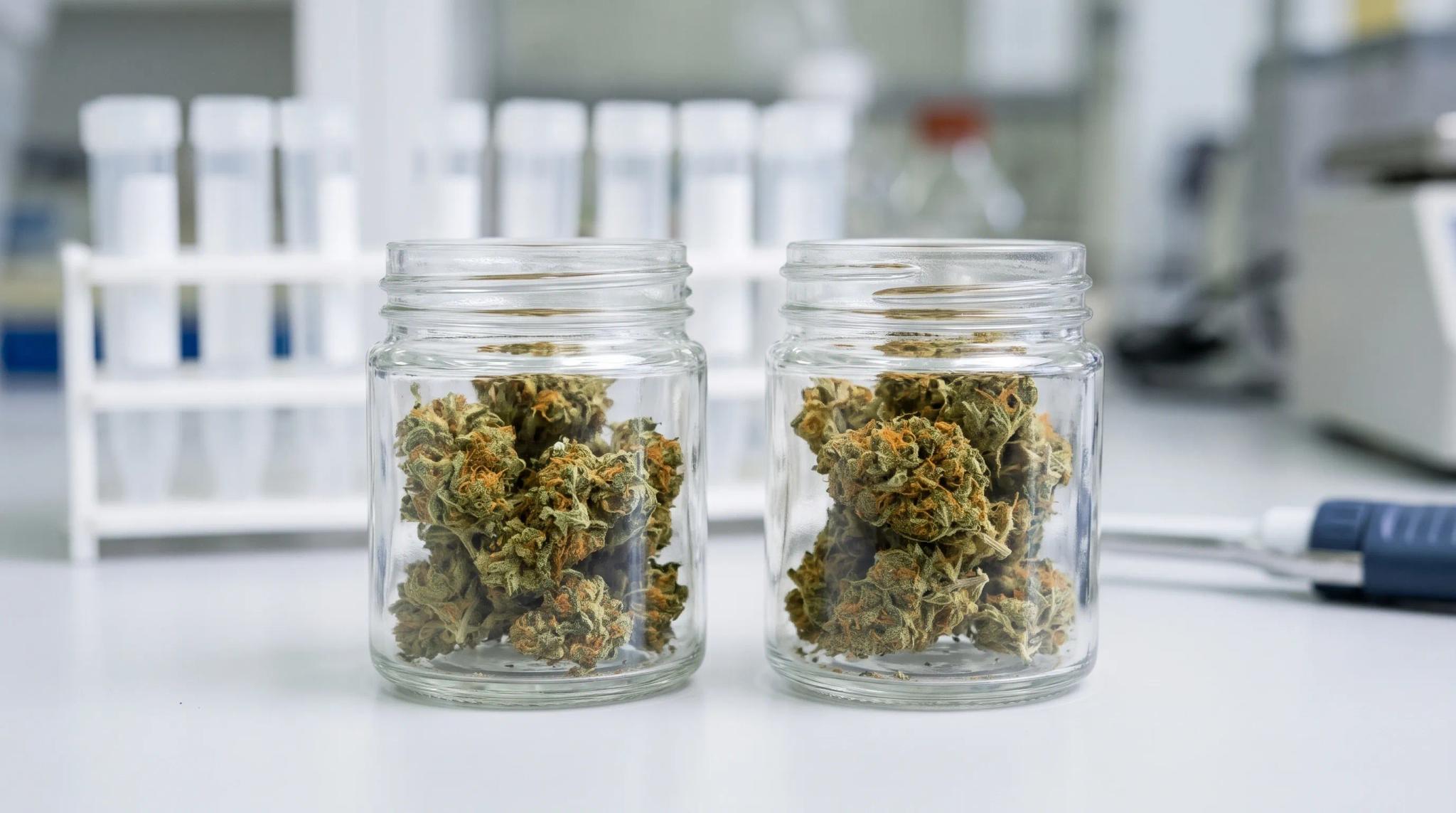
A strain name tells you what a grower, breeder or seller chose to call a plant. Whether two jars with the same name hold the same plant is a separate question, and two research teams have tested it: one by reading the plants' DNA, the other by measuring their chemistry. Both found that products sold under one name often differ. The chemistry study also found that many names are more consistent than random labeling would be. Here is what each study found, and what tells you more than the name.
Where do strain names come from?
In their 2019 paper, Anna Schwabe and Mitchell McGlaughlin wrote that the cannabis industry had no way to verify strains and that cannabis varieties had no legal protections.
Our guide to cannabis origin stories covers how naming habits changed over time, from place names to breeder and marketing names. A famous name does not settle a plant's ancestry either, as our history of OG Kush shows.
What did DNA testing of same-name strains find?

Schwabe and McGlaughlin, of the University of Northern Colorado, published their genetic test of commercial strains in the Journal of Cannabis Research. They collected samples of 30 strains from 20 dispensaries or donors in Colorado, California and Washington, 122 samples in all, and compared them using genetic markers.
Their question was whether samples with the same strain name, obtained from different places, were genetically consistent. Of the 30 strains, only 4 showed the same genetic assignment and mix across every one of their samples. Most strains contained at least one genetic outlier. In many cases the inconsistencies were limited to one or two samples, and the authors concluded that half of the included strains showed relatively stable genetic identity among most samples.
What did the chemistry study find?

The larger study came in 2022, when Christiana Smith, Daniela Vergara, Brian Keegan and Nick Jikomes analyzed the cannabinoid and terpene content of commercial cannabis samples across six US states. Their dataset held 89,923 flower samples with cannabinoid measurements from Alaska, California, Florida, Michigan, Oregon and Washington, and 42,843 of those samples also had terpene data. They found distinct chemical profiles, which they call chemotypes, that are reliably present. They also found that commercial labels do not consistently align with that chemical diversity.
To test strain names, the authors took the 41 names linked to at least five producers, with at least five samples from each producer. They compared the terpene profiles of THC-dominant products that share a name with a version of the data in which the names were shuffled at random. For most names, products with the same name were more alike than in the shuffled data. For some names they were not, and consistency varied widely from name to name.
The paper gives examples. 96% of Purple Punch product averages fell into one cluster, high in caryophyllene and limonene, and 88.5% of Blue Dream products fell into another cluster, high in myrcene and pinene. Only 62.5% of Tangie product averages fell into any single cluster. The authors summed it up this way: many strain names are more consistent from product to product than chance would predict, but they are far from ideal.
What do these studies not cover?
Both studies have limits. The DNA study covered 30 strains collected in three states, so it does not test every strain or every market. The chemistry study's name test used the 41 names that met its threshold, all of them THC-dominant, and it compared terpene profiles rather than genetics.
Both studies measured plant material in a lab. Neither one measured how a product feels to use, and nothing in this article is a claim about effects.
Why can one name cover different plants?
Schwabe and McGlaughlin started from the expectation that samples sharing a strain name should have identical, or at least highly similar, genotypes no matter where they came from. They noted that strains propagated through cloning should have minimal genetic variation, and that eight of the strains they examined were reportedly clone-only. For seed, they cited earlier research that found considerable genetic variation in cannabis grown from seed, suggesting that seed lots are not consistent.
Where samples did not match, they pointed to how plants are handled: errors in plant labeling, misplacement, misspellings, especially on handwritten labels, and relabeling along the entire chain of production. Without verification systems, they wrote, there is the potential for misidentification and mislabeling, for names given to plants of unknown origin, and even for plants renamed or relabeled with prominent names for better sale.
Is a strain name the same as indica or sativa?
No. Indica, sativa and hybrid are a separate labeling system. The 2022 paper notes that the legal industry markets products using labeling systems purported to predict the effects of different strains, and it tested commercial labels against measured chemistry. In the 2019 DNA study, the samples split into two genetic groups, but those groups did not correspond to the commonly reported sativa, hybrid and indica types. The 2022 study concluded that strain names may be a better marker of product chemistry than indica, sativa and hybrid labels, though still far from ideal. Our indica vs sativa guide covers that system in more detail.
What tells you more than the name?
Both studies measured something a name cannot carry: one read DNA, the other measured cannabinoids and terpenes. On a shelf, the closest you can get is the label's measured figures and, where the store can show them, the lab results for that batch.
Our guides to reading a cannabis label, choosing flower and terpenes explain what those numbers mean. Our Jack Herer history works through the same question for one well-known name.
When you shop at one of our stores, use the strain name as a starting point and ask about the measured figures for the batch in front of you.
Sources and further reading
- PLOS ONE, The phytochemical diversity of commercial Cannabis in the United States, Smith, Vergara, Keegan and Jikomes, 2022
- Journal of Cannabis Research, Genetic tools weed out misconceptions of strain reliability in Cannabis sativa: implications for a budding industry, Schwabe and McGlaughlin, 2019


