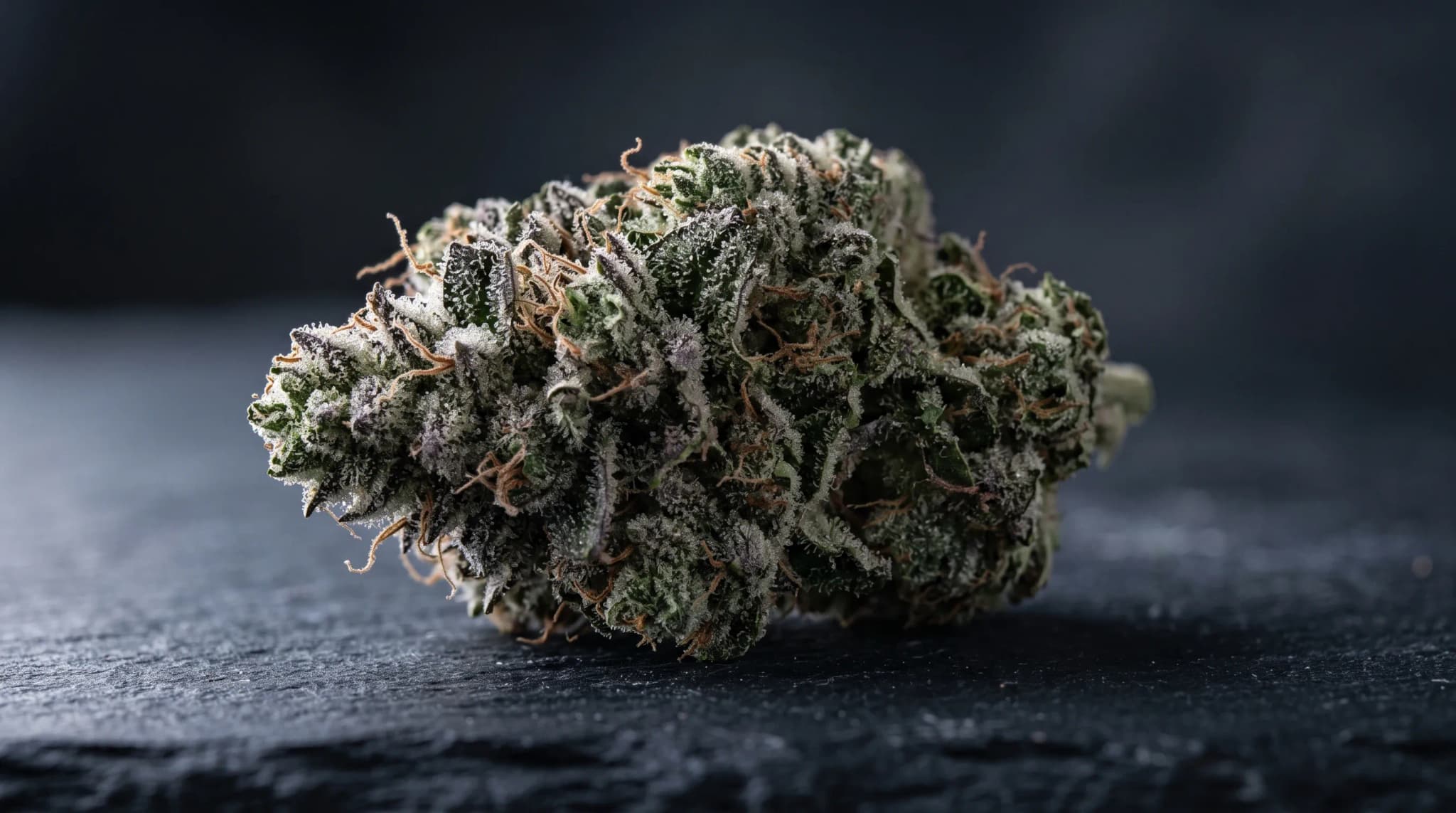
To choose good cannabis flower, look at the buds, smell them if you can, and read the label for the packaging date and the lab results. Don't choose on the THC number alone. Research on retail flower in Colorado has found that printed THC figures often run high, and that how pleasant a flower smells predicts how much people enjoy it better than its THC percentage does.
This guide walks through each of those checks in the order you can make them at the counter, and explains what a California label is required to show and what it leaves out. The sources are linked at the end.
What good cannabis flower looks like
Start with the buds themselves. A few things are worth checking.
- Trichomes. The frosty, sparkling coating on a bud is made of trichomes, tiny resin glands. The stalked glandular trichomes on female flowers are where the plant makes most of its cannabinoids, such as THCA, and the terpenes that give each flower its smell. A visible, intact coat of trichomes is a good sign. Buds that look dull or rubbed bare may have been handled roughly or stored badly. For how growers read trichomes before harvest, see our guide to trichome ripeness.
- Color. Healthy buds are usually green, sometimes with purple or orange tones that depend on the plant. Brown, grey or faded flower is a warning sign.
- Trim. Well-trimmed buds show mostly flower with little leaf. Leafier buds are not necessarily weaker, but you are paying for leaf by weight.
- Seeds. Seeds mean the plant was pollinated, which most growers work to avoid. A seed or two is a quality miss, not a safety problem.
- Mold. Anything fuzzy, webbed or powdery-white that is not trichomes, or a musty, damp smell, is a reason not to buy it, or to contact the store if you already have.

Bud size matters less than people think. Smaller buds, often sold as "smalls" or "popcorn," can come from the same plants as large ones and are often priced lower. For how weight and tier affect what you pay, see how dispensary flower is priced.
Smell tells you more than the THC number
A flower's smell comes from volatile compounds, mostly terpenes, made largely in the same trichomes as the cannabinoids. It may also be the most useful thing you can check.
A 2022 study in the journal Psychoactives analyzed more than 3,000 consumption sessions from volunteer judges at an Oregon cannabis competition, each rating flower samples they had been given. Pleasant aroma was the strongest predictor of how much people enjoyed a flower. Neither its THC potency nor its total terpene content predicted enjoyment. The judges were a self-selected group rating competition entries, so this is not the last word, but it points the same way as everyday experience: if a flower smells good to you, that matters.
If the store has a display sample, ask to see it and smell it. If the flower is only available sealed, ask the budtender to describe its aroma, and use the terpenes listed on the lab report, if there are any, as a rough guide.
What a California label tells you
California's Department of Cannabis Control sets what a flower label must show. On a package of flower, look for:
- Net weight, in both metric and U.S. units.
- Total THC as a percentage. Total THC combines THC, delta-8 THC and THCA, adjusting THCA for the weight it loses when heat turns it into THC. For more on that conversion, see what THCA is and how it becomes THC.
- Any other cannabinoid that makes up 5 percent or more of the cannabinoid content, if the cannabinoid label was applied after lab testing. A label applied before testing only has to show total THC.
- The date of packaging for retail sale, with month, day and year.
- A unique tracking number from the state's track-and-trace system, and the name of the licensed cultivator or packager, with a phone number or website.
Two things are often missing. California does not require a harvest date on flower, so the packaging date is usually the only date you get, and flower can sit for a while between harvest and packaging. And terpenes are not a required part of the label, so many packages list none.
The rules also limit what a label can claim. Flower cannot be labeled "organic," and it can only carry the "OCal" mark if it meets California's own certification standard. A California city or county name can only appear on the label if all of the cannabis was grown there.
For a full walk-through of every panel on a package, see how to read a weed label before you buy.
Why the THC percentage is not a quality score
High THC numbers sell flower, and that creates pressure to inflate them.
A 2023 study in PLOS ONE bought 23 flower products from 10 Colorado dispensaries and had them retested by a single lab. About 70 percent tested more than 15 percent lower than the THC printed on the label, and three had only about half of the highest potency their labels claimed.
California has taken a step aimed at the same problem. Since January 1, 2024, every licensed lab has had to measure the cannabinoids in dried flower, including non-infused pre-rolls, using the same state-set method.
None of that makes the number useless. It is a rough measure of strength, not of quality, and a few points either way say little about how much you will enjoy it. A flower that smells great at 19 percent is often a better buy than one that smells like hay at 30.
The same goes for strain names and the "indica" and "sativa" labels. A 2022 study of commercial flower across six states found that those labels do not consistently match the flower's actual chemistry. Our guide to indica vs sativa vs hybrid covers why.
Moisture and freshness
Flower that is too wet can grow mold. Flower that is too dry crumbles and smokes harsh.
California tests every batch of dried flower for water activity, a measure of how much free water is available for mold to grow, and fails any batch above 0.65. The lab also reports moisture content as a percentage on the certificate of analysis. A batch that passed was dry enough when it was tested. What happens after that depends on how it was stored.

At the counter, good flower should feel springy and slightly sticky. It should break apart with a little resistance, not crush to dust or feel spongy.
Aroma fades as its volatile compounds evaporate, so a recent packaging date is worth more than a premium-sounding name. To keep flower fresh once it is home, see does weed go bad.
Indoor, outdoor and greenhouse
California licenses indoor, outdoor and mixed-light cultivation, which covers greenhouses that use some artificial light. Each can produce excellent flower, and each can produce bad flower. The grow method affects price and often appearance, but it does not decide quality on its own. Judge the flower in front of you rather than the category.
Lab results: what the label does not show
Before flower can be sold in California, every batch has to pass lab testing. The certificate of analysis covers more than potency, including tests for pesticides, microbial contamination, mycotoxins, heavy metals, foreign material, moisture and water activity. If the package has a QR code, it often links to that report. If it does not, ask the store whether it can show you the certificate for that batch. The label guide linked above explains how to read one.
How to choose flower at the counter
- Look first. An intact frosting of trichomes, good color and no seeds, mold or excess leaf.
- Smell it if you can. Pleasant aroma predicts enjoyment better than THC percentage.
- Check the packaging date. It is usually the only date on the jar, and fresher is better.
- Treat the THC number as a rough guide. A few points either way tell you little about quality.
- Don't buy on the strain name. Names and indica-sativa labels are unreliable guides to chemistry.
- Ask for the lab report. Testing covers contaminants and moisture as well as potency.
- Try smaller amounts. An eighth of something new is a cheaper experiment than an ounce.
If you would rather buy flower already rolled, see how to choose a pre-roll.
Sources and further reading
- Labeling requirements: Non-manufactured products in final form — California Department of Cannabis Control, on what a flower label must show and what it may not claim
- Standard cannabinoid test method and operating procedures: FAQs — California Department of Cannabis Control, on the standardized potency method required from January 1, 2024
- Testing laboratories — California Department of Cannabis Control, on required testing and what happens to batches that fail
- Medicinal and Adult Use Cannabis Regulations, July 2026 (PDF) — California Department of Cannabis Control. Section 15717 sets the water activity standard for dried flower
- Uncomfortably high: Testing reveals inflated THC potency on retail Cannabis labels — Schwabe and others, PLOS ONE, 2023
- The phytochemical diversity of commercial Cannabis in the United States — Smith and others, PLOS ONE, 2022
- The Nose Knows: Aroma, but Not THC Mediates the Subjective Effects of Smoked and Vaporized Cannabis Flower — Psychoactives, 2022
- Cannabis glandular trichomes: a cellular metabolite factory — Tanney and others, Frontiers in Plant Science, 2021
- Gene networks underlying cannabinoid and terpenoid accumulation in cannabis — Zager and others, Plant Physiology, 2019, on trichomes as the main site of cannabinoid and terpene production
This article is general information for adults 21 and older and is not medical advice. Labeling and testing rules described here are California's; other states differ. Information is current as of October 2, 2026.


