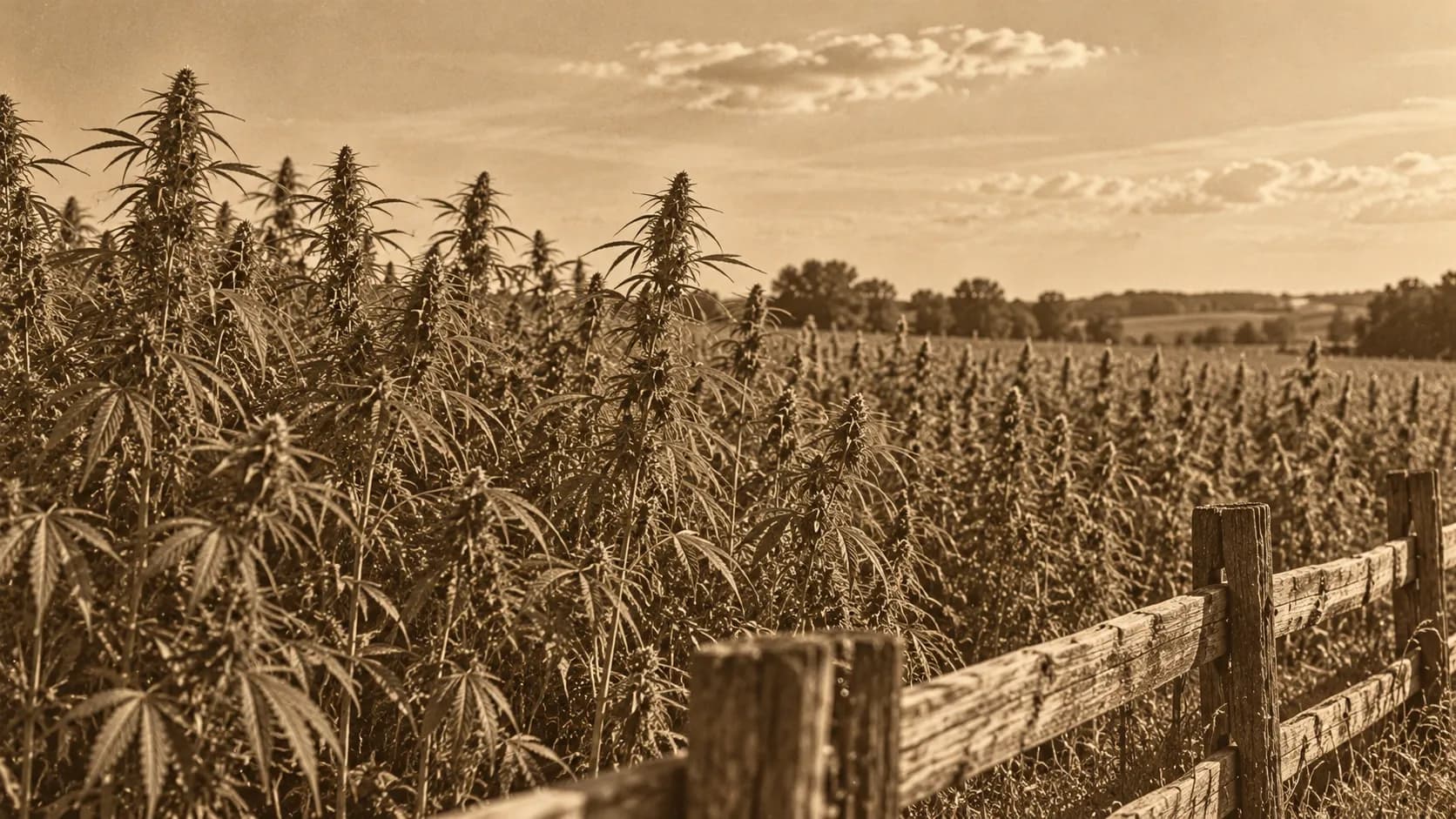
Hemp has had one of the strangest careers of any American crop. Colonial governments told people to plant it. The federal government made a film in 1942 urging farmers to grow it for the war. By 1958, commercial hemp farming in the United States had stopped entirely, and it took until 2014 for federal law to allow it again, for research.
Here's that history, from the records, with a few popular myths taken out along the way.
Colonial hemp: planting by order
Hemp came to the colonies as a working crop, grown for fiber to spin and weave and to make rope.
Some colonial governments pushed it by law. In 1619, Virginia's first General Assembly told householders who had hemp or flax seed to "make trial thereof," meaning plant it and see whether it would grow. In 1640, according to the U.S. Department of Agriculture's Chronological Landmarks in American Agriculture, Connecticut "ordered every family to plant hemp." A USDA report from 2000 says the Puritans brought hemp to New England in 1645 as a fiber for household spinning and weaving.
Hemp even reached Spanish California. The same USDA chronology records that hemp production, subsidized by the Spanish government, began in California in 1795. The subsidy was withdrawn in 1811.
Rope, sails and the Kentucky hemp belt

The crop found its center in the middle of the country. According to the USDA's 2000 report on industrial hemp, hemp reached Kentucky in 1775, where it "grew so well a commercial cordage industry developed." The industry flourished in Kentucky, Missouri and Illinois between 1840 and 1860, driven by the Navy's demand for sailcloth and rope.
It didn't last. The same report says cotton spread across the South and cheaper imported fibers, jute and abaca, eventually displaced most domestic hemp production.
1937: legal, but licensed
The Marihuana Tax Act of 1937 was aimed at marijuana, but it caught hemp too. The USDA report says the act required every hemp grower to register and be licensed with the federal government. The Congressional Research Service describes it as the first federal law to discourage cannabis grown for marijuana while still permitting industrial uses of the plant.
So hemp stayed legal, but growing it now came with federal paperwork. Our history of Reefer Madness covers the 1937 congressional hearing that led to the act.
Hemp for Victory
World War II briefly reversed the decline. The fibers that had replaced American hemp came from overseas, and the war cut off those imports.
The government's answer was an emergency hemp program. According to the USDA report, its Commodity Credit Corporation contracted with War Hemp Industries, Inc., which it calls a quasi-official organization, to produce planting seed and fiber. Production peaked in 1943 and 1944.
To recruit farmers, the USDA made a short film. Hemp for Victory was produced in 1942 to encourage farmers to grow hemp for the war effort, according to the American Institute of the History of Pharmacy's catalog record. That record credits Raymond Evans as director and notes the film pays special attention to hemp farming in Wisconsin and Kentucky. The USDA's National Agricultural Library holds the film in its collection, listed as a 14-minute black-and-white 16 mm print.
After the war: the last harvest
The wartime boom ended with the war. "After the war, production rapidly declined as imports resumed and legal restrictions were reimposed," the USDA report says. A small fiber industry continued in Wisconsin until 1958. The Congressional Research Service reached the same end date, and pointed to three causes: synthetic fibers, the Marihuana Tax Act and anti-drug sentiment. Fewer and fewer acres were planted, and none at all after 1958.
The Controlled Substances Act of 1970 closed the door. Under it, according to the Congressional Research Service, production of all varieties of cannabis became tightly regulated regardless of THC content or intended use. Hemp products sold in the United States had to be imported or made from imported hemp.
2014 and 2018: hemp comes back
Hemp's return began with research. Section 7606 of the Agricultural Act of 2014 let universities and state departments of agriculture grow industrial hemp for research, where state law allowed it, at sites registered with the state. That law defined industrial hemp as cannabis with no more than 0.3% delta-9 THC on a dry weight basis.
The 2018 Farm Bill carried the same threshold forward and took hemp out of the Controlled Substances Act entirely. Our explainer on hemp vs marijuana covers what that definition means. The federal definition is changing again in 2026; our guide to when the federal hemp ban takes effect has the current dates.
Three hemp myths
The Declaration of Independence was written on hemp paper. It wasn't. The signed Declaration was engrossed on parchment, which is made from animal skin, according to Thomas Jefferson's Monticello. Monticello also notes that the paper of Jefferson's rough draft was most likely Dutch, and the Dutch more often made paper from flax or linen rags than hemp.
The founding fathers smoked hemp. Jefferson grew hemp mainly for fiber to make clothing, and Washington grew it too, according to PolitiFact. It found no record of Jefferson ever smoking the plant and rated the claim Mostly False.
Colonists everywhere were forced to grow hemp. Some colonies did push it hard, and Connecticut's 1640 order applied to every family. But Virginia's famous 1619 law applied only to householders who already had seed, requiring them to try planting it, and it named no penalty. The rules varied by colony and by decade.
Sources
- Industrial Hemp in the United States: Status and Market Potential, U.S. Department of Agriculture, Economic Research Service, January 2000
- Chronological Landmarks in American Agriculture, Agriculture Information Bulletin No. 425, U.S. Department of Agriculture, Economic Research Service, revised 1990
- Laws Enacted by the First General Assembly of Virginia, 1619, via Teaching American History
- Hemp as an Agricultural Commodity, Congressional Research Service, RL32725, 2005
- Hemp for Victory, National Agricultural Library Special Collections, U.S. Department of Agriculture
- Hemp for Victory Movie, American Institute of the History of Pharmacy Digital Collection
- Agricultural Act of 2014, Section 7606, U.S. Department of Agriculture, Agricultural Marketing Service
- Declaration of Independence Paper, Thomas Jefferson Foundation (Monticello)
- Fact-check: claims about Thomas Jefferson and marijuana, PolitiFact, March 2019


