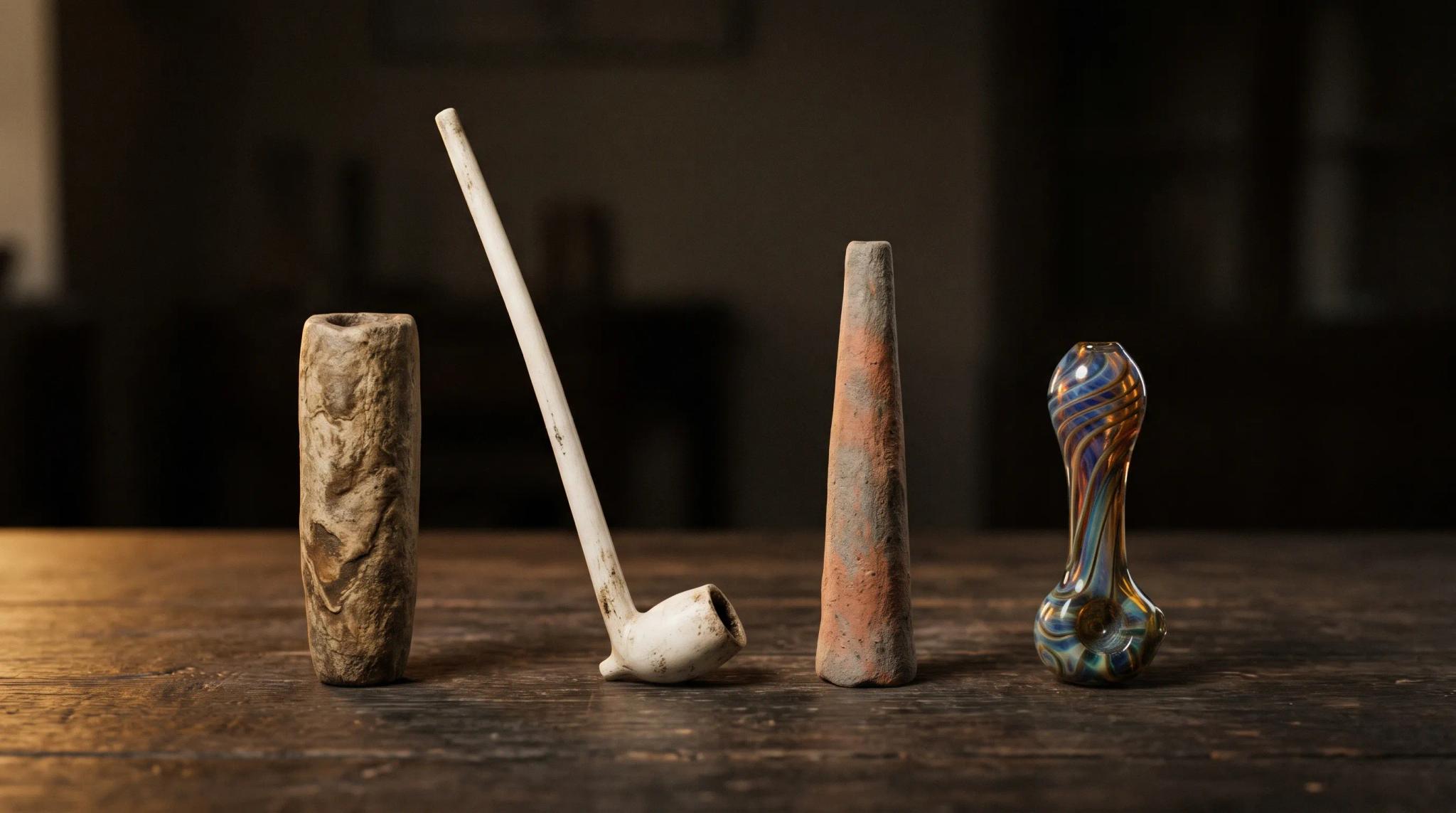
No one person invented the smoking pipe. Pipes are far older than any written record of who made them, and the oldest ones that can be dated come from the Americas, where people smoked tobacco in them thousands of years before Europeans arrived. Europeans picked up the habit in the late 1500s.
This article covers the dry pipe: a bowl and a stem, with no water. The water pipe has its own history, which we tell in who invented the bong?
How old is the smoking pipe?
Older than the evidence for what people smoked in it. In 2018, a team led by Stephen Carmody reported nicotine in a smoking tube from the Flint River site in northern Alabama. The tube dates to the Late Archaic period, 1685 to 1530 BC. Troy University's announcement of the find noted that it was excavated decades earlier at a site that is now underwater, and that smoking pipes have been found at much older sites. What made this one notable was the nicotine: Troy described it as the earliest evidence of tobacco use in North America north of Mexico at the time.
A 2018 study of stone pipes from the Columbia River Basin in Washington State found nicotine in 8 of the 12 pipes and fragments tested, dating from about 1,200 years ago to historic times. The same paper places the earliest pipes found in the mid-Columbia and Snake River region in the Tucannon Phase, between 2500 and 500 BC.
Tobacco itself goes back further still. In 2021, researchers reported evidence of human tobacco use at the Wishbone site, in the desert west of North America, about 12,300 years ago, which they described as 9,000 years earlier than previously documented. That evidence comes from activity around a hearth, not from a pipe, so it dates tobacco use rather than the pipe.
The oldest evidence of people burning cannabis is a separate story, covered in our article on cannabis origin stories.
How the pipe reached Europe

Tobacco smoking reached Britain in the late 16th century, after European explorers encountered it in the Americas, according to the London Museum. Europeans began making clay tobacco pipes in the closing decades of that century. A study of the clay pipe industry published in Internet Archaeology says the birthplace is still debated between England and Holland, with majority opinion favoring London, and that English workshops appear to have been established by the 1590s.
A German visitor, Paul Hentzner, wrote in 1598 that the English were constantly smoking tobacco and that "they have pipes on purpose made of clay."
Pipes for cannabis: the chillum and the sebsi
Some pipe traditions grew up around cannabis rather than tobacco.
The chillum. Collins English Dictionary defines a chillum as a short pipe, usually of clay, used especially for smoking cannabis. Dictionary.com dates the word in English to 1775 to 1785, from the Hindi cilam. The Victoria and Albert Museum says tobacco reached India with the Portuguese in the early 16th century and arrived at the Mughal court in 1604. How far back the chillum itself goes is not well documented, and we could not find a reliably dated origin for it.
The sebsi. In Morocco, kif traditionally meant chopped cannabis mixed with chopped tobacco. A 2017 Transnational Institute briefing on Moroccan cannabis says kif was smoked in a sebsi, a pipe with a small clay or copper bowl. Moroccan kif, a mixture of chopped cannabis and tobacco, is not the same thing as the kief collected from trichomes and sold at dispensaries today.
For the oldest evidence we could verify of cannabis smoked through water, from Ethiopia, see our bong history.
Who invented the glass pipe?

No single person did. Leafly's profile of Bob Snodgrass, the glassblower its headline credits with inventing heady glass, says plainly that he did not invent the glass pipe either.
According to Leafly, Snodgrass first became interested in glass pipes in 1971 and sold his one-of-a-kind pieces to fellow Grateful Dead fans as the band toured the country. His best-known technique, fuming, bonds vaporized silver, gold or platinum to the glass, which makes the pipe change color as it darkens with use. The Corning Museum of Glass traces the pipemaking scene to the parking lots of Grateful Dead concerts, and says glass has been the material of choice for cannabis pipes since the late 1990s.
The scene took a hit in 2003. Leafly reports that a federal sting called Operation Pipe Dreams ended in coordinated raids that saw 55 people arrested over the sale of paraphernalia.
The pipe today
A hand pipe is a bowl, a stem and a mouthpiece, with no water. Our guide to choosing a pipe or bong explains the main types and what to look for in the glass. For using one, see how to pack a bowl, and for keeping it clear, how to clean a glass pipe. The pipe's paper rival has its own story in who invented rolling papers?
Sources and further reading
- Journal of Archaeological Science: Reports, Evidence of tobacco from a Late Archaic smoking tube recovered from the Flint River site in southeastern North America, Carmody, Davis, Tadi, Sharp, Hunt and Russ, 2018
- Troy University, TROY professor helps uncover earliest use of tobacco in U.S., June 15, 2018
- PNAS, Biomolecular archaeology reveals ancient origins of indigenous tobacco smoking in North American Plateau, Tushingham, Snyder, Brownstein, Damitio and Gang, 2018
- Nature Human Behaviour, Earliest evidence for human use of tobacco in the Pleistocene Americas, Duke, Wohlgemuth, Adams, Armstrong-Ingram, Rice and Young, 2021
- London Museum, Clay tobacco pipe, 1640 to 1660
- Internet Archaeology, study of the clay tobacco pipe industry, section on its origins
- Dictionary.com, chillum, citing Collins English Dictionary
- Victoria and Albert Museum, Huqqa mouthpiece
- Transnational Institute, Morocco and Cannabis: Reduction, containment or acceptance, Tom Blickman, March 2017
- The Corning Museum of Glass, Pipe Making, library research guide
- Leafly, Meet Bob Snodgrass, the Hippie Deadhead Who Invented Heady Glass, David Bienenstock, 2019


