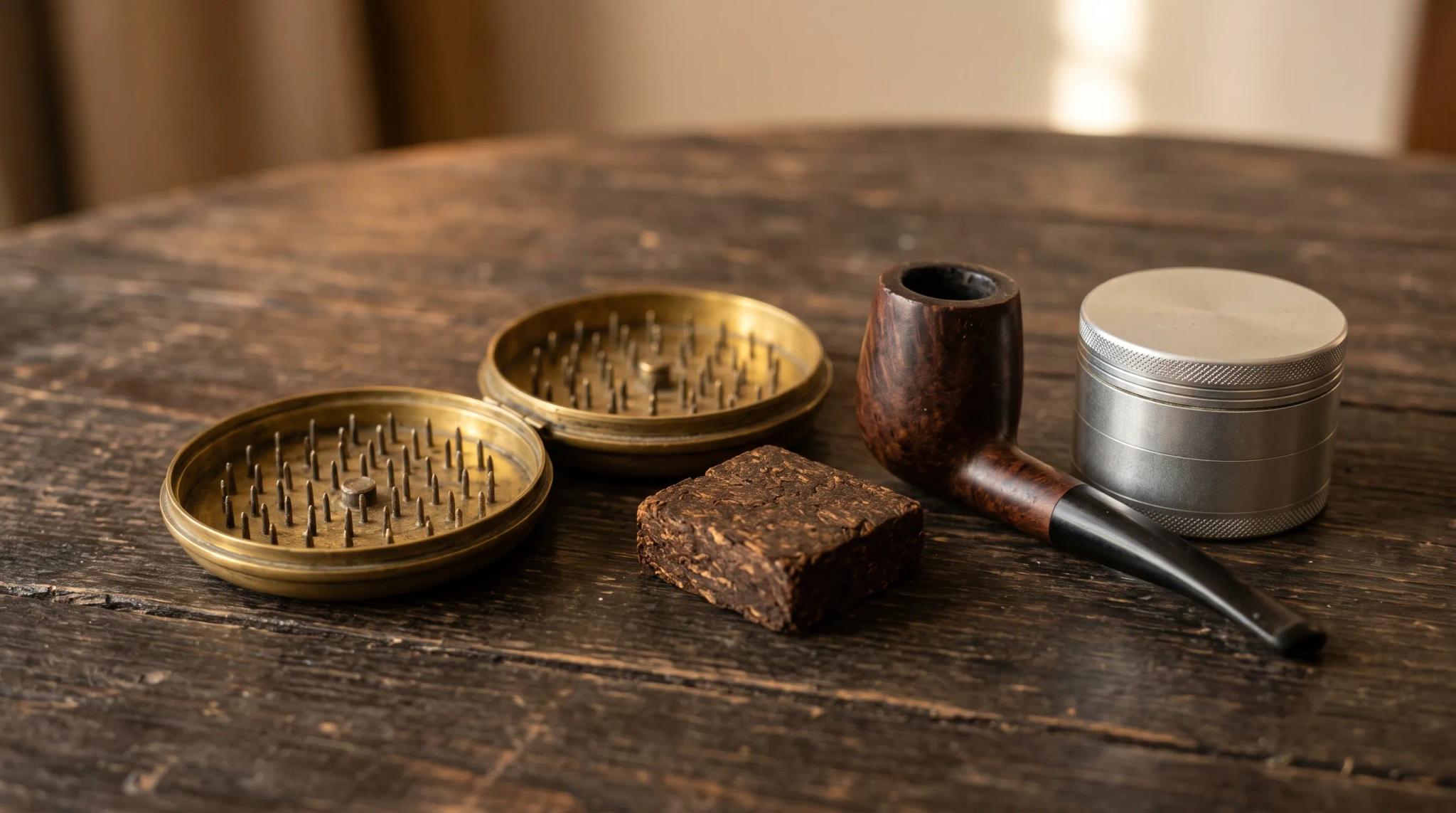
The pocket grinder used on cannabis today was not designed for cannabis. The earliest patent we found that matches its basic design was granted in the United States on July 25, 1905, to two men from Boort, Victoria, Australia: William Henry Wingfield and John Balding. They built it for pipe smokers who needed to break up plug tobacco.
What follows is what that patent describes, what it already had in common with a modern grinder, and what the patent record shows about the changes since.
When was the grinder invented?
The patent, US 795,746, is titled "Case and Device for Holding and Disintegrating Tobacco or Other Substances." Wingfield and Balding filed the application on April 19, 1905, and it was granted three months later.
Its stated purpose was narrow. The device was meant primarily to let a smoker break up plug tobacco for a pipe without using a knife, and to keep the shredded tobacco stored until it was needed. The inventors gave a short reason for why that mattered: "A knife is not always available."
How did the first grinder work?

The device had two members that fitted together. The top member had a set of pins pointing down, and the bottom member had a set of pins pointing up. When the two were closed, the pins interleaved so that neither set blocked the other. Some of the pins had angular edges to help shred the tobacco, and each member had a milled edge to grip.
To use it, you held the lower member with its pins facing up and worked the plug across the pin points with a back-and-forth or circular motion, pressing down as you went. A smaller lump could be impaled on a pin and broken up by turning the top member to and fro while pressing it down. Turning the two members against each other also cleared fragments that had jammed between the pins, and the closed case could be turned upside down while you worked.
Did the first grinder have a catch chamber?
The lower member's base was enclosed by a rim and could have holes in it. A receptacle could be fitted underneath, attached with a bayonet joint or something similar, to collect the shreds that fell through.
That is close to the layout of a modern three-piece grinder: a grinding chamber on top, holes in its floor, and a chamber underneath that holds the ground material. Our guide to choosing a cannabis grinder explains how the two-, three- and four-piece designs differ today.
Who made the first weed grinder?
We could not find a reliable record of when cannabis smokers started using toothed grinders, or who first sold one for cannabis. The histories we found online either skip the decades between 1905 and the modern brands or make claims without sources, so this article sticks to what the patent record shows.
That record shows the tobacco wording lasting a long time. A patent application tied to the Santa Cruz Shredder, filed on June 11, 2012 by Mark E. Edwards, was titled "Tobacco Grinder." It describes a "custom radial angular cutting tooth design" that, in its words, "allows for bidirectional cutting and grinding." The patent that claims priority from it, US 9,392,908, was granted on July 19, 2016, credits Edwards and Nathaniel I. Stewart as inventors, and is titled simply "Herb grinder."
Its background section starts from the point that grinders and shredders were already known for processing dried leaves. It then describes serrated teeth, a screen that limits the size of the ground particles, an optional second, finer screen for collecting fine grounds, and, in one version, a magnet in the base to catch magnetic debris.
When did grinders get kief screens?

A patent granted on January 26, 2016 to Dane Dukat (US 9,241,597, filed in 2014) lays out a four-tier grinder. Its top tiers carry arced cutters. Below them sits a fine mesh pollen screen that, in the patent's words, "filters out the ultra-fine particles, or trichomes, from the rest of the ground up herb," and a fourth tier that acts as a pollen catcher.
We do not know that this was the first four-piece grinder. It is one clear description of the design. What collects in that bottom tier is kief, which our guide to what kief is covers in detail.
The same patent defines the device broadly: an herb grinder is a mechanical device "for pulverizing dried herbs, spices, tobacco, and other dried plants into particulates."
How has the grinder changed since 1905?
Put the 1905 patent next to the modern ones and the core idea is the same: two halves with interleaving teeth, turned against each other, with the ground material falling into a chamber below. The later patents add detail around that core. The Santa Cruz patent focuses on tooth shape and screens, and the Dukat patent adds a separate screen and a catch tier for the finest particles.
What the patents do not tell you is who made the first grinder sold for cannabis, or when the word "weed" got attached to a device built for tobacco. If a source names a single inventor of the cannabis grinder, ask what it is citing.
The histories of other cannabis tools
Our histories of who invented the bong, who invented rolling papers and who invented the vape pen trace the others.
Once the flower is ground, it is ready for a joint or a bowl.
Sources and further reading
- Google Patents, US795746A - Case and device for holding and disintegrating tobacco or other substances., Wingfield and Balding, 1905
- Justia Patents, Tobacco Grinder, US patent application 20130015278, Edwards, 2013
- Google Patents, US9392908B2 - Herb grinder, Edwards and Stewart, 2016
- Google Patents, US9241597B2 - Apparatus for herb grinding and related methods, Dukat, 2016


