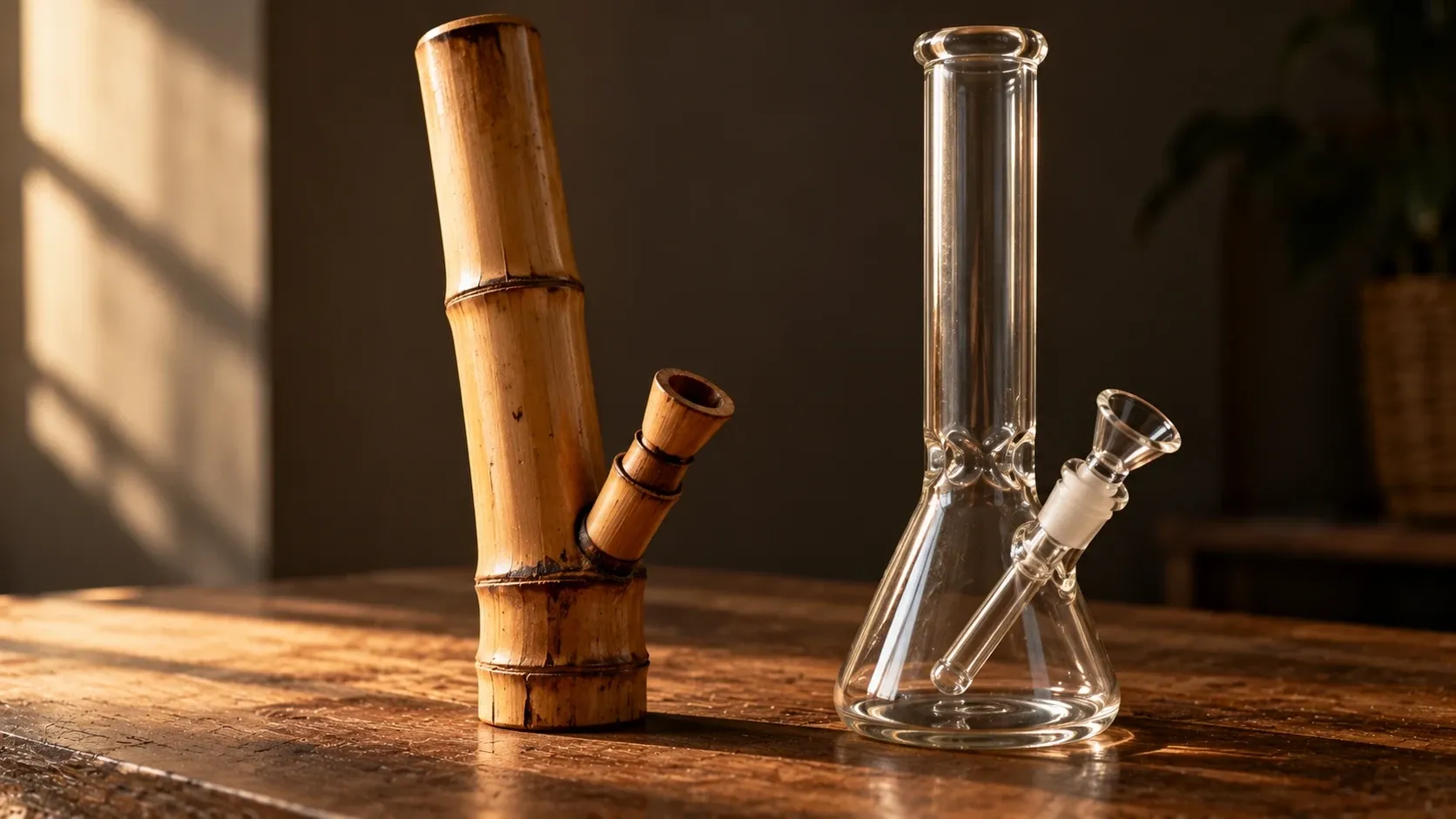
Nobody invented the bong. The device is a water pipe, and people were drawing smoke through water long before anyone called it a bong. The word itself is much younger, and it arrived in American English only in the 1960s or early 1970s.
The short version: the name comes from Thai, the earliest physical evidence we could verify of cannabis smoked in a water pipe comes from Ethiopia and is roughly 500 to 640 years old, and the modern glass bong became the target of a federal crackdown in 2003.
Where does the word "bong" come from?
The word is borrowed from Thai. Merriam-Webster traces bong to the Thai word for a hollow piece of wood or bamboo, and gives 1971 as its first known use in this sense.
The Online Etymology Dictionary dates the slang to the 1960s in the United States. It says the word is "said to be" from the Thai "baung," a cylindrical wooden tube, and "said to have been introduced by Vietnam War veterans." Both sources use hedged wording there, and so should anyone retelling the story: the Thai origin is well attested, but exactly how the word traveled to the United States is not documented.
It is easy to see why bamboo would be the image behind the word. A length of bamboo is already a tube, closed at each joint, and it makes a simple water pipe with almost no work.
Plenty of other cannabis words have their own stories. Our guide to why weed is called weed covers where many of them come from.
How old is the water pipe?
Much older than the word. The earliest physical evidence we could verify of cannabis smoked through water comes from Ethiopia.

Archaeologists excavating Lalibela Cave recovered the remains of two ceramic water pipe bowls. A 1998 review of the physical evidence for ancient cannabis summarizes the find: the bowls were dated to about 500 to 640 years before present, both contained trace amounts of a THC compound, and that was interpreted to mean cannabis containing THC had been smoked in them. The original analysis was published by van der Merwe in 1975.
Africa may hold the longer story. In a 1983 article on African smoking and pipes, John Edward Philips put forward the hypothesis that cannabis was smoked in water pipes in eastern and southern Africa before tobacco arrived, and called for research to prove or disprove it. It remains a hypothesis rather than a settled finding.
What about the Scythian "gold bongs"?
In 2015, headlines described 2,400-year-old gold "bongs" found in Russia. The objects are real and remarkable, but the archaeologists who studied them did not call them bongs.
In a burial mound called Sengileevskoe-2, about 30 miles east of Stavropol in southern Russia, archaeologists led by Andrey Belinski found gold vessels from the Scythians, the nomadic people of the Eurasian steppe. As Archaeology magazine reported in 2016, residue inside tested positive for opium, and experts also identified cannabis particles. Belinski's interpretation is that the opium was drunk, perhaps while cannabis burned nearby. The article never describes the vessels as water pipes.
The best-known ancient account of cannabis use, the Greek historian Herodotus describing Scythians breathing hemp vapor in a covered tent over hot stones, involves no water at all. Our article on cannabis origin stories covers that account and the earliest well-dated evidence of people burning cannabis.
What are bongs made of today?
The bongs on most shop shelves today are glass rather than bamboo or ceramic, and most share the same basic parts: a bowl that holds the flower, a downstem that carries smoke under the water, a water chamber and a neck. Our guide to choosing a pipe or bong explains how those parts work, which glass holds up, and what one lab test found about how much the water actually filters.
The same water-pipe idea carries over to concentrates. A dab rig is essentially a small water pipe built for them.
Why did the government go after bongs in 2003?
Federal law names the bong directly. The drug paraphernalia statute, 21 U.S.C. 863, makes it unlawful to sell drug paraphernalia, ship it through the mail or other interstate commerce, or import or export it, and its list of examples includes both "water pipes" and "bongs." The same statute exempts anyone authorized by local, state or federal law to make, possess or distribute such items, and items traditionally intended for use with tobacco.

In February 2003 federal paraphernalia charges drove a nationwide sweep of glass pipe makers and sellers. The Justice Department's Operation Pipe Dreams and Operation Headhunter led to the indictment of 55 people, NORML reported at the time, with raids on more than 100 homes and businesses.
The best-known defendant was the actor and comedian Tommy Chong, whose glass company and home were both raided. He pleaded guilty to a drug paraphernalia charge, and in September 2003 a federal judge in Pittsburgh sentenced him to nine months in prison and fined him $20,000.
Once you have a bong, keeping it clean matters more than its history. Our guide on how to clean a bong covers that.
Sources
- Merriam-Webster, bong
- Online Etymology Dictionary, bong
- Fleming and Clarke, Physical evidence for the antiquity of Cannabis sativa L., Journal of the International Hemp Association, 1998
- Philips, African Smoking and Pipes, The Journal of African History, 1983
- artnet News, Ancient gold bongs discovered in Russia, 2015
- Andrew Curry, Rites of the Scythians, Archaeology, July/August 2016
- 21 U.S.C. 863, Drug paraphernalia, U.S. Code via GovInfo
- NORML, Justice Department conducts nationwide sweep of glass pipe manufacturers, February 2003
- NORML, Noted actor sentenced to prison on drug paraphernalia charges, September 2003


