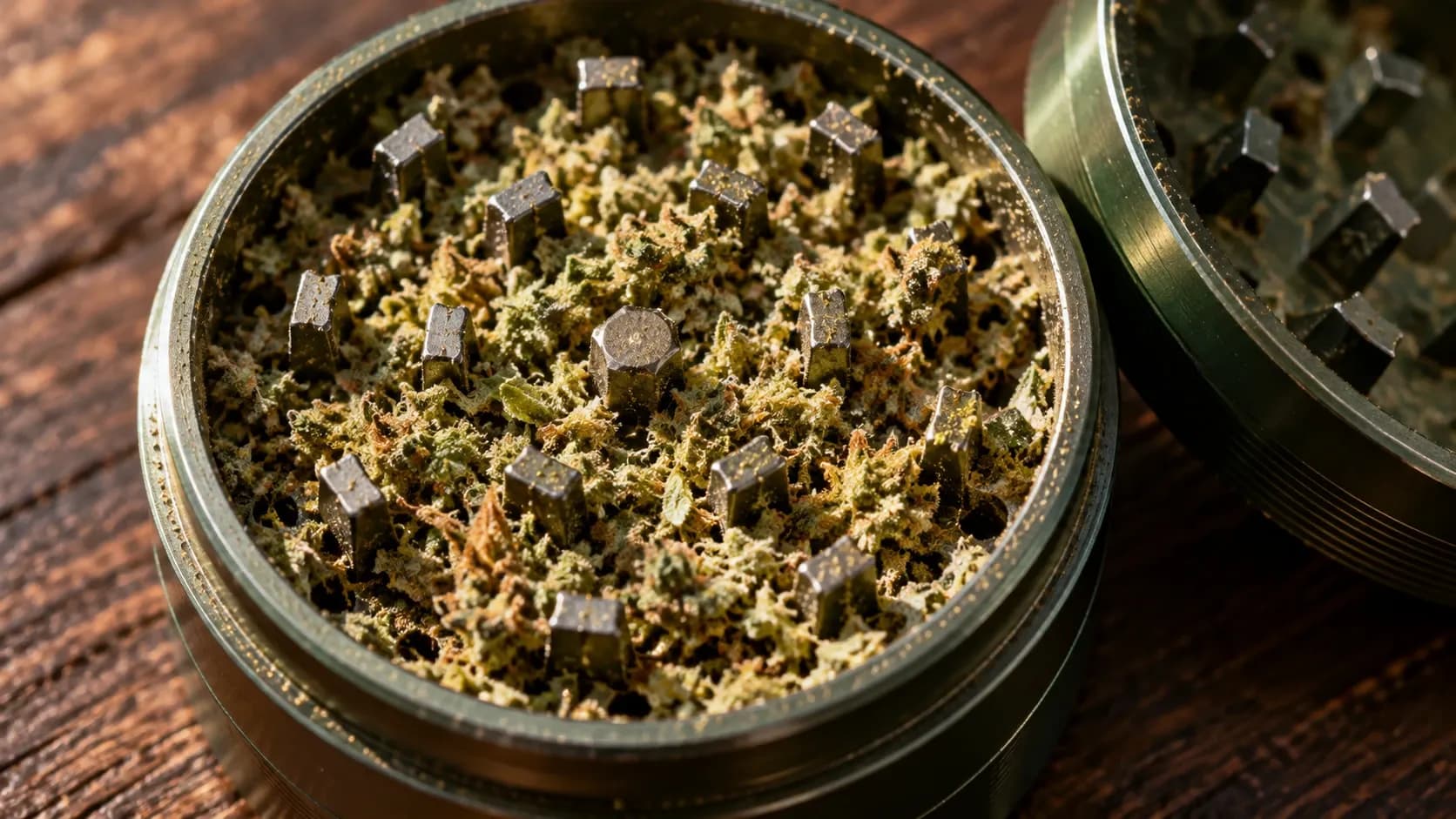
Most grinder shopping happens on feel. You pick up two grinders, one costs four times the other, and nothing on either package explains the difference. Piece count, tooth shape, anodizing, kief screens: the vocabulary is specific, and almost none of it is backed by published measurement.
One part of this has been measured, though, and it is the part that actually reaches you. Grind size changes how much cannabinoid comes off per puff, how much comes out of the joint in total, and how long the joint lasts. Those three things do not move in the same direction, which is the useful finding.
This guide covers what the measurement says, then what separates one grinder from another, and it flags where the evidence runs out.
Grind size: what has actually been measured
A team at Delic Labs in Vancouver ran ground flower through a smoking machine and measured what came out. They sieved flower into 1 mm, 3 mm and 5 mm particle sizes, rolled about 0.5 g of each into 84 mm cones, and smoked 18 joints on a Cambustion Smoke Cycle Simulator, capturing aerosol at the beginning, middle and end of each joint and quantifying it by HPLC.
What they found:
- Finest grind, most per puff, but not in a straight line. The 1 mm grind delivered the most THC per puff at 0.67 mg. The 5 mm grind came second at 0.51 mg, and the 3 mm grind was lowest at 0.31 mg. The authors attribute the 3 mm result to those joints struggling to stay lit in the second half.
- Coarser grind, more in total. The 1 mm and 3 mm joints delivered 16 to 19 mg of THC over the whole joint. The 5 mm joints delivered 28 mg.
- Coarser grind, longer joint. The 1 mm THC joint finished in about 28 puffs. The 3 mm and 5 mm joints took 52 to 54.
- The joint is not uniform. THC delivery ranged roughly tenfold, from 0.09 to 0.88 mg per puff, with the lowest at the beginning and generally the highest near the end.
- Plenty never arrives. The THC joints showed recoveries of 34 to 59 percent, meaning the rest never reached the filter.
The authors' own framing is worth repeating: a coarser grind may suit someone who wants a joint to last, and a finer grind suits fewer, more concentrated puffs. Neither is better.
Read the limits. This ran three replicates per particle size on one THC-dominant and one CBD-dominant flower, and the authors report significant variability between replicates and say the optimal size is probably not one-size-fits-all. It appeared in a trade publication and was presented at a chemistry conference. As far as we found, it has not been peer reviewed. And the flower was prepared with a coffee grinder and sieves, not a hand grinder, so it measures particle size rather than any particular grinder.
The finding that matters most for grinders
The same team's earlier work, which they summarize in that article, points somewhere more interesting. Hand-ground flower gave the most sought-after joint qualities, a smooth smoke and a consistent burn, while flower milled to a single uniform particle size was associated with harsh smoke. Pairing two milled particle sizes in one joint reproduced the hand-ground result, which they attribute to particles of different sizes interlocking inside the joint.

So the target is not the finest possible grind. It is a mixed, medium grind that packs without compacting. That is a reasonable way to judge a grinder: not how fine it can go, but whether it produces a usable spread of particle sizes without turning flower to powder.
For what happens after the grind, see how to choose a pre-roll, which covers how particle size and packing affect burn, and why ground flower does not keep as well as whole bud.
Two-piece, three-piece or four-piece grinders
Grinders are sold as two-piece, three-piece and four-piece, and the count describes what is in the stack.
- Two-piece. A lid and a grinding chamber. Everything stays where you ground it. Fewer parts to clean, nothing to lose.
- Three-piece. Adds a collection chamber beneath a set of holes, so ground flower falls through and the chamber holds it.
- Four-piece. Adds a mesh screen below the collection chamber and a bottom compartment. The screen separates loose trichome heads, the powder usually called kief, which collects underneath.
Whether the fourth chamber is worth it depends entirely on whether you would use what collects there. It fills slowly. If you have never wanted it, a three-piece is simpler and the chamber is one less thing to clean.
Grinder materials: aluminum, steel, glass and acrylic
Grinders are sold in anodized aluminum, stainless steel, wood, acrylic and glass.
Here the evidence thins out. Sellers make firm and directly contradictory claims about whether aluminum grinders shed metal particles. One seller states that a well-made grinder with proper anodization does not shed particles at all, and puts the difference down to material grade, machining precision and the coating. Another seller says loose shavings are most common on a brand new grinder, left behind by machining, and recommends washing it before first use.
We found no independent testing of grinders that would settle this. That is worth stating plainly, because contamination testing does exist for adjacent products: rolling papers have been tested by a commercial lab and in a peer-reviewed study, as covered in how to choose rolling papers. Grinders have not, as far as we can find. Studies that measured metals in vape hardware are about heated components in contact with liquid and do not transfer here.
What that leaves is practical rather than scientific. Inspect a new grinder before you use it, wash it, and look at what comes out. Visible metallic flecks in ground flower are visible for a reason, and a grinder producing them is one to stop using. Acrylic is the one material sellers broadly agree is the weakest, being softer and easier to damage than metal or glass.
Glass is inert and non-porous, which is why it is used for tips as well. That property is described in what a joint crutch actually does, and it applies to a glass grinder for the same reason.
Teeth, screens and the parts that wear out
Tooth shape gets a lot of marketing language, with diamond, triangular and pin shapes all claimed to cut rather than tear. We found no measurements comparing them. What can be judged in the shop is simpler: teeth should be evenly spaced and aligned, the lid should turn without grinding metal on metal, and magnets should hold the lid closed squarely rather than letting it rock.

Screens are mesh, and finer mesh passes less. A torn or stretched screen lets material through that should have stayed above it, which is the most common way a four-piece stops working as intended.
Threading is the other wear point. Cross-threading a lid is easy on cheap grinders and effectively ends their life, so check that the lid starts smoothly by hand.
How to use that when you shop
- Pick for how you smoke, not for fineness. Longer joint and more total delivery points coarser. Fewer, stronger puffs points finer.
- Aim for a mixed, medium grind. Flower milled to one uniform size was associated with harsh smoke; a mix of sizes was not.
- Choose piece count honestly. A kief chamber you never empty is a chamber you clean for nothing.
- Judge what you can actually check. Alignment, smooth threading, an intact screen, and no loose flecks. Those are inspectable. Tooth geometry claims are not.
- Ask what is in stock. Availability varies by store, and staff can show you how a grinder turns before you buy.
Where to find grinders
Each location's accessories page lists grinders among what the store carries. What is actually on the shelf changes, so ask staff what is in stock. Visit us in Fresno, Canoga Park, Orcutt, La Mesa or Chicago.
Sources and further reading
- Does Size Matter for Performance? A Study of How Particle Size Influences Joint Smoking — Sun, Plommer, Shah and Roggen, DELIC Labs, in Cannabis Science and Technology, April 2023. The per-puff, total-delivery and puff-count figures above
- Science Reveals How to Roll the Perfect Joint — Scientific American's coverage of the same work
- Are Aluminum Grinders Safe? — a seller's position that properly anodized aluminum does not shed particles
- Are Aluminum Grinders Safe? Myths Debunked — a retailer's contrasting account of machining shavings on new grinders
This article is for general information for adults 21 and older and is not medical advice. Product availability varies by location; ask staff what is in stock. Information is current as of September 23, 2026.


