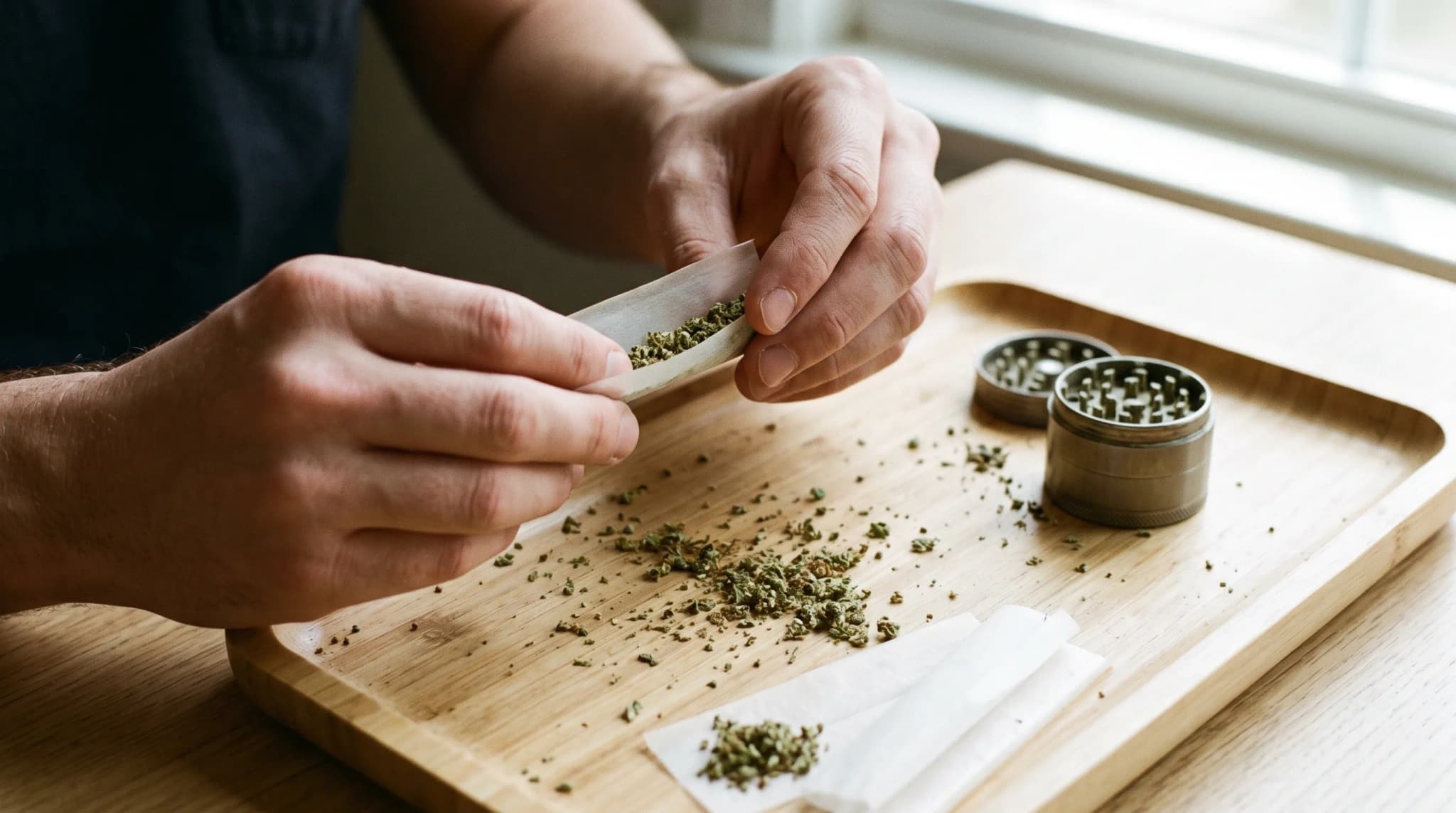
To roll a joint, grind your flower evenly, fold a small crutch for the mouth end, spread the flower along a rolling paper, shape it into a cylinder, tuck the near edge of the paper around it, roll it up and seal it on the gum strip. Then pack the end and twist it closed.
That's the whole process. The details that make a joint burn evenly are an even grind, an even fill and a firm tuck. This guide covers what you need, each step in order, how fine to grind according to a lab study, and how to fix the most common problems. The sources are linked at the end.
What you need to roll a joint
- Flower. Fresh flower that is springy rather than crumbly rolls more easily. Our guide to choosing cannabis flower covers what to look for.
- A grinder. You can break flower apart by hand, but a grinder gives you a more even grind, and an even grind burns more evenly. See how to choose a cannabis grinder.
- Rolling papers. Many beginners find a wider paper, such as a 1 1/4, easier to handle than a narrow single wide. Size names vary between brands, so our guide to choosing rolling papers lists the typical measurements.
- A crutch or tip. A strip of thin card, or a glass tip. It is not a filter, but it holds the mouth end open and keeps bits of flower out of your mouth. See what a joint crutch actually does.
- Something to pack with. A pen, a chopstick or the poker that comes with many cones.
A rolling tray is optional, but it catches what you spill.
How to roll a joint, step by step
1. Grind the flower. Aim for an even, fluffy grind with no large chunks or stems. Stems can poke through the paper.
2. Make the crutch. Fold a few small accordion pleats at one end of a strip of card, then roll the rest of the strip around the pleats. Its thickness sets the width of the mouth end, so make it about as thick as you want the joint to be.
3. Set up the paper. Hold the paper with the gum strip along the top edge, sticky side facing you, and crease it lengthwise down the middle to make a trough. Put the crutch at one end.
4. Fill it. Spread the ground flower evenly along the crease. Put a little more flower toward the far end if you want a cone shape.
5. Shape it. Pinch the paper between your thumbs and forefingers and roll it back and forth, so the flower packs into an even cylinder. This step decides how evenly the joint will burn, so take your time.
6. Tuck and roll. Tuck the bottom edge of the paper, the one without the gum, around the flower and under it, starting at the crutch end, where the crutch gives you something firm to tuck against. Then roll upward until only the gum strip is showing.
7. Seal it. Lightly moisten the gum strip and press it down along its length. Use as little moisture as you can. A soggy seam can come apart or burn unevenly.
8. Pack and twist. Tap the crutch end on the table, and press the open end gently with your pen or poker to settle the flower. Top it up if it looks loose, then twist the paper closed.

If it's your first time, practice with an empty paper, or a little flower, before you roll one you plan to smoke.
How fine to grind for a joint

A 2023 lab study looked directly at grind size. Researchers at DELIC Labs in Vancouver separated ground flower into 1, 3 and 5 mm pieces, filled pre-rolled cones of about half a gram with each, and smoked them on a smoke-cycle machine. Their results, published in Cannabis Science and Technology, showed a trade-off:
- Fine grind, stronger puffs. The 1 mm joints delivered the most THC per puff, about 0.67 mg. But they burned fast, finishing in about 28 puffs, while the 3 and 5 mm joints took 52 to 54.
- Coarse grind, more in total. The 5 mm joints burned more slowly and delivered about 28 mg of THC across the whole joint, compared with 16 to 19 mg for the finer grinds.
- Much of it never arrives. Only 34 to 59 percent of the THC in the THC-dominant joints was collected from the smoke.
The study had limits. It used a machine rather than people, tested one THC-dominant and one CBD-dominant flower, and used three joints per size. It also didn't test hand-rolled joints.
For hand rolling, the practical takeaway is that an even grind matters more than chasing a particular size. A very fine grind burns faster, and large chunks make a joint lumpy and harder to roll. Our grinder guide covers the study in more detail.
Fixing common joint problems
It's burning down one side (running or canoeing). This usually comes from an uneven fill. One side has more air or less flower, so it burns ahead. Briefly touch your flame to the side that's lagging so it catches up, and roll a more even cylinder next time.
It won't draw. It's packed too tight, or a stem or chunk is blocking it. Gently roll the joint between your fingers to loosen it. Next time, shape it more loosely before you tuck.
It's too loose and burns too fast. There's not enough flower, or the tuck was loose. Pack it down from the open end and add a little more flower before you twist it closed.
The paper won't stay sealed. The gum was too wet or too dry. Moisten it lightly, press along the full length, and hold it for a moment.
It keeps going out. That can mean the joint is packed unevenly. It can also mean the flower is damp. Relight it, and give it a few puffs to get going.
Which rolling papers to avoid
Plain, undyed papers are the simple choice. A 2024 study of rolling papers in ACS Omega found that several manufacturers appear to use copper-based pigments. It estimated that regular use of those papers could lead to copper exposures several times the maximum limits the authors used for comparison. Colored, printed and metallic-effect papers and tips are the ones to skip. Our rolling papers guide covers the testing in detail.
Rolling a joint vs using a cone or a pre-roll
If rolling is a struggle, a pre-rolled cone gets you most of the way. You fill it with ground flower, pack it with a poker, and twist it closed. It's how the grind-size study filled its joints.
If you'd rather skip the work, a pre-roll from a licensed dispensary is already rolled, and California requires its contents to be lab-tested. See how to choose a pre-roll for the difference between whole-flower and trim fills, and the sizes.
Before you light it
Adults 21 and older can smoke cannabis in California, but not everywhere. State law bans smoking it in public places, apart from licensed lounges where a city or county allows them, and anywhere tobacco smoking is banned. See where you can smoke weed in California before you light up. Keep your lighter away from the tray, and don't leave a lit joint unattended.
Sources and further reading
- Does Size Matter for Performance? A Study of How Particle Size Influences Joint Smoking — Sun, Plommer, Shah and Roggen, DELIC Labs, Cannabis Science and Technology, April 2023
- Elemental Composition of Commercially Available Cannabis Rolling Papers — Wright and others, ACS Omega, 2024
This article is general information for adults 21 and older and is not medical advice. Information is current as of October 9, 2026.


