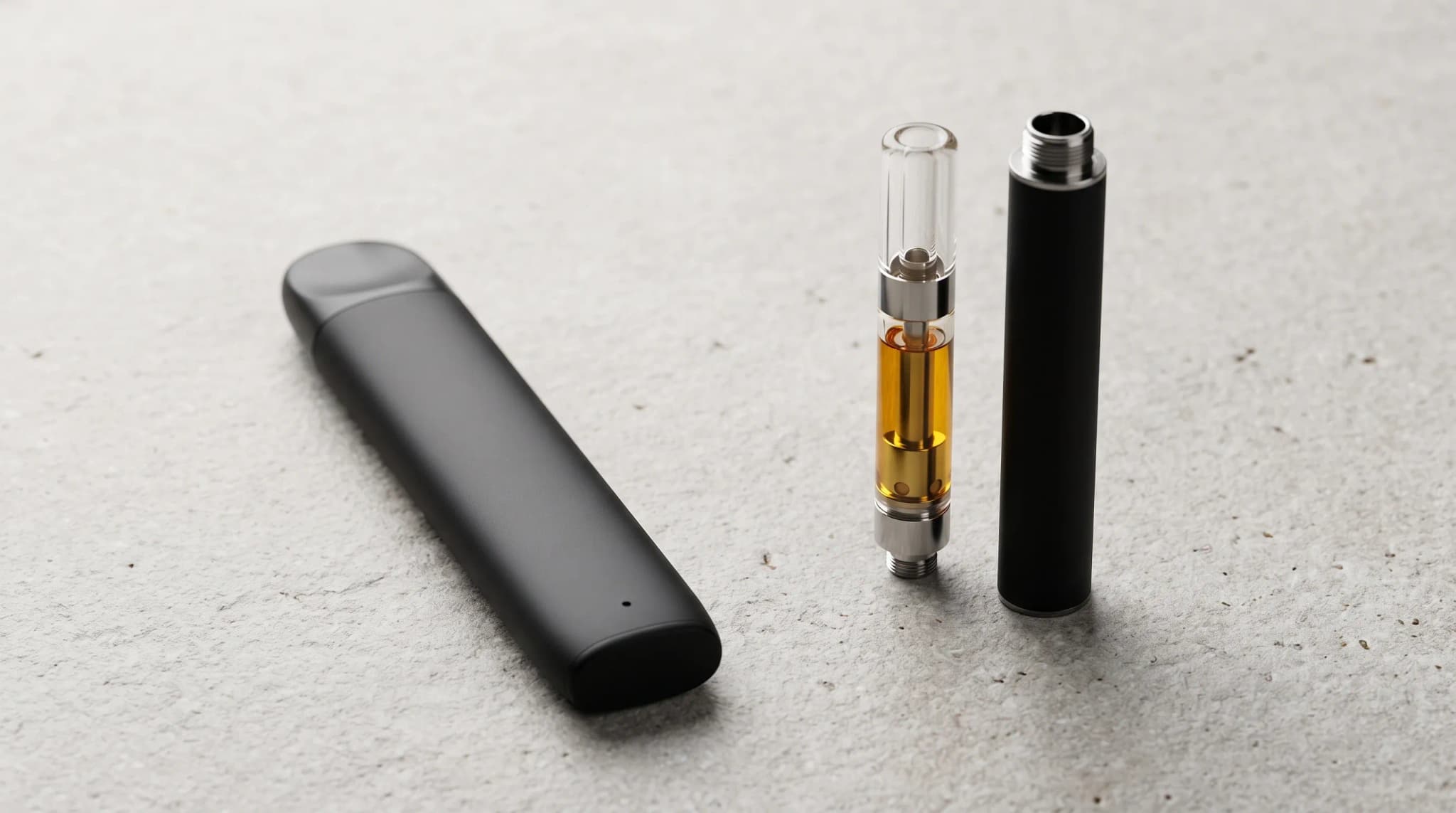
An all-in-one vape is a sealed unit with the battery and the oil built in. A cartridge holds only the oil and screws onto a separate, reusable battery. An all-in-one is simpler, with nothing to match or set up. A cartridge setup costs more to start, because you buy the battery once, but after that you only replace the cartridge, and you can choose from more products and battery settings.
Many people call all-in-ones "disposable vapes," but in California they are not disposable, and neither are cartridges. State law treats an empty one as hazardous waste, and California's new vape ban, signed in 2026, does not cover cannabis vapes at all. This guide explains both, then walks through how to choose. The sources are linked at the end.
All-in-one vs cartridge: what each one is
An all-in-one vape is one sealed device: a battery, a heating element and a tank of cannabis oil. California's cannabis law calls it an "integrated cannabis vaporizer." You use it until the oil runs out. Many have a charging port so the battery outlasts the oil, but you cannot refill it.
A cartridge is a small tank of oil with its own heating element, sold without a battery. Most screw onto a standard 510-thread battery, which you buy separately and keep. When a cartridge is empty, you replace it and keep the battery. For what "510 thread" means and how battery settings work, see our guide to choosing a vape battery.
Some brands also sell pods, which click into a battery made for that brand only. They work like cartridges, but they only fit their own battery.
Why California says they aren't disposable

Since July 1, 2024, California law, through Assembly Bill 1894, has barred the packaging, labeling, advertising and marketing of cannabis cartridges and integrated cannabis vaporizers from saying or implying that they are disposable, or that they can go in the trash or the recycling.
The same law requires advertising and marketing for these products to carry a disposal statement. For an all-in-one, it reads:
"An empty integrated cannabis vaporizer shall be properly disposed of as hazardous waste at a household hazardous waste collection facility or other approved facility."
For a cartridge:
"A spent cannabis cartridge shall be properly disposed of as hazardous waste at a household hazardous waste collection facility or other approved facility."
For all-in-ones, the battery is a large part of the problem. Their batteries can't easily be removed, and California's hazardous waste law already bars putting batteries in the trash or in household recycling bins. Lithium-ion batteries in the waste stream can start fires at trash trucks, landfills and recycling centers.
Does California's 2026 disposable vape ban cover cannabis?
No. In September 2026, Governor Newsom signed Assembly Bill 762, which bans single-use vapes that contain a tobacco product. It stops the import and manufacture of those devices for sale in the state from January 1, 2027, and their sale from January 1, 2028.
The final law defines the banned devices as ones that contain a tobacco product, "but not cannabis or a cannabis product." Earlier versions of the bill would have covered cannabis vapes too, and some news coverage of the new law hasn't made the distinction. As signed, the ban doesn't apply to cannabis all-in-ones or cartridges sold in licensed dispensaries. The disposal rules above still do.
The oil matters more than the format

An all-in-one and a cartridge can hold the same kinds of oil, and the oil decides much of what you'll taste and feel. Whether it is distillate, live resin or another extract, and what it was tested for, matters at least as much as whether the battery is built in.
Either way, buy from a licensed store. Licensed products in California have to pass lab testing before they can be sold. Our guide to choosing a vape cartridge covers oil types, hardware, how to read the lab report and why the 2019 vaping outbreak makes the licensed market matter, and all of it applies to all-in-ones too. For how to check that a store is licensed, see how to tell if a California dispensary is licensed.
How much THC one vape can hold
A vape's oil is cannabis concentrate under California's rules, and the state caps THC per package. A concentrate sold for adult use can contain no more than 1,000 milligrams of THC per package. A product labeled "For Medical Use Only" can contain up to 2,000 milligrams, and can only be sold to medicinal patients.
That cap applies to cartridges and all-in-ones alike, whatever their size. A larger device does not automatically mean more THC.
Vapes also count toward your daily purchase limit as concentrate, not as flower. For how that adds up, see how much weed you can buy in California.
Which should you buy?
An all-in-one makes sense if you:
- Want the simplest option, with nothing to match, screw on or set up.
- Vape occasionally, or want to try a product before committing to a battery.
- Want to carry one small device rather than a battery and spare cartridges.
A cartridge makes sense if you:
- Vape regularly, since you keep the battery and replace only the cartridge.
- Want to choose your own battery, including its heat settings and size.
- Like switching between products, since one battery runs any compatible cartridge.
Either way, plan for disposal. An empty all-in-one still contains its battery. With a cartridge setup, it is only the empty cartridge that goes, and the battery keeps working.
How to dispose of a vape pen in California
Don't put an empty all-in-one or cartridge in the trash or the recycling. Take it to your city or county's household hazardous waste program, or another approved facility. Your local waste or public works department can tell you where that is.
If a battery is swollen, damaged or hot, stop using it and keep it away from anything flammable until you can drop it off.
Sources and further reading
- AB 762, disposable, battery-embedded vapor inhalation devices (bill text) — California Legislature, Chapter 717, Statutes of 2026
- AB 762 committee analysis (PDF) — Assembly Committee on Environmental Safety and Toxic Materials, on battery disposal rules and fire risks
- 2022 signed and vetoed legislation — California Department of Cannabis Control, summarizing AB 1894's disposal and labeling requirements
- Medicinal and Adult Use Cannabis Regulations, July 2026 (PDF) — California Department of Cannabis Control. Section 15000 defines cannabis concentrate, section 15409 sets daily limits, and section 17304 sets THC limits per package
This article is general information for adults 21 and older and is not legal or medical advice. Information is current as of October 5, 2026.


