California has had legal adult-use cannabis since 2016, and it still has a bigger unlicensed market than a licensed one. That is not a moral point about who you buy from. It is a practical one, because an unlicensed shop can look exactly like a licensed shop from the sidewalk — same signage, same glass cases, same staff in branded shirts — and the difference only shows up in what is actually in the jar.
Checking takes about thirty seconds. Here is how.
How big the problem actually is
The numbers are worse than most people assume. According to the state's 2024 cannabis market report, licensed growers in California produced about 1.4 million pounds of cannabis in 2024. Unlicensed operations produced an estimated 11.4 million pounds — roughly eight times as much. Much of that illicit supply ships out of state, but Californians consumed around 3.8 million pounds that year, which means about 40% of what people in this state actually smoke, eat and vape now comes through the legal market — up from roughly a third in 2019, but still a minority.
Part of the reason is geography. Roughly 56% of California cities and counties still ban cannabis retail entirely, so in much of the state there is no licensed shop to walk into even if you want one.
Enforcement is real but it is playing catch-up. The Governor's Unified Cannabis Enforcement Task Force reports seizing more than 841,000 pounds of illegal cannabis to date, with an estimated value of $1.3 billion, across more than 750 search warrants — figures the department last reviewed at the end of 2025.
Why licensing is the thing that matters
A license is not paperwork for its own sake. It is the mechanism that forces everything else.
Licensed cannabis in California has to be lab tested by an independent, licensed testing lab before it can be sold. That testing screens for pesticides, heavy metals, residual solvents left over from extraction, mold and microbial contamination, and it verifies that the THC number on the label is close to the THC actually in the product. We've written separately on how cannabis lab testing works and what the certificate of analysis actually tells you.
Unlicensed product goes through none of that. There is no requirement, no lab, and no recall mechanism if something goes wrong. You are trusting the seller, and the seller has already demonstrated a willingness to skip the rules.
The single clearest illustration came during the 2019 vaping injury outbreak. Of the California patients interviewed who had used THC vape products, about three-quarters — 65 of 87 — had obtained them from informal sources rather than licensed retailers. That episode is years old now, but the underlying structure has not changed: untested supply chains fail in ways nobody catches until people are already hurt.
The license number and the QR code
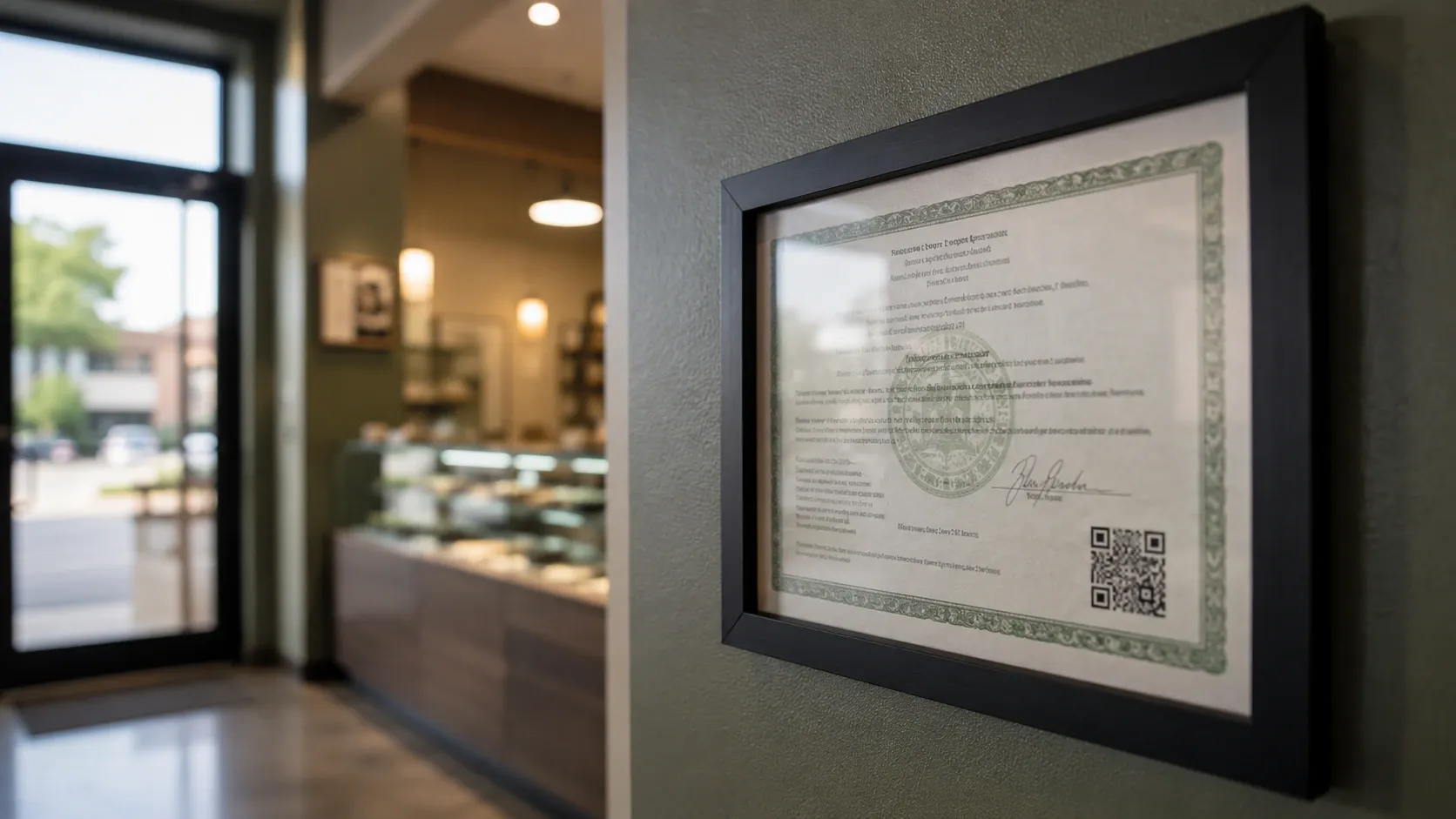
Every licensed cannabis retailer in California is issued a state license certificate, and it carries a QR code. Scan it with any phone camera and it resolves to the state's license record for that business.
The certificate should be posted where you can see it. A shop that will not show you its license certificate when asked has told you what you needed to know.
The license number itself follows a readable format. Retail storefront licenses are Type 10 and begin with `C10`; delivery-only retail licenses are Type 9 and begin with `C9`. An issued license number looks something like `C10-0000111-LIC`. If a shop shows you a number starting with something else, it may hold a license for a different activity entirely, like distribution or cultivation, which does not authorize selling to you.
Look it up yourself
Do not rely on the certificate alone. Certificates can be expired, borrowed, or fake. The authoritative source is the state's own database.
The Department of Cannabis Control runs a public license search tool that is updated daily and covers every business it licenses. You can search by business name, by address, or by license number. Searching by address is the most useful check, because it confirms that the license belongs to the storefront you are actually standing in front of, not to some other location the operator controls.

The DCC's guide to the tool explains what each field means.
Read the status field carefully
This is the part almost nobody explains, and it is where a shop can be technically findable in the database and still not be allowed to sell you anything.
Active means the license is valid and the business may legally do what the license permits at the listed address. This is the one you want.
About to Expire means the license is still active but falls within 60 days of its expiration date. Still legal.
Expired – Pending Renewal means the license lapsed within the last 30 days and can still be renewed with a late fee. The business cannot legally conduct commercial cannabis activity in this state.
Expired means the license lapsed and was not renewed. No commercial cannabis activity is permitted.
So "I found them in the database" is not the same answer as "they are licensed." Read the status, and check the address on the record matches the address you are at. Other statuses appear too — a surrendered license, for instance, means the business gave it up. Anything that does not read Active deserves a second look.
Signals that are not signals
A few things people treat as red flags that are not:
Cash only. Licensed dispensaries are frequently cash-preferred or cash-only, because federal banking restrictions still limit card processing for cannabis businesses. This has nothing to do with licensing status — it is the same reason Chicago dispensaries run on cash in a completely separate legal market.
No storefront. Licensed delivery-only retailers are legitimate. They hold a different license class, and they show up in the same database.
Low prices. Licensed retailers do run genuine discounts, and California's legal market has been in a price war for years. Cheap is not proof of anything by itself, though a price far below every licensed shop in the area is worth a second thought given the tax load legal retailers carry.
Things that are worth attention: operating outside the legal hours window, which state law sets at 6:00 a.m. to 10:00 p.m. with cities free to restrict further; not checking ID at the door, which licensed retailers are required to do for every customer; and products in packaging with no license information, no testing data, and no child-resistant features. If you are not sure what a compliant label looks like, reading a cannabis product label is a skill worth ten minutes.
Hemp products changed in January 2026
One category deserves its own note. As of January 1, 2026, California prohibits the sale of intoxicating hemp-derived products — delta-8, THCA flower, smokable hemp — through unlicensed retail channels. If you are buying an intoxicating hemp product from a smoke shop, gas station or convenience store in California, that sale is no longer permitted regardless of how the product is labeled.
This is worth understanding alongside the broader distinction between hemp and marijuana as legal categories, which is shifting at the federal level too.
What to do if a shop is not licensed
Leave, first. Beyond that, the DCC accepts complaints about both licensed and unlicensed cannabis businesses, and they can be filed anonymously. You do not need to identify yourself or explain why you were there.
Buying licensed in California
Our California locations in Fresno, Orcutt and Canoga Park are all state-licensed retailers, and the license certificate is posted in each store. You are welcome to scan it. Anyone selling cannabis legally in this state should be fine with you checking, and the ones who are not are telling you something.


