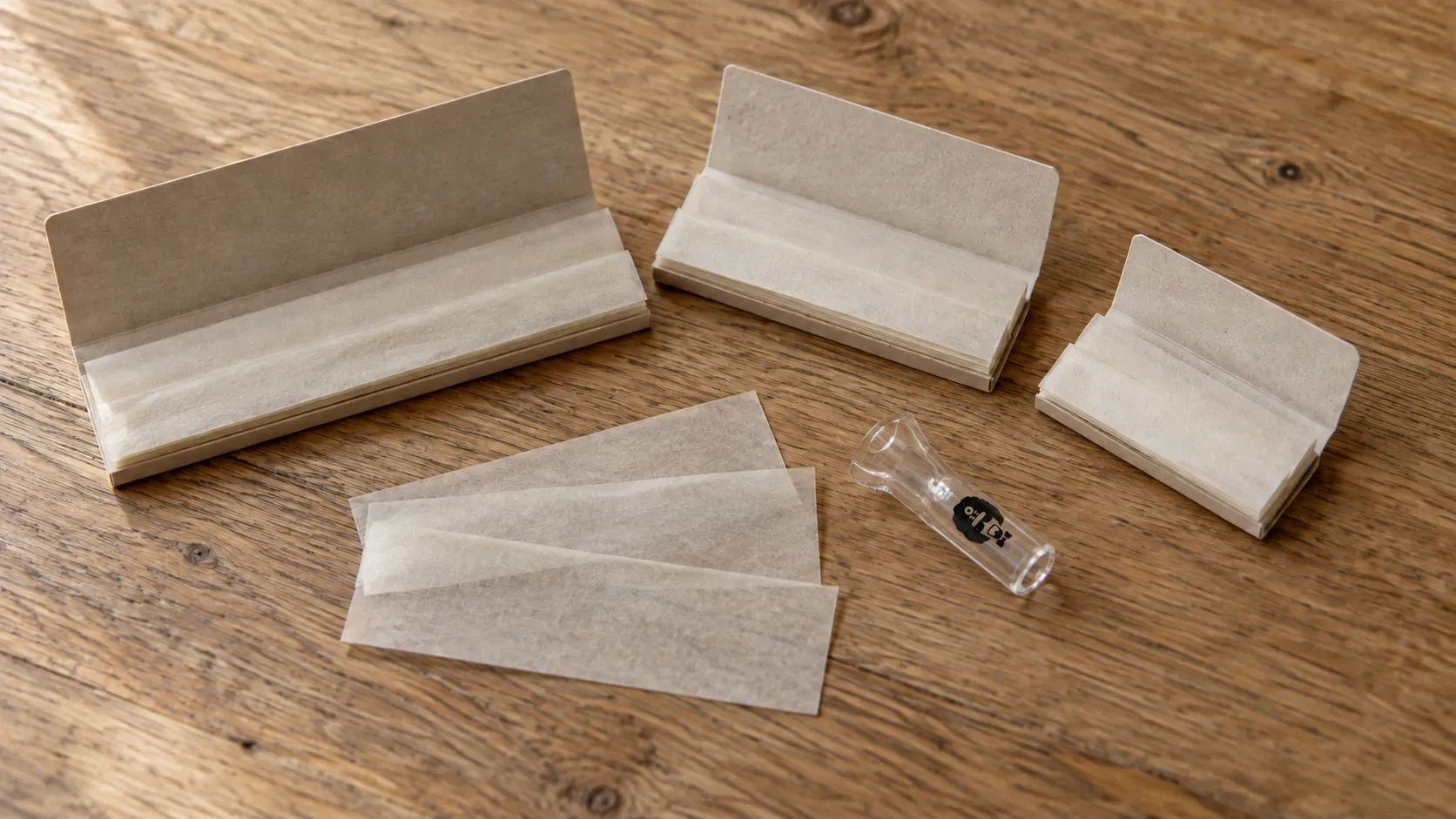
Choosing rolling papers comes down to three things: size, which decides how the joint rolls and what tip fits it; material, which is mostly a matter of feel and taste; and what is in the paper, which is the only part independent labs have measured. The high readings they found were tied to dyes, metallic tips and clear cellulose papers, not to the everyday fiber names on the booklet.
Most of the rest of what is printed on a booklet, from slow burns to pure taste, is neither standardized nor backed by published measurements. This guide covers the three questions in order and flags where the evidence runs out.
Rolling paper sizes: the names are loose
Rolling papers are sold under a handful of size names: single wide, 1 1/4, 1 1/2, king size and king size slim. The names sound precise. They are looser than they look.
Sellers say so themselves. One supplier's size chart notes that both the exact measurements and the nicknames of paper sizes vary by manufacturer, even though leading brands follow similar patterns. Published dimensions reflect that, sometimes within a single company. King size papers are listed at 100 to 110 mm long, but two pages from the same supplier give their width as 55 to 60 mm and as 42 to 46 mm. Another seller lists single wide at about 68 to 70 by 34 to 36 mm and 1 1/4 at about 76 to 78 by 45 to 48 mm. The name describes a size class, not a measurement.
What this means in practice:
- Buy by the joint you want, not by the label. Wider papers make a fatter joint; longer papers make a longer one. If the booklet lists dimensions, read them.
- Stick with one brand and size once you find one that works. Because sizes drift between brands, switching brands at the same size name can change how the paper wraps.
- Size decides your tip. A crutch or glass tip has to sit snugly inside the rolled paper, so the tip and the paper have to be chosen together.
Matching a paper to a crutch or glass tip

The end of the joint you hold is doing a job: keeping the mouth end open as the paper softens and keeping loose flower out of your mouth. We covered what that part does, and does not do, in what a joint crutch actually does. The short version is that a crutch is structural, not a filter.
Where papers come in is fit. Glass tips such as Phuncky Feel Tips, the hand-blown borosilicate tips created by B-Real of Cypress Hill with ROOR, are reusable and have a fixed outside diameter. A paper crutch is rolled to whatever width you make it. That makes the glass tip the fixed variable and the paper the one you adjust. If a tip slides around inside a joint, the paper is too wide for it; if the paper will not close around it, the paper is too narrow.
Tip sizing is its own mess. Sellers disagree about which tip diameter suits which paper size, which is the same standardization problem showing up at the other end of the joint. The practical rule does not change: match the tip to the paper you actually use, and bring the paper with you if you are buying a tip for the first time. If you are unsure, ask staff before you buy.
Hemp, rice, flax or wood pulp: what the material claims rest on
Rolling papers are made from a small set of fibers. Seller guides consistently list the same ones:
- Wood pulp, the traditional and most common material, sold bleached or unbleached.
- Hemp, from industrial hemp fiber.
- Flax, from the fibers of the linseed plant.
- Rice, typically sold as the thinnest option.
- Clear cellulose, a transparent sheet sold as processed plant cellulose rather than plastic.
Blends of more than one fiber are also common.
Seller guides go further and rank these materials by burn speed, taste and ease of rolling. Those descriptions are useful as a shopper's vocabulary, but we did not find one that cited a measurement. They are impressions, often from companies selling the product being described.
There is a reason to hold them loosely. In the paper industry, burn behavior is engineered rather than left to the fiber. Patents for cigarette paper describe controlling how fast a paper burns through its air permeability, its mineral filler (typically calcium carbonate) and chemical burn additives such as citrate salts. Those documents describe cigarette paper, not rolling papers specifically, so applying them here is an inference. But it is a reasonable one: in the 2024 study discussed below, calcium was the most abundant element found across the rolling papers tested, consistent with mineral filler being part of how many of them are made.
The upshot is that two papers of the same fiber can behave differently, and a "slow-burning hemp" claim tells you about one product rather than about hemp. Material is worth choosing on feel and taste. Sellers generally describe thinner papers, such as rice, as harder to handle, and thicker ones as easier to roll. Try a booklet before you buy a box.
The adhesive strip is less variable. Many manufacturers state that they use gum arabic, also called acacia gum, a plant-derived gum used widely in food under the additive code E414. That comes from manufacturers describing their own products; we have not seen independent testing of gum strips.
Heavy metals in rolling papers: what labs have measured
SC Labs, 2020. SC Labs, a cannabis testing lab, investigated after a cluster of pre-roll samples failed compliance testing for the pesticide chlorpyrifos. The flower had passed on its own; the contamination was traced to the rolling paper. The lab then tested a set of rolling papers, cones and wraps. It reported at least one heavy metal in 90 percent of the products, with 8 percent containing at least one metal above California's limits for inhalable cannabis products. Lead was the most common. Pesticides turned up in 16 percent of samples, and 5 percent were over the action limits.
Two details from that work matter for shoppers. Standard rolling papers appeared to have the lowest contaminant levels in the set. Clear cellulose papers had much higher heavy metal levels, with two of the three tested exceeding the allowable lead level by more than 100 times. SC Labs itself cautions that a paper is a small share of the material in a pre-roll, that most detections were below California's limits, and that most pre-rolls on the market are safe. SC Labs sells testing services, which is worth knowing when you read its recommendations.
Lake Superior State University, 2024. A peer-reviewed study published in ACS Omega measured 26 elements in 53 commercially available rolling papers and cones. The authors estimated potential maximum exposures and concluded that some products, particularly those high in copper, chromium and vanadium, may present a potential hazard to frequent users. Their results suggest copper-based pigments are used by a number of manufacturers.

The study linked several of the high readings to product design, especially color and decoration:
- Color. In a multicolored cone, copper appeared only in the green, blue and purple sections, with the strongest signal in the blue.
- Metallic tips. The gold- and silver-colored tips on two cones were made of PET plastic containing antimony, which is used as a catalyst in making that plastic.
The authors are careful about what their numbers mean. They are estimates of potential maximum exposure, not measurements of what reaches a person smoking the paper, and the study calls for further research under realistic smoking conditions. They also note that rolling paper composition is largely unregulated, with only a minority of jurisdictions regulating papers, and then only as part of a finished cannabis product.
How to use that when you shop
Neither lab named a "best" paper, and we will not either. What the two sets of results do point to is a simple pattern: the high readings clustered in colored or printed papers, metallic-effect tips and clear cellulose, while standard, non-cellulose papers measured lowest in the SC Labs set.
If that matters to you, the practical steps are modest:
- Choose plain, undyed paper over printed, colored or metallic designs.
- Ask for a certificate of analysis. SC Labs suggests asking for a COA on rolling papers the same way you would on flower. If a brand cannot produce one, you have no data either way.
- Know the difference between a pre-roll and a booklet. The SC Labs case surfaced because pre-rolls went through compliance testing as finished products, paper included. A loose booklet of papers is not a cannabis product and, per the 2024 study, is largely unregulated. For what to look for on a finished pre-roll, see how to choose a pre-roll, and for reading the label and COA itself, see how to read cannabis product labels.
Where to find papers and tips
Our store pages list accessories, including rolling papers, among what each location carries. What is on the shelf changes, so ask staff what papers and tips are on hand, and bring the paper you use if you want to check how a glass tip fits. Visit us in Fresno, Canoga Park, Orcutt, La Mesa or Chicago.
Sources and further reading
- Elemental Composition of Commercially Available Cannabis Rolling Papers — Wright et al., ACS Omega, 2024 (PubMed record: PMID 38708199)
- SC Labs Report: Rolling Papers Tested for Heavy Metals and Pesticides — SC Labs, 2020
- Should rolling papers be tested for pesticides and heavy metals? — SC Labs, 2021
- Cigarette paper with improved ash characteristics — US Patent 5,730,840, describing permeability, calcium carbonate filler and burn additives in cigarette paper
- Rolling Paper Size Chart — Hara Supply, noting that measurements and size names vary by manufacturer, and listing king size widths of 55 to 60 mm
- Rolling Paper Sizes Guide — Hara Supply, listing king size widths of 42 to 46 mm
- What Size Rolling Paper? — MJ Wholesale, listing single wide at about 68 to 70 by 34 to 36 mm and 1 1/4 at about 76 to 78 by 45 to 48 mm
This article is for general information for adults 21 and older and is not medical advice. Product availability varies by location; ask staff what is in stock. Information is current as of September 22, 2026.


