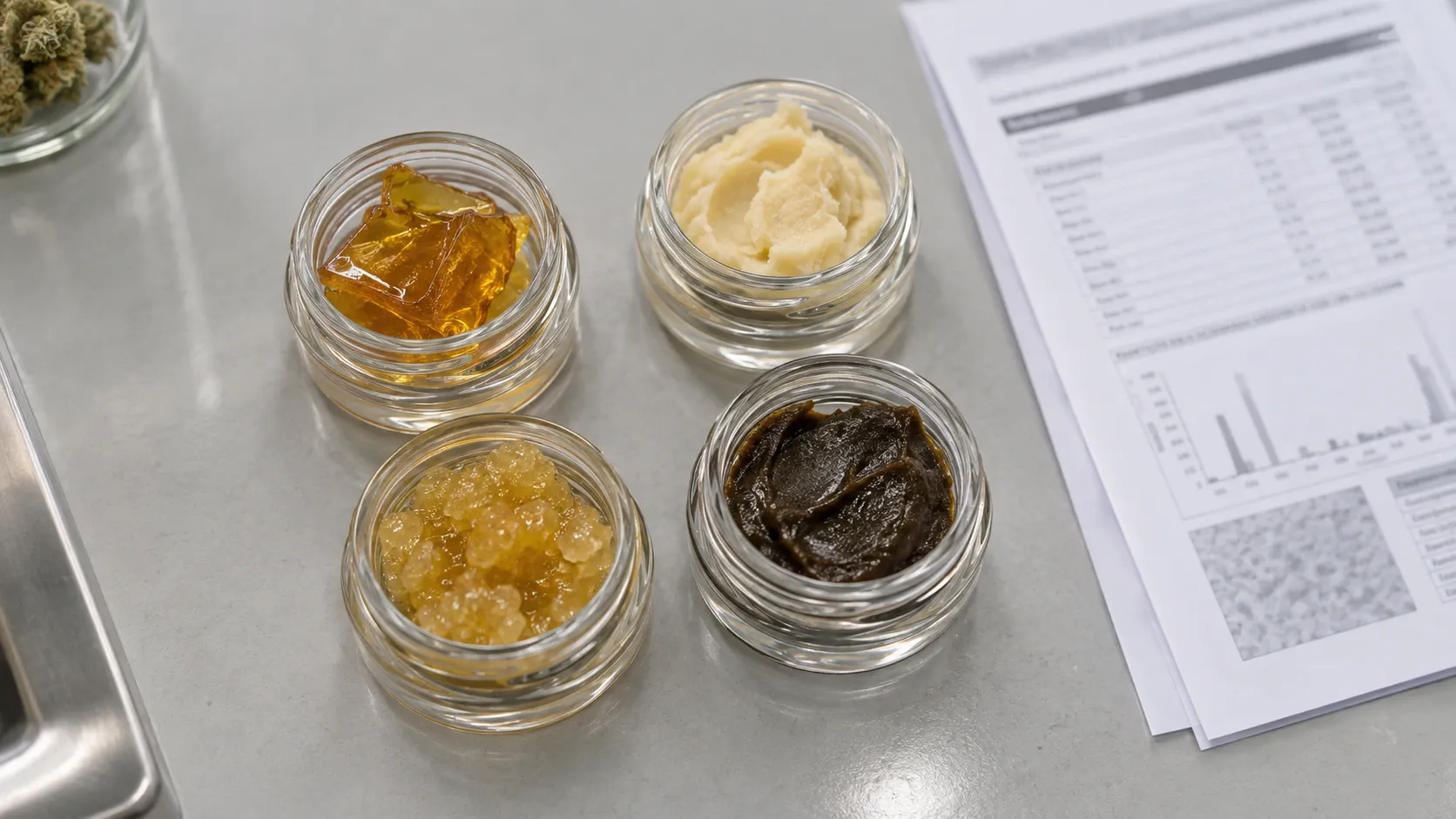
Concentrates are the most heavily tested thing on a dispensary shelf. Every non-flower product in California has to clear a residual solvent panel before it can be sold, and the results are reported down to the microgram per gram. Almost none of that reaches the label.
So the gap between what is known about a concentrate and what you can read on the jar is wider here than in any other category. This is how to close it.
Solvent and solventless is a process difference, not a quality ranking
The first split anyone will offer you is solvent versus solventless, and it is usually presented as a hierarchy. It isn't one.
Solvent extraction uses a chemical — butane, propane, ethanol, CO2 — to pull cannabinoids and terpenes off the plant, then purges that chemical out. Live resin, shatter, sauce and most vape oil come from this route. Solventless uses heat, pressure, water and agitation instead. Rosin and bubble hash are the common ones. If you want the full picture of how each process works, we covered that in our guide to cannabis concentrates.
What actually separates a good jar from a bad one is the starting material and the care taken. A rosin pressed from mediocre trim is worse than a live resin pulled from fresh-frozen flower by someone who knows what they are doing. The process tells you what questions to ask. It does not answer them.
If the question you are actually trying to settle is live resin versus distillate in a cart, that one belongs to choosing a vape cartridge.

What the COA tells you about solvents
This is the part worth learning, because it is the one piece of hard data attached to every concentrate sold in California.
Under 4 CCR §15718, a licensed lab analyzes the sample and reports each residual solvent in micrograms per gram, then marks the panel pass or fail on the certificate of analysis. Solvents are split into two categories with very different treatment.
Category I is six chemicals — benzene, chloroform, methylene chloride, trichloroethylene, ethylene oxide and 1,2-dichloroethane — each capped at 1.0 µg/g. That limit is low enough to function as a prohibition. These are not solvents anyone should be extracting with, and the number says so.
Category II is fourteen chemicals that can legitimately be present in trace amounts, with limits that vary by more than an order of magnitude depending on how dangerous each one is:
- 5,000 µg/g — acetone, butane, ethanol, ethyl acetate, ethyl ether, heptane, isopropyl alcohol, pentane, propane
- 3,000 — methanol
- 2,170 — total xylenes
- 890 — toluene
- 410 — acetonitrile
- 290 — hexane
Butane sits at 5,000 because a properly purged butane extract carries almost none of it. Hexane sits at 290 and toluene at 890 because those carry more risk at lower concentrations. A batch that exceeds any single limit fails the panel and cannot be released for retail sale.
What this means at the counter: a concentrate on a licensed shelf in California has already cleared this. The COA is not telling you whether the product passed — that was settled before it got there. It is telling you how much margin the producer left. A panel reading non-detect across the board came out of a different operation than one clearing hexane at 250 of an allowed 290.
Ask to see the COA. Most stores will pull it up. Scan for the residual solvent section and read the numbers, not just the pass mark. The same logic applies across every category, and we went through how lab testing and COAs work in more detail separately.
What the label actually carries
Here is where California and Illinois diverge, and it matters if you buy in both.
A California concentrate is a manufactured cannabis product, so its label follows the manufactured-goods requirements. The primary panel carries product identity, net weight or volume in both metric and US units, and the universal cannabis symbol at a minimum half-inch height. The informational panel carries the manufacturer's licensed name and contact, the packaging date, the full government warning in bold capitals, the track-and-trace UID, the batch or lot number, instructions for use, and ingredients in descending order by weight — plus allergens, artificial colorings and a refrigeration statement where those apply.
What it does not carry is the extraction method or the solvent used. That information exists — the lab measured it, the producer knows it — and California does not require the package to tell you.
Illinois does, conditionally. Under section 1300.930 of the Illinois administrative code, a concentrate or extract must disclose the extraction method including any solvents or gases used — but that clause applies only where solvents were used to make it. A solventless rosin sold in Chicago carries no extraction disclosure under it. A second clause is broader and carries no such condition: any other chemicals or compounds used to produce or refine the concentrate must be disclosed.
Illinois labels also carry more testing detail than California's. The cultivation centre or craft grower is named, a serial number ties the package to its batch and lot, and the label states minimum and maximum percentages by weight for THC, THCA, CBD and CBDA. Two further items — the date of final testing with the testing lab's identity, and a pass/fail rating across the microbiological, mycotoxin, pesticide and solvent residue analyses — appear on the label where the batch was sampled.
So two jars of the same product, one bought in Chicago and one in Fresno, can carry materially different amounts of information. That is a regulatory difference, not a quality one.

Reading texture without over-reading it
Texture gets treated as a quality signal more than it deserves. Most of what separates shatter from badder from sauce is post-extraction handling — temperature, agitation, whether the producer let it nucleate or stopped it. The same extract can be finished three different ways.
What texture does tell you:
Consistency should be uniform. A jar that has separated into a runny layer and a solid layer, or that looks like it partially melted and reset, has been temperature-abused somewhere between the lab and the shelf.
Color is weak evidence, used carefully. Very dark, syrupy extracts sometimes indicate degraded or low-grade starting material. But some excellent solventless is dark, and distillate can be water-clear and unremarkable. Color rules out less than people claim.
Visible plant matter in a solvent extract is a problem. In bubble hash it is a sign of a coarser wash. In shatter it means filtration was skipped.
The one thing texture is genuinely good for: matching the product to how you plan to use it. Badder and budder handle easily with a tool. Shatter is brittle and fussy. Sauce and diamonds need a container that won't leak.
Potency, and what it leaves out
Concentrate potency numbers run high enough that comparing them stops being useful. The distance between a 78% and an 84% extract is real on paper and hard to isolate in practice.
Terpene content is the number that varies more between products, and it is the one most often missing. Terpenes are the aromatic compounds that carry a concentrate's smell and flavour, and some extraction and post-processing routes strip them out while others preserve them. Not every COA breaks terpenes out and not every producer prints the figure — but when it is there, it describes something the THC line does not.
This mirrors the flower situation, where cannabinoid percentage has become a shorthand people trust well past what it supports. We got into how that shapes pricing in how dispensary flower is priced.
Storage
Concentrates degrade faster than flower and less forgivingly. Heat drives off terpenes and pushes textures to separate. Light degrades cannabinoids. Air oxidizes.
Cool, dark, closed. Not the car, not a windowsill, not on top of anything that runs warm. Silicone is convenient for short-term handling, but glass is better for anything you are keeping more than a few weeks.
If a jar has been sitting in a cabinet for six months and smells like nothing, that is terpene loss, and it does not come back.
A sequence that works at the counter
Ask what the starting material was — fresh-frozen, cured flower, or trim. Ask to see the COA and read the residual solvent numbers rather than the pass mark. Check whether terpenes are reported. Look at the jar for uniformity. Then match the texture to how you actually consume.
That takes about two minutes and it uses information the store already has. Our concentrate selection varies by store, and each one lists what it carries: Chicago, Fresno, La Mesa, Canoga Park and Orcutt.
If reading the package itself is the part that trips you up, how to read a cannabis product label covers the panel layout in full.
Sources
- California Code of Regulations, Title 4, §15718 — Residual Solvents and Processing Chemicals Testing
- California Department of Cannabis Control — Labeling requirements: manufactured cannabis products in final form
- Illinois Administrative Code, Title 8, §1300.930 — Labeling Requirements
This article reflects California and Illinois regulations as of September 2026. It is general information, not legal advice.

