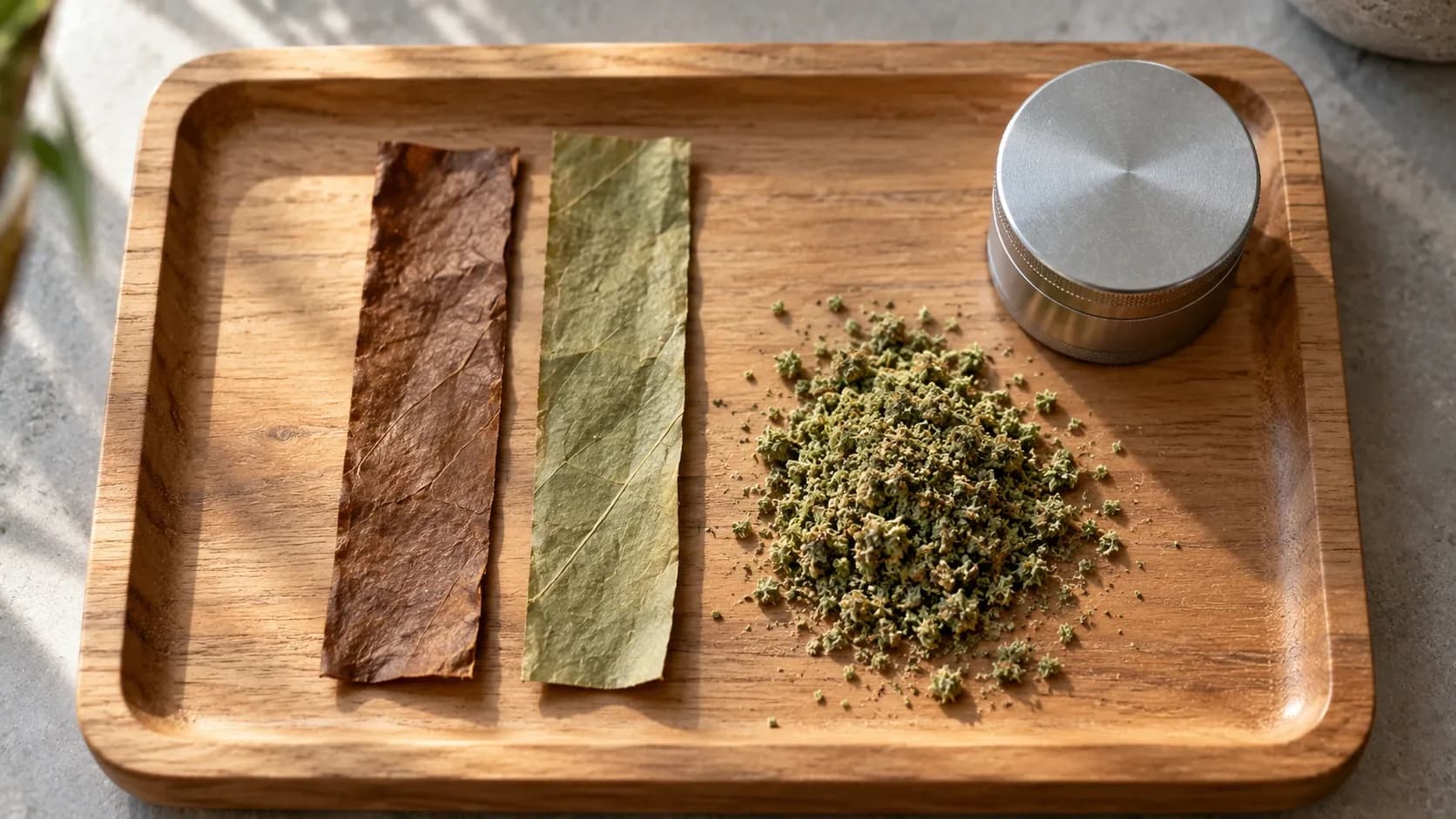
A blunt is cannabis rolled in a cigar-style wrap instead of rolling paper. The technique is close to rolling a joint, but the wrap behaves differently: it is thicker, it holds moisture, and if it is made of tobacco it carries nicotine.
This guide covers the wrap choice first, because it changes what you are smoking, then the rolling itself, then how to fix the problems that come up most often. If you want the story behind the name, our history of cannabis slang covers where "blunt" comes from.
The short version: split or unroll the wrap, moisten it slightly, fill it evenly with ground cannabis, tuck and roll it like a joint, then seal the seam and let it dry. If the wrap is tobacco, the blunt contains nicotine no matter what you put inside.
What do you need to roll a blunt?
- A wrap: either a cigarillo you split open, or a pre-made blunt wrap sold flat or rolled in a tube.
- Ground cannabis. A blunt usually holds more than a standard joint, so plan for more flower than you would roll in paper.
- A grinder, or patient fingers. Our grinder guide covers grind size, though its measurements come from joints and cones, not wraps.
- Optionally, a crutch or glass tip for the mouth end.
- A lighter, and a little water or saliva to seal the seam.
Tobacco wrap or tobacco-free wrap?

A blunt starts with the wrap. Traditional blunt wraps and the cigarillos people split open are made of tobacco, so a blunt contains tobacco even when nothing but cannabis goes inside. That matches how our guide to rolling a joint defines the three: a joint is cannabis in paper, a spliff mixes tobacco into the fill, and a blunt puts cannabis inside a tobacco wrap.
Tobacco wraps carry nicotine
The wrapper alone is a real nicotine source. A 2016 analysis tested the wrappers of cigars commonly used for blunts and, as later studies summarize it, found nicotine levels ranging from 1.2 to 6.0 milligrams. A 2023 study of the national PATH survey cites that range and notes that blunts are often perceived as less harmful than cigarettes or cigars.
That same 2023 study followed people who had never used cigarettes, e-cigarettes or cigars. Those who smoked blunts had higher odds of later starting all three than people who used neither blunts nor cannabis. The study shows an association, not that blunts caused the later tobacco use.
Federal law sets 21 as the minimum age to buy any tobacco product. The FDA's Tobacco 21 page lists cigars among the covered products, so tobacco blunt wraps and cigarillos fall under it.
Flavored wraps in California
California restricts flavored tobacco sales. Since December 21, 2022, state law has barred retailers from selling flavored blunt wraps and flavored little cigars and cigarillos, along with most other flavored tobacco. The state's fact sheet notes that premium cigars with a wholesale price of $12 or more are exempt, and that the law penalizes retailers, not people who buy, possess or use these products.
Tobacco-free wraps
Wraps made from hemp or from whole plant leaves are sold as tobacco-free alternatives. They are what to look for if you want a blunt without tobacco. Read the package, since some wraps are flavored and the label is the only way to know what is in them.
One wrap-related finding applies across materials. A 2020 SC Labs investigation found at least one heavy metal in 90 percent of the rolling papers, cones and wraps it tested. Our rolling papers guide covers what that testing measured.
If you are in Illinois, note that the state's new hemp rules take effect November 12, 2026 and bar consumer hemp cannabinoid products intended for smoking. The state's bulletin does not address plain hemp-fiber wraps, and our article on the federal hemp changes covers the wider picture.
How to roll a blunt, step by step
The steps differ slightly depending on whether you start from a cigarillo or a pre-made wrap.
Starting from a cigarillo
- Split it lengthwise. Run a fingernail or a small blade along the seam from end to end. Go slowly so the wrap opens in one piece.
- Empty the tobacco. Shake out the filler completely. Anything left behind ends up in your blunt.
- Moisten the wrap lightly. A slightly damp wrap is flexible and less likely to crack. Too wet and it will tear or burn unevenly.
Starting from a pre-made wrap
- Unroll it gently. Flat wraps are ready to fill. Wraps sold rolled in a tube can be dry, so warm them in your hands for a few seconds before you open them.
Filling and rolling
- Fill it evenly. Spread the ground cannabis along the length of the wrap, a little thicker in the middle than at the ends. If you are using a crutch, set it at one end now.
- Tuck and roll. Pinch the wrap around the cannabis, tuck the edge closest to you under the fill, and roll it up with your thumbs, the same tuck-and-roll motion you use for a joint.
- Seal the seam. Lick or dab water along the exposed edge and press it down. Some people pass a lighter flame along the outside, a short distance away, to dry the seam faster. Keep the flame off the wrap itself.
- Let it set. Give it a minute before lighting so the seam can dry.
Why does my blunt keep running or going out?

Most blunt problems come from the wrap's moisture. A wrap is thicker than rolling paper, and how damp it is decides most of what goes wrong: too dry and it cracks, too wet and it tears or burns unevenly.
- It will not seal. The wrap is too dry. Moisten the edge a little more and press it longer.
- It cracks while you roll. Also too dry. Warm the wrap in your hands or moisten it lightly before you start.
- It burns down one side. Called running or canoeing. The fill is uneven or the seam is damp. Rotate the blunt as you light it, and wet a fingertip to slow the side that is burning faster.
- It keeps going out. A thick wrap can go out between draws, especially if it is still damp. Relight it evenly and draw slowly.
- It is hard to pull. The fill is packed too tight, or the grind is too fine. A medium grind and a looser roll help.
Should you use a crutch?
A crutch keeps the mouth end open and stops fill from reaching your mouth. It works in a blunt the same way it works in a joint. Our guide to joint crutches explains what a crutch does and what a glass tip changes.
Before you light it
California law treats a blunt like any other smoked cannabis: there are limits on where you can light it, and anywhere tobacco smoking is banned is off limits too. Our guide to where you can smoke weed in California covers the rules.
If you would rather skip the rolling, many dispensaries carry pre-rolled blunts. Our pre-roll guide covers what to look for on the label.
Sources
- Peters et al., Does marijuana "blunt" smoking contribute to nicotine exposure? Preliminary product testing of nicotine content in wrappers of cigars commonly used for blunt smoking, Drug and Alcohol Dependence, 2016
- Fairman et al., Blunt and non-blunt cannabis use associated with cigarette, e-cigarette, and cigar initiation: Findings from the Population Assessment of Tobacco and Health (PATH) Study, Drug and Alcohol Dependence, 2023
- Kong et al., Blunt Use among Adolescents and Young Adults: Informing Cigar Regulations, Tobacco Regulatory Science, 2018
- U.S. Food and Drug Administration, Tobacco 21
- California Department of Public Health, California's flavored tobacco law fact sheet
- California Department of Public Health, SB 793 and AB 935 fact sheet
- Illinois Department of Agriculture, June 2026 Illinois Hemp Act informational bulletin
This article is general information for adults 21 and older. It is not medical or legal advice. Tobacco and nicotine carry their own health risks. Current as of October 2026.


