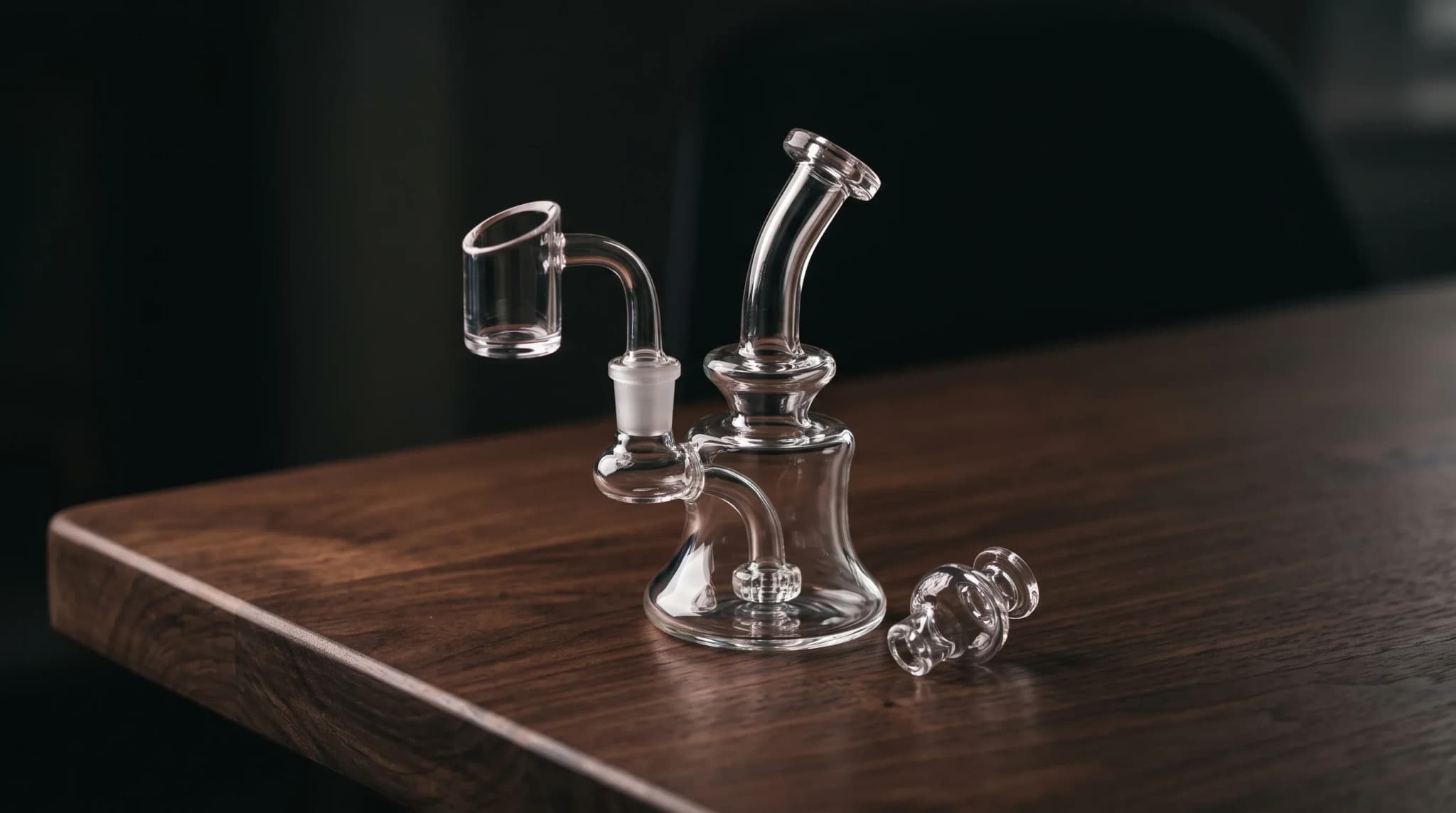
A dab rig is a small water pipe built for cannabis concentrates. Instead of a bowl for flower, it has a nail, or banger, that you heat, then touch the concentrate to so it vaporizes. When you choose one, the parts that matter most are the nail and how you heat it, because that decides the temperature, and temperature affects both flavor and what you inhale.
Lab research has found that dabbing at high temperatures turns terpenes, the compounds that give concentrates their smell, into harmful byproducts, including benzene. The simplest improvements are to measure or control your nail temperature and to keep it lower. This guide covers the parts of a rig, the three ways to heat one, and what the research shows. The sources are linked at the end.
How a dab rig differs from a bong

A dab rig looks like a small bong, and it uses water the same way. The difference is at the top. A bong has a bowl that holds flower you light. A rig has a nail, such as a quartz banger, that you heat until it is hot enough to vaporize concentrate on contact.
Rigs are usually smaller than bongs, and the glass and joint sizes follow the same standards. For what the glass should be made of and what the 10, 14 and 18 mm joint sizes mean, see our guide to choosing a pipe, bubbler or bong. Check that your nail and rig use the same joint size and gender before you buy either one.
The parts of a dab setup
- The rig. The glass water pipe. Smaller rigs are common for concentrates, and the same glass-quality advice applies as for any pipe.
- The nail or banger. The heated surface the concentrate touches. Nails are made from quartz, titanium or ceramic, and a banger is a bucket-shaped quartz nail. Whichever you choose, it has to match your rig's joint.
- A carb cap. A small cover that sits over the banger while you inhale. As the authors of the main dabbing study describe it, the cap reduces the pressure over the concentrate, which lets it vaporize at a lower temperature.
- A dab tool. A small metal or glass pick for moving the concentrate onto the nail. Don't use your fingers.
- A heat source. A torch, an electric nail or an all-in-one electric rig. This choice matters most, and the next sections explain why.
Torch vs e-nail vs e-rig: how to heat a dab rig
A torch heats the nail with a butane flame. It is cheap and works with any rig. The drawback is control. The nail's temperature depends on how long you heat it and how long you wait before dabbing. The researchers behind the main study on dabbing temperature noted that most people heat the nail with a torch, which gives them no control over its temperature.
An electric nail, or e-nail, replaces the torch with a heating coil around the nail and a controller you set to a temperature. It usually plugs into the wall and fits a standard rig, so it is the way to add temperature control to glass you already own.
An electric rig, or e-rig, is a battery-powered unit with its own heating chamber, often with a few preset heat levels. It needs no torch and no separate glass, and it is usually the most portable of the three. You trade some flexibility for convenience, and you are limited to the settings and parts the maker offers.
If you use a torch, an infrared thermometer gives you a reading instead of a guess. Infrared readings depend on the surface being measured, so treat the number as a guide rather than an exact figure.
The best dab temperature: what the research shows

In 2017, chemists at Portland State University published a study that simulated real-world dabbing. They put the terpenes found in cannabis extracts, the compounds that give them their smell, onto a heated ceramic nail attached to a small water pipe, measured the nail with a thermal camera, and analyzed what came out.
They tested four temperature ranges, with median nail temperatures of about 322, 403, 455 and 526 °C, roughly 612, 757, 851 and 979 °F. What they found:
- Methacrolein, an irritant chemically similar to acrolein, was not detected at the lowest temperature in the main measurements. It appeared at the next range and rose as the nail got hotter.
- Benzene, a known carcinogen, appeared only at the highest temperature range. At that range it measured about 15 parts per billion in the vapor, compared with an average of about 0.3 parts per billion in U.S. outdoor air across the sites the authors cited.
- The authors noted that their figures were likely underestimates, because the terpene they used for the main measurements produced fewer byproducts than the others they tested.
A follow-up study by the same group, published in 2019, found that people using cartridge vaporizers and dabbing may be exposed to methacrolein, benzene and methyl vinyl ketone. For how this applies to vape batteries and cartridges, see our guide to choosing a vape battery.
The study had limits. It tested terpenes rather than whole concentrates, and it didn't compare dabbing with smoking. But the direction of the finding is clear: the hotter the nail, the more harmful byproducts formed. The authors also noted that most dabbers use high temperatures to vaporize everything on the nail, while a minority choose lower temperatures to preserve flavor.
How to choose a dab rig
- Decide on the heat source first. It matters more than the glass. If you want control without a torch, look at an e-nail for a rig you already have, or an e-rig if you want everything in one portable unit.
- If you use a torch, add a thermometer. An infrared thermometer turns guesswork into a rough reading.
- Match the joint. The nail or banger must match the rig's joint size and gender.
- Get a carb cap and a dab tool. The cap helps concentrate vaporize at a lower temperature, and the tool keeps your fingers off a hot nail.
- Buy glass that's built for heat. The same glass advice applies as for any pipe or bong.
- Start with good concentrate. A rig only vaporizes what you put on it. Our guide to choosing a concentrate covers what the label and lab report tell you.
Safety basics
A butane torch and a nail hot enough to vaporize concentrate can burn you, and they can start a fire. Let the nail cool on a heat-safe surface, keep the torch and its butane away from children, and never leave a torch lit and unattended.
In California, the law that bans smoking cannabis in public places defines smoking to include heated devices and vaporizers, so dabbing follows the same rules. See where you can smoke weed in California.
Sources and further reading
- Toxicant formation in dabbing: the terpene story (PDF) — Meehan-Atrash, Luo and Strongin, ACS Omega, 2017, open-access copy from Portland State University
- Aerosol gas-phase components from cannabis e-cigarettes and dabbing: mechanistic insight and quantitative risk analysis — Meehan-Atrash and others, ACS Omega, 2019
This article is general information for adults 21 and older and is not medical advice. Information is current as of October 8, 2026.


