Most people choose a pipe or bong by how it looks. The things that decide whether it lasts, whether replacement parts fit and whether you will actually keep it clean are harder to see: the glass it is made from, the size and type of its joint, and how many pieces come apart. This guide covers those, plus what a 1996 lab test found about the water in a bong.
If you are putting together the rest of a flower setup, our guides to choosing a grinder and choosing rolling papers cover the other pieces.
Hand pipe, chillum, bubbler or bong: the four basic types
The names get used loosely, but the working differences are simple.
- Hand pipe. A bowl, a stem and a mouthpiece, with no water. Some have a small side hole called a carb that you cover while drawing and uncover to clear the smoke.
- Chillum. Collins English Dictionary defines a chillum as a short pipe, usually of clay, used especially for smoking cannabis.
- Bubbler. A compact, handheld water pipe. The pipe maker Vessel describes most bubblers as having a bowl, a fixed downstem, a small water chamber and a mouthpiece, usually built as one solid piece.
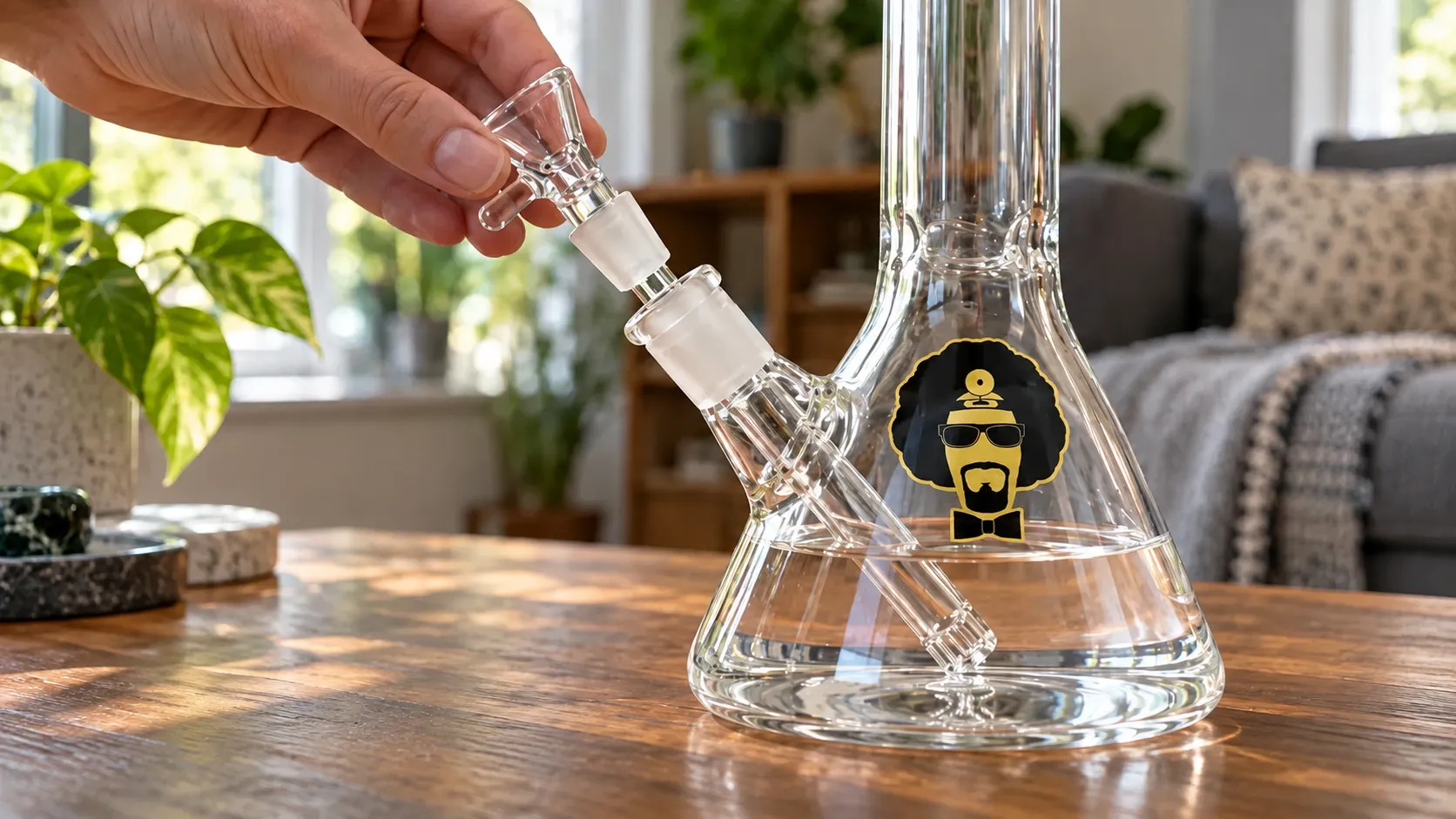
- Bong. A larger water pipe with a bigger chamber. Vessel lists a usually removable bowl piece, a downstem, a water chamber, a neck and a mouthpiece, with percolators as an option.
One practical split between the last two is cleaning. Vessel notes that a one-piece bubbler has to be soaked rather than taken apart, while a bong's removable parts and wider openings make it easier to reach inside with a brush.
Dab rigs look similar but are built for concentrates, with a heated nail in place of a bowl. Our concentrates guide covers them.
What glass should a pipe or bong be made of?
Most of the durability question comes down to one number: how much the glass expands when its temperature changes.
The glass maker SCHOTT explains that glass conducts heat poorly, so heating or cooling it quickly creates temperature differences within the piece, and the stress those differences cause rises with the glass's thermal expansion. SCHOTT lists its DURAN borosilicate glass at a linear thermal expansion of 3.3 millionths of its length per degree Celsius, which it calls the lowest of the large-scale, mass-produced technical glasses with high chemical resistance, and it describes that glass's resistance to thermal shock as exceptional. SCHOTT's AR-GLAS, a soda-lime glass from the same family as window and bottle glass, is listed at 9.1 millionths per degree, nearly three times as much.
Two more practical points come from the same source. SCHOTT notes that cracking starts almost exclusively at the glass surface and that cooling is usually more critical than heating. Retailers make a related warning: do not run hot or boiling water over a glass piece. SCHOTT also explains that the real-world strength of glass is set by surface damage, tiny chips and cracks, rather than by the material itself.
So when you shop:
- Ask whether a glass piece is borosilicate. A listing that does not say is a question worth asking before you buy.
- Look closely for chips and scratches, especially around the joint and the rim of the bowl, since surface damage is where glass fails.
- Know what the material means for cleaning. The retailer HEMPER recommends against isopropyl alcohol and salt on silicone pipes, and against alcohol or boiling water on ceramic ones, because both can damage the material.
Bong joint sizes: 10 mm, 14 mm and 18 mm

If you ever plan to swap a bowl, add an accessory, or replace a broken piece, the joint matters more than the shape.
Bongs connect their removable parts through a ground-glass joint: a male piece that slides into a female socket. The retailer Shatter Kitchen lists three standard sizes, 10 mm, 14 mm and 18 mm, and explains that labels reading 14.5 mm or 18.8 mm, or sometimes 19 mm, describe the same two joints rather than different ones.
Those odd numbers match laboratory glassware. ISO Recommendation R 383, the 1964 international specification for interchangeable conical ground glass joints that was later issued as the ISO 383 standard, lists 10, 14.5 and 18.8 mm among its large-end diameters, specifies a 1-in-10 taper, and rounds 14.5 to 14 and 18.8 to 19 when naming joints.
Fit comes down to two things:
- Size. The joint and the part going into it must be the same size.
- Gender. Opposites connect. A male bowl slides into a female joint, and a female piece slides over a male joint.
Shatter Kitchen's quick check needs only a dime: a dime drops through an 18 mm female joint, while a 14 mm female joint is just a little smaller than a dime. A 10 mm joint is small enough to tell apart by eye.
Percolators: what they do and whether you need one
A percolator is an extra glass structure inside some bongs. Vessel describes it as a small glass pipe or disc that breaks the smoke into smaller bubbles, and notes that it adds drag, meaning you have to pull harder. Designs vary: Vessel calls the flat honeycomb style one of the easier ones to clean and the horizontal inline style trickier.
Percolators are sold on smoothness. We did not find any independent measurement of what a given percolator design does to the smoke itself, so the most useful things to judge are the ones you can see: how hard it pulls, and whether you can reach every surface to clean it.
Does bong water filter smoke? What one lab test found
The most common assumption about bongs is that the water cleans the smoke. One lab test of that question came out differently.
In a study sponsored by MAPS and California NORML, reported by Dale Gieringer in the MAPS newsletter in 1996 and revised in 2000, researchers ran smoke from seven devices through a smoking machine and compared the amount of cannabinoids to the amount of tar in each. The unfiltered joint beat every device except the two vaporizers. Every water pipe did worse than the joint, and the best of them, a standard bong, produced about 30 percent more tar per unit of cannabinoids. The author's explanation was that water appeared to absorb THC more readily than tar.
The study's own limits matter as much as its result. It used low-potency cannabis, around 2.3 percent, supplied by the National Institute on Drug Abuse. It did not measure the gases in smoke, and the author said water might still capture some of those. And it is one test, published in a nonprofit's newsletter rather than a peer-reviewed journal. The author also noted that many people prefer water pipes for their cooler, milder smoke.
So the fair reason to choose a bong or bubbler is how it feels to use, not an assumption about what the water removes. If you mostly smoke joints and are weighing a glass tip against paper, see what a joint crutch actually does.
How to clean a glass pipe without cracking it

Glass cleans easily as long as you avoid sudden temperature changes.
The retailer Smoke Cartel describes the common alcohol-and-salt method for glass pipes:
- Rinse out loose material with running water.
- Put the pipe in a sealable bag or container with coarse salt, about a teaspoon per 4 inches of pipe.
- Add isopropyl alcohol, at least 90 percent and ideally 99 percent, until the pipe is submerged.
- Shake gently and let it soak. Smoke Cartel suggests 12 hours or more.
- Clear what remains with pipe cleaners rather than a paper clip or pin, which can damage the glass.
- Rinse with warm water, not hot or boiling water, which can crack the glass, and let it dry completely.
Smoke Cartel also advises never putting a glass pipe in the dishwasher.
Treat the alcohol as the hazard it is. NOAA's CAMEO Chemicals database lists isopropanol with a flash point of 53 degrees F and a flammability rating meaning it can ignite under almost all normal room temperatures. Work away from lighters and open flames, keep the room ventilated, and make sure the piece is fully rinsed and dry before it goes anywhere near a flame.
For other materials, HEMPER recommends hot water and mild dish soap for silicone, and a vinegar and baking soda paste for ceramic.
How to choose: a quick summary
- For portability, a glass hand pipe, with no water to carry or change.
- For water in something you can hold, a bubbler, accepting that a one-piece design is harder to clean.
- For a home piece with replaceable parts, a bong. Note its joint size and gender before you buy any extras.
- Whatever the type, ask whether the glass is borosilicate and check for chips before you pay.
- On percolators, judge the drag and whether you can clean it, not claims about the smoke.
Sources and further reading
- Marijuana Water Pipe and Vaporizer Study — Dale Gieringer, MAPS newsletter, Volume 6 Number 3, Summer 1996, revised February 2000
- SCHOTT Technical Glasses: Physical and technical properties — SCHOTT, February 2010 edition, copy hosted by jb-electronics.de
- DURAN Technical Data — SCHOTT data sheet
- ISO/R 383:1964, Interchangeable Conical Ground Glass Joints — International Organization for Standardization, preview via iTeh Standards
- How to Measure a Ground Glass Joint Size — Shatter Kitchen
- Bubbler vs. Bong: What's the Difference, Pros & Cons, and Which Is Better? — Vessel
- What Is A Percolator Bong? — Vessel
- How to Clean a Glass Pipe — Smoke Cartel
- How to Clean a Pipe Correctly — HEMPER
- Isopropanol — Chemical Datasheet, CAMEO Chemicals, NOAA
- chillum — Dictionary.com entry, citing Collins English Dictionary
This guide is general product information for adults 21 and older where cannabis is legal. It is not medical advice, and nothing here suggests that any pipe, bong or filter makes smoking safe. Check your local laws before buying or using smoking accessories.


