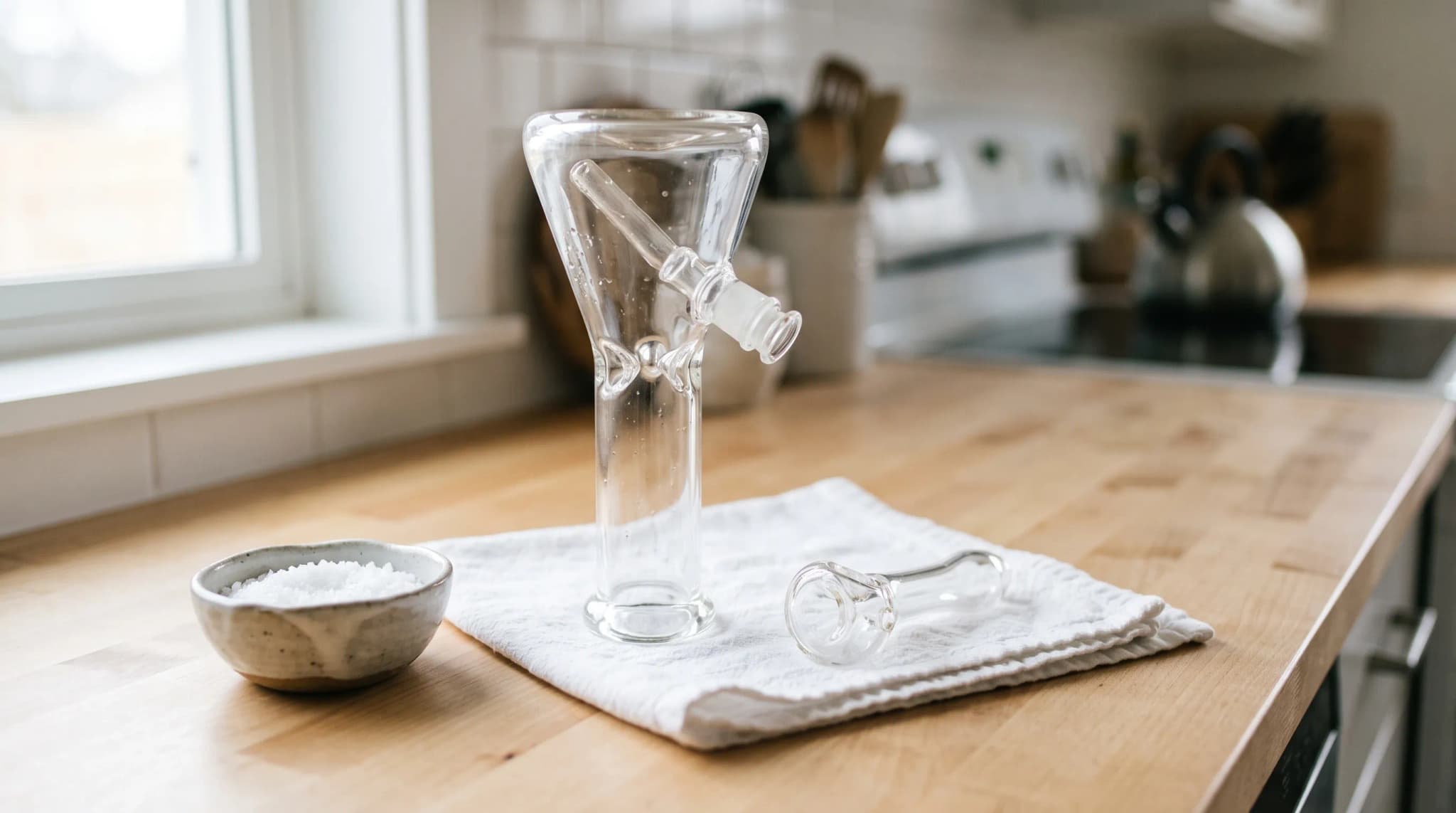
The short version: empty the bong, fill the bottom with isopropyl alcohol and a spoonful or two of coarse salt, plug the openings and shake. Soak the downstem and bowl separately, rinse everything with warm water, and let it dry completely before you use it again. Change the water every day you use it.
This guide covers bongs and bubblers. For a glass hand pipe, our guide to choosing a pipe or bong walks through the soak method, plus what the glass is made of and why that matters.
What you need
- Isopropyl alcohol, ideally 91% or 99%
- Coarse salt (kosher or rock salt; finer table salt scrubs less)
- Warm water
- A zip-top bag for the downstem and bowl
- Pipe cleaners and a narrow bottle brush
- Plugs for the openings: silicone caps, or your hands and a paper towel
- A towel to dry on
Why alcohol works and water alone doesn't
The sticky brown film inside a used bong is left by smoke, and the cannabinoids in it don't dissolve in water. The FDA label for dronabinol, a synthetic form of delta-9 THC, describes the compound as a sticky, resinous oil and states plainly that it is insoluble in water. That's a big part of why a rinse moves loose ash but leaves the film behind.
Alcohol dissolves it. The salt does a different job: it's the scrubber, grinding against the glass as you shake.
Strength matters. Rubbing alcohol on drugstore shelves is commonly about 70% isopropyl alcohol and the rest water, according to NOAA's chemical database. Since water doesn't dissolve the residue, more alcohol and less water is the reason to reach for 91% or 99%. A 70% bottle still works; expect more soaking and shaking.
How to clean a bong, step by step

1. Empty it and rinse with warm water. Dump the old water and rinse out loose debris with warm tap water. Not hot or boiling: a sudden temperature change can crack glass.
2. Pull the downstem and bowl. Most bongs have both as removable pieces. Set them aside for their own soak.
3. Add alcohol and salt to the chamber. Pour in enough alcohol to cover the bottom of the chamber and add a tablespoon or two of coarse salt.
4. Plug and shake. Cover the mouthpiece and the downstem opening, then shake and swirl so the mix reaches the base, the percolator if there is one, and up into the neck. For heavy buildup, let it sit and shake again.
5. Rinse thoroughly. Rinse with warm water until the alcohol smell is gone and no salt grit remains.
6. Let it dry completely. Stand it upside down on a towel with the windows open. Isopropyl alcohol is a Class IB flammable liquid with a flash point of 53°F, according to NIOSH, which means it gives off enough vapor to ignite at ordinary room temperature. Don't put a flame near a piece that's still wet with it.
The downstem and bowl

The downstem is the narrow tube that carries smoke from the bowl down into the water, and its slits or holes are where a bong clogs. Put the downstem and bowl in a zip-top bag with alcohol and a pinch of salt, seal it, shake it, and leave it to soak while you do the chamber.
Afterward, push a pipe cleaner through the downstem and run it across each slit. Rinse both pieces with warm water and dry them with the rest of the bong.
Percolators and bubblers
A percolator is a second water chamber inside the bong, and its small openings are hard to reach with a brush. That's where the shaking does the work. Give it extra alcohol and extra time, and swirl so the liquid passes back and forth through the perc.
A bubbler is a small, usually one-piece water pipe, so you can't take it apart. Clean it like a bong with the downstem left in: alcohol and salt in the chamber, plug the openings, shake, rinse and dry.
Silicone and other non-glass bongs are different. Some makers advise against alcohol and salt on silicone, so check the instructions that came with yours before you soak it.
How often to change the water
Change the water every day you use the bong. Water that sits collects ash and plant debris, and it smells.
For a full alcohol-and-salt clean, no study sets a schedule. A sensible rule is to clean when you can see buildup in the chamber or downstem, or when the draw starts to feel restricted. The more often you use it, the sooner that comes.
Regular cleaning is also easier. Light residue comes off in one shake; heavy, baked-on buildup can take repeated soaks.
Never add bleach
Bleach can seem like a way to disinfect and degrease at once. Don't. The New Jersey Department of Health warns that bleach mixed with rubbing alcohol forms chloroform, which can cause dizziness, nausea, headaches and even loss of consciousness, and tells people never to mix cleaning products, especially anything containing bleach.
Alcohol on its own needs some care too. Its vapor irritates the eyes and upper respiratory tract, according to NOAA's chemical database, so clean with a window open or a fan running.
A clean bong isn't a shareable one
Cleaning removes residue between sessions. It does nothing about what happens when one mouthpiece passes between people in the same session.
That gap has shown up in outbreak investigations. A 2006 report in the CDC's journal Emerging Infectious Diseases traced matching TB strains among 11 young patients in Seattle who were socially linked, with frequent marijuana use the behavior that connected them. The authors also noted an earlier Australian cluster in which sharing a bong was linked to transmission. A 2024 case-control study from Thailand found that people who smoked and shared a bong had about four times the odds of active pulmonary TB as controls, after adjusting for other factors. TB is far more common in Thailand than in the U.S., which the CDC says has one of the lowest TB rates in the world, so the number doesn't transfer directly. The direction does.
The practical version: use your own piece when you can, don't pass a mouthpiece when someone is sick, and treat a session with friends the way you'd treat a shared drinking glass.
If you grind before you pack, the grinder collects residue too. Our guide to choosing a cannabis grinder covers the main types.
Sources
- NIOSH Pocket Guide to Chemical Hazards: Isopropyl alcohol, Centers for Disease Control and Prevention
- CAMEO Chemicals: Isopropyl alcohol, National Oceanic and Atmospheric Administration
- Marinol (dronabinol) capsules prescribing information, U.S. Food and Drug Administration
- Hazard Alert: Mixing Bleach with Other Cleaning Products Can Be Deadly, New Jersey Department of Health
- Tuberculosis Outbreak in Marijuana Users, Seattle, Washington, 2004, Oeltmann et al., Emerging Infectious Diseases, 2006
- Tuberculosis — United States, 2023, Morbidity and Mortality Weekly Report, Centers for Disease Control and Prevention, 2024
- Increased active pulmonary tuberculosis risk from sharing bong of cannabis: a case-control study from Thailand, Chumchuen and Chongsuvivatwong, Frontiers in Public Health, 2024
This article is general information for adults 21 and older and is not medical advice. Cleaning a bong does not make smoking safe. Information is current as of October 15, 2026.


