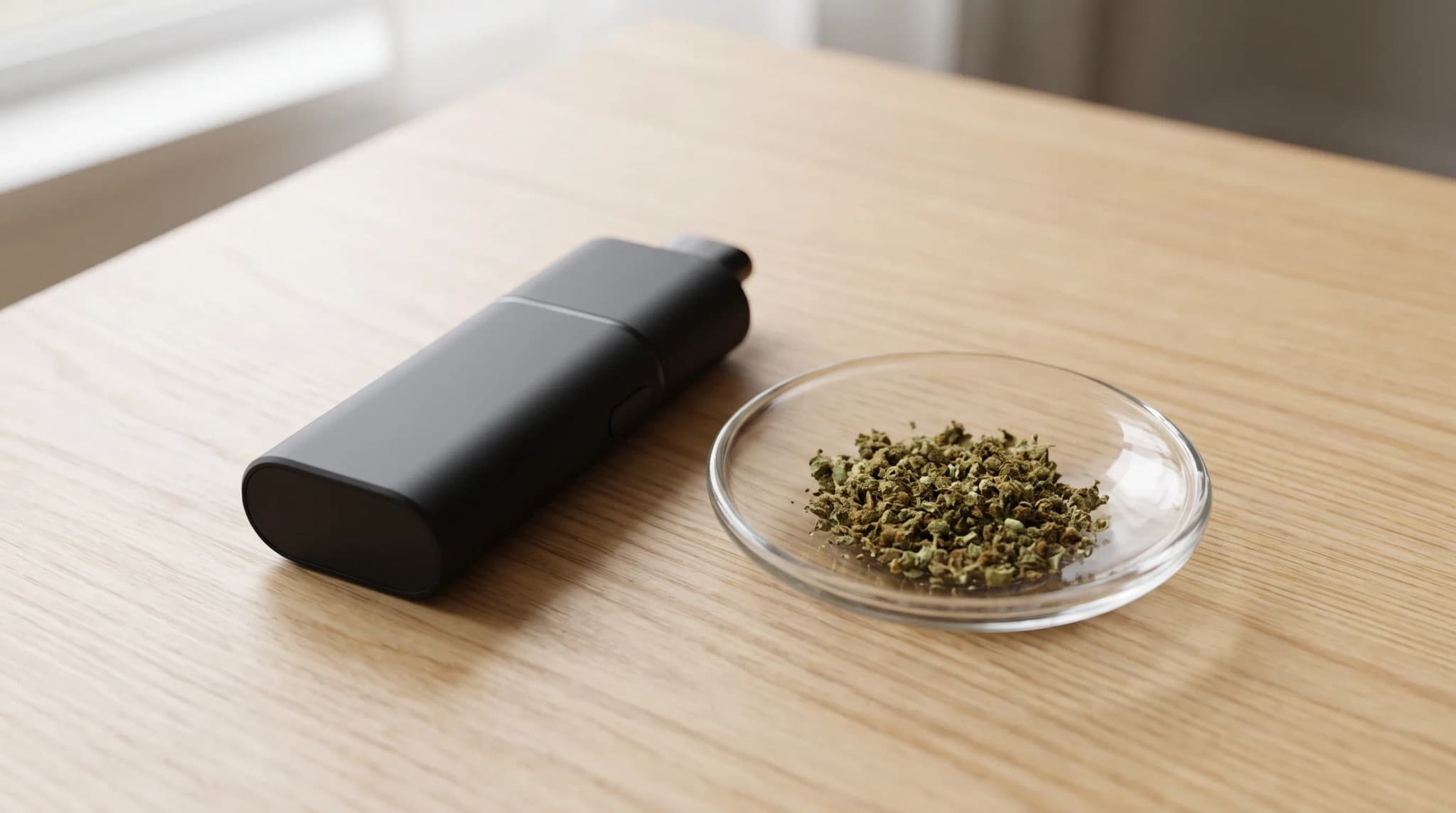
A dry herb vaporizer heats cannabis flower until its cannabinoids and aromatic compounds turn to vapor, without setting the plant on fire. It's a different device from an oil vape. An oil vape heats a cartridge of extract; a dry herb vaporizer heats the flower itself.
Here's how the devices work, what temperatures researchers used, and what the studies actually measured. If you're comparing oil options instead, our guide to all-in-one vapes and cartridges covers those.
How a dry herb vaporizer works
Every dry herb vaporizer has the same basic parts: a battery or power supply, a heating element, and a chamber, often called the oven, where the ground flower goes. You load the chamber, set a temperature, wait for it to heat, then draw vapor through a mouthpiece.
The key word is heat, not flame. Raw flower holds most of its THC as THCA, which isn't intoxicating until heat converts it. Our explainer on how THCA converts to THC covers that chemistry. A vaporizer does the same conversion a lighter does, at a temperature it controls.
That control showed up clearly in a 2016 lab study published in PLOS ONE. The researchers tested five commercial vaporizers on cannabis flower. The four electric devices, set to 210°C (410°F), converted at least 97% of the THCA to THC. The fifth, heated by a butane flame with no way to set or monitor the temperature, was the only one where the researchers saw signs of combustion: ash and visible smoke.
Conduction vs convection

Vaporizers heat flower in one of two ways, or a mix of both. The retailer Dank Geek describes them this way:
- Conduction: the flower touches a hot surface, usually the metal or ceramic wall of the chamber. It heats up quickly, but it can heat unevenly if the chamber is packed tight, and the flower can scorch if it isn't stirred.
- Convection: hot air passes through the flower, more like an oven. It heats more evenly, with fewer hot spots, but usually takes a little longer to warm up.
Some devices use a hybrid of the two. None of the studies below compared conduction with convection; what they do show is the value of a controlled temperature.
The temperatures researchers used
You'll see a lot of confident temperature charts online. The studies themselves used a fairly narrow band.
- In the 2016 PLOS ONE study, every electric vaporizer was set to 210°C (410°F).
- A 2006 study in the Journal of Pharmaceutical Sciences tested the Volcano, a tabletop vaporizer with settings from 130°C to 226°C. The researchers found the highest setting gave the best THC delivery, and that THC release peaked after about two minutes of heating.
- A 2007 University of California, San Francisco study heated cannabis to between 180°C and 200°C, just short of combustion.
Those numbers describe what worked in a lab, not a personal recommendation. Device thermostats differ, and a setting on one vaporizer may not match the same number on another.
How much THC actually comes out
A vaporizer doesn't release everything in the chamber. In the 2016 study, the share of the flower's total THC recovered in the vapor ranged from about 55% to 83%, depending on the device. The 2006 Volcano study found an average of about 54% of the loaded THC reached the device's collection balloon, and the researchers detected no breakdown products when they vaporized pure THC.
Those figures measure what a device delivers into its mouthpiece or bag. They don't measure what a person absorbs, which depends heavily on how deeply and how long someone inhales.
What studies found in people

Two human studies compared vaporizing with smoking directly.
In the 2007 UCSF study, 18 people stayed in a hospital research ward and used cannabis both ways on different days. The researchers reported that blood THC levels were comparable between vaporizing and smoking at every strength tested. Smoking raised the carbon monoxide in participants' breath, as expected. Vaporizing caused little or no increase, which the researchers used as a marker of exposure to combustion products. A significant majority of participants preferred vaporizing.
The second study is the one new users should know about. In a 2018 trial at Johns Hopkins, published in JAMA Network Open, 17 adults who rarely used cannabis inhaled the same doses of THC by vaporizer and by pipe. At the same dose, vaporized cannabis produced stronger effects and higher blood THC than smoked cannabis. At the higher dose, two participants vomited after vaporizing, and another had hallucinations, according to Johns Hopkins.
The researchers' takeaway was practical: people who don't use cannabis often need to be careful about how much they use with a vaporizer. If you're switching from a joint or a pipe, don't assume a vaporizer session will feel the same as what you're used to.
What a vaporizer doesn't change
A vaporizer changes how flower is heated. It doesn't change the rules about where you can use it. In California, the law that bans smoking cannabis in public places counts vaporizers as smoking. Our guide to where you can smoke weed in California explains what that covers.
It also doesn't settle every health question. The studies above measured specific things, such as carbon monoxide, cannabinoid delivery and short-term effects, in small groups of people. None of them followed users over years. If you're comparing vaporizers with water pipes, our guide to choosing a pipe or bong covers the one well-known lab comparison of the two, with its limits.
Grind matters too. Vaporizer chambers are loaded with ground flower, and Dank Geek notes that packing a conduction chamber too tightly can make it heat unevenly. Our guide to choosing a cannabis grinder covers the main types.
Sources
- Medicinal Cannabis: In Vitro Validation of Vaporizers for the Smoke-Free Inhalation of Cannabis, Lanz, Mattsson, Soydaner and Brenneisen, PLOS ONE, 2016
- Evaluation of a Vaporizing Device (Volcano) for the Pulmonary Administration of Tetrahydrocannabinol, Hazekamp et al., Journal of Pharmaceutical Sciences, 2006
- Vaporization as a Smokeless Cannabis Delivery System: A Pilot Study, Abrams et al., Clinical Pharmacology and Therapeutics, 2007
- News release on the vaporizer study, University of California, San Francisco, May 15, 2007
- Acute Effects of Smoked and Vaporized Cannabis in Healthy Adults Who Infrequently Use Cannabis, Spindle et al., JAMA Network Open, 2018
- Vaping Cannabis Produces Stronger Effects Than Smoking Cannabis for Infrequent Users, Johns Hopkins Medicine, 2018
- Convection vs. Conduction Heating: What's the Difference?, Dank Geek
This article is general information for adults 21 and older and is not medical advice. Information is current as of October 18, 2026.


