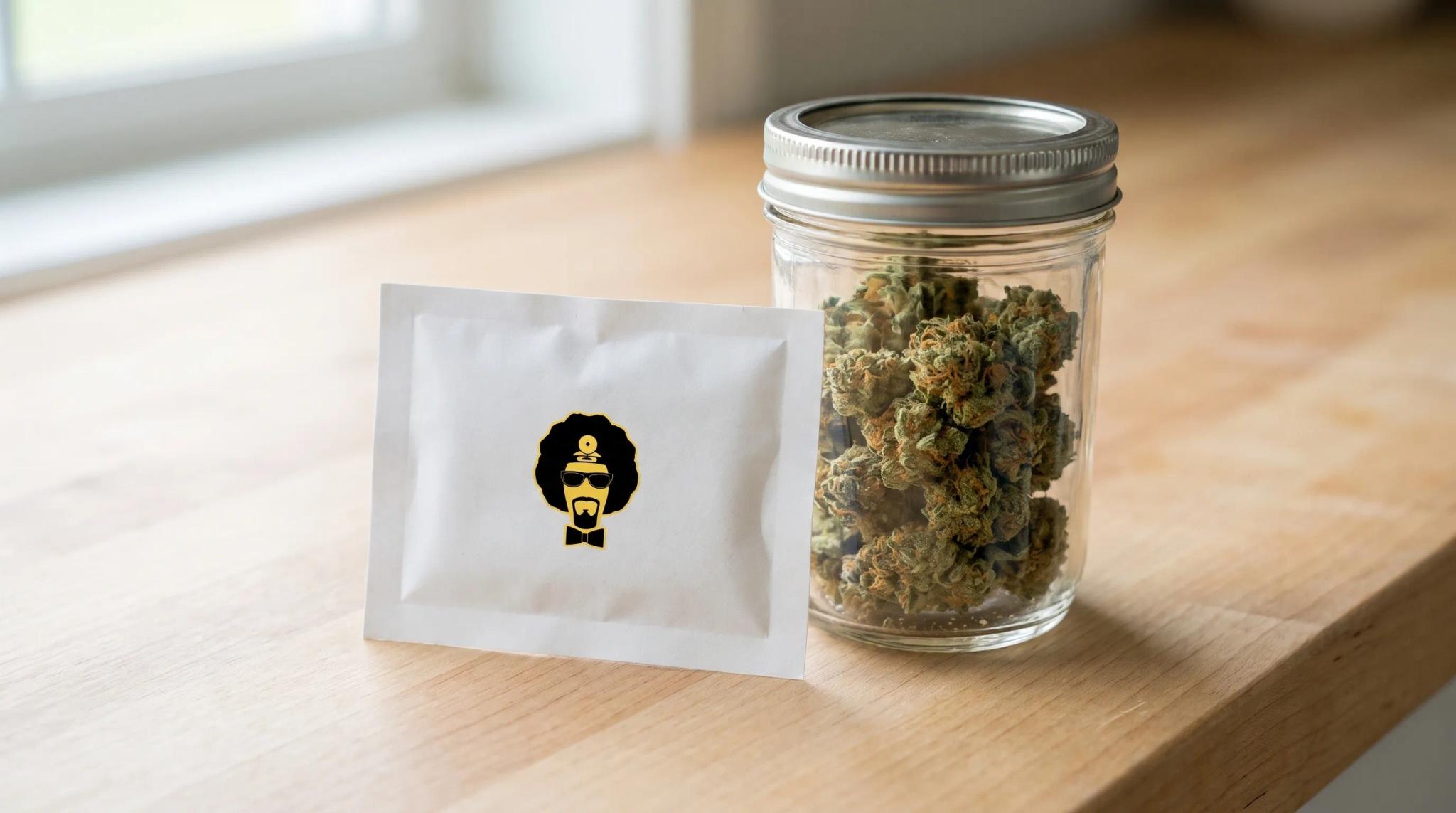
A humidity pack is a small sealed pouch that holds the air inside a closed container at a set humidity. The kind sold for cannabis is a two-way pack: it gives off moisture when the air in the jar is too dry and takes it up when the air is too damp. Vivi, which makes humidity packs for cannabis, puts the target for flower at 55% to 65% relative humidity.
This guide covers what the pack is doing inside the jar, what is in one, how to pick a rating and how long a pack lasts. If your flower is already dry, our guide on how to rehydrate dry weed has the step-by-step method.
What a humidity pack actually controls
Relative humidity describes how much water vapor the air holds compared with the most it can hold at that temperature. A University of California food preservation guide puts it simply: at 100% relative humidity, the air holds as much water vapor as it can.
In a sealed jar, the contents and the air trade moisture until they reach equilibrium. The same UC guide describes a food in a sealed jar setting the humidity of the air by giving off or taking up water, and the U.S. Food and Drug Administration's technical guide on water activity gives the relationship: water activity equals the equilibrium relative humidity divided by 100. By that relationship, flower kept in a jar held at 62% relative humidity is heading toward a water activity of about 0.62.
Those numbers line up with the standards. ASTM International's specification for stored cannabis flower, D8197, sets the acceptable water activity range at 0.55 to 0.65. Below 0.55, it says, flower is open to breakage in handling; above 0.65, it is open to the growth of microorganisms such as mold. Our guide to choosing cannabis flower explains how California tests every batch of dried flower against that 0.65 line.
Two-way packs vs silica gel packets

Silica gel packets are a different tool. Dictionary.com defines silica gel as a highly adsorbent form of silica used chiefly as a dehumidifying and dehydrating agent.
A two-way pack works in both directions. Integra describes its packs as releasing or absorbing moisture as needed, and Boveda says its packs regulate humidity from a salt and water solution. That is the difference that matters for flower, which can be too wet or too dry.
Desiccants still have a place: our guide to storing THC gummies suggests a food-safe silica gel packet for gummies kept somewhere humid. Flower is different, because it can also get too dry. ASTM's lower limit of 0.55 is there because flower drier than that is open to breakage.
How a pack holds one humidity level

Boveda's packs use a method laboratories have long relied on: a saturated salt solution. Boveda says its packs rely on the principle that certain salts combined with water naturally regulate humidity, and that the film around the solution lets only water vapor through.
The chemistry is well documented. Conservation Physics, a reference site on humidity control for conservation work, explains that the air above a salt solution holds less water vapor than the air above pure water, and that keeping the solution saturated, with solid salt crystals in it, keeps its concentration steady even as water enters or leaves. In 1977 the U.S. National Bureau of Standards published a compilation of 28 saturated salt solutions covering relative humidities from about 3% to 98%, and the same paper lists glycerine and water solutions among the chemical systems used to control humidity.
Not every pack uses salt. Integra describes its Boost packs as salt-free, with a plant-based glycerin and water formula.
Conservation Physics adds one caution: when room temperature is unstable, a salt solution behaves unpredictably.
Which rating should you use for flower?
Vivi's guide puts the range for flower at 55% to 65% relative humidity, with the lower end giving a more pliable product and the higher end stickier buds. Within that range the choice is mostly about texture.
The thing to avoid is a pack rated for something else. Integra, for example, rated its cigar packs at 69% and 72% in a 2020 announcement, which is above the 0.65 water activity line ASTM sets to guard against mold. Check the percentage on the pack before it goes in a jar of flower.
How long does a humidity pack last?
A pack keeps working only while its solution can still trade moisture. Vivi recommends swapping its pack every three months, and says a pack lasts from 2 to 6 months depending on how airtight the container is and how often it is opened. Unopened, Vivi says, a pack has a two-year shelf life.
Some packs come with a signal. Integra includes a humidity indicator card with each pack for hands-free monitoring. Since Vivi ties a pack's life to how often the container is opened, opening the jar only when you need to helps it last.
What a humidity pack cannot do
A pack controls moisture, not age. The storage research we cover in does weed go bad? found that terpenes, the compounds behind most of a flower's smell, fall during storage, and nothing in that research suggests a pack brings them back. Our terpenes explainer covers what those compounds are. A pack also does nothing about light, which the same research names as a main cause of loss, so the jar still belongs somewhere dark. The label guide covers the dates that tell you how long a product has been sitting.
For jars and other storage accessories, check the menu at La Mesa or Canoga Park.
Sources and further reading
- ASTM International, Standard Specification for Maintaining Acceptable Water Activity (aw) Range (0.55 to 0.65) for Dry Cannabis Flower Intended for Human/Animal Use, D8197-22
- U.S. Food and Drug Administration, Water Activity (aw) in Foods, Inspection Technical Guide No. 39
- University of California Master Food Preserver Program, Water Activity and Its Role in Food Preservation
- Dictionary.com, silica gel
- Conservation Physics, Saturated salt solutions for controlling relative humidity
- Journal of Research of the National Bureau of Standards, Humidity Fixed Points of Binary Saturated Aqueous Solutions, Lewis Greenspan, 1977
- Boveda, Other Uses
- PR Newswire, Integra By Desiccare Offers Smart Solutions For Keeping Cigars Fresh (And Cozy) This Holiday Season, Integra press release, November 11, 2020
- Vivi, How to Rehydrate Weed, Explained
- Vivi help center, When should I replace my Vivi Fresh Pack?
This article is general information for adults 21 and older. It is not medical or legal advice. Current as of November 2026.


